Written by: Doug Camplejohn, CEO & Co-Founder, Coffee | Last updated: September 21, 2026
Key Takeaways
- RB2B’s person-level identification works only in the US, while company-level tracking works globally, so traffic geography drives tool selection.
- Person-level match rates usually land between 5–20% of total traffic, while company-level ranges from roughly 30–65% of business traffic.
- RB2B has no native CRM integration or outbound features, so teams need Zapier or similar tools to push data into Salesforce or HubSpot.
- Alternatives differ by use case: Coffee or Artisan for US person-level with outreach, Dealfront or Snitcher for EU-compliant company tracking, and 6sense for enterprise ABM.
- Coffee combines visitor identification, CRM, and AI outreach in one system, which removes the need for separate enrichment and sequencing tools.
Person-Level Vs. Company-Level Identification: The Decision That Determines Everything
Company-level identification matches a visitor’s IP address to the company that owns it. It returns account-level behavior, such as company name, industry, headcount, location, pages viewed, traffic source, and visit time, but not a named individual. Leadfeeder’s benchmark for company-level identification is a 10–40% match rate of total traffic, with other sources citing 20–65% depending on traffic mix and geography. Independent testing in 2026 measured real-world company-level match rates of 30–65% on resolved matches.
Person-level identification matches browser signals to identity graphs and returns a named individual with a work email and sometimes a LinkedIn profile. Real-world person-level match rates sit at 5–20% of total traffic. These figures describe different things: a company-level rate measures the share of business traffic matched to a company, while a person-level rate measures the share of all traffic matched to a named human.
Person-level identification works where the identity graph is deep, mainly in the US. It struggles with VPNs, Safari’s tracking protection, and Apple Private Relay, which block the browser signal the match needs. Person-level visitor identification is effectively US-only because the identity-graph data is overwhelmingly US-sourced, and GDPR’s prior-consent model does not scale for this technique.
This distinction shapes whether you can run outbound, what you pay, and which tools fit your traffic mix. Because geography drives viability, run a quick pre-purchase test: pull last month’s traffic by country. If more than a quarter of your visitors sit outside the US, a person-level tool will miss most of them and no trial will change that.
Rb2B’s Actual Limits
RB2B’s contact-level identification is US-only across all tiers, while company-level identification is global. The Starter plan at $79/month provides LinkedIn profile URLs, full name, job title, industry, and pageview history pushed to Slack or Microsoft Teams, but no business email addresses and no integrations beyond Slack or Teams.
The Pro plan starts at $149/month for 600 monthly credits, and Pro+ starts at $199/month for the same 600 credits with Premium Resolution. RB2B’s pixel installs in under five minutes and begins identifying visitors the same day, but routing that data into Salesforce or HubSpot requires Zapier or webhook configuration, because there is no native CRM integration and setup takes roughly an hour at minimum. RB2B also does not send the email, run the sequence, or book the meeting, so teams must source the outbound layer separately.
What Is The Best Rb2B Alternative?
The table below compares leading RB2B alternatives by focus, geography, and pricing so you can quickly shortlist tools before diving into details.
| Tool | Core Focus | Geographic Scope | Pricing Range |
|---|---|---|---|
| Coffee | Visitor ID + CRM + Outreach | US / Global | Seat-based, with the agent’s unlimited labor included |
| Artisan | Visitor ID + AI Outreach | US (Person) / Global (Company) | From $250/mo (annual billing) |
| Warmly | Real-time Visitor Chat | Global / US focus | $10k–$30k/yr |
| Breakout | Global AI Conversations | Global | Custom |
| Dealfront | GDPR Company Tracking | Europe-first | Free to €599/mo |
| Koala | PLG Product-Led Signals | US-focused | Starter $200/mo (free tier and higher tiers available) |
| Snitcher | Company ID + GA4 | EU-strong | $49–$529/mo |
| Factors.ai | Company ID + Attribution | Global | $199/mo–$20k/yr |
| 6sense | Enterprise ABM + Intent | Global | $50k–$300k+/yr |
| Visitor Queue / Leadinfo | Company ID | Global | From $31/mo |
The best RB2B alternative depends on your situation. For US person-level identification with outreach built in, Coffee or Artisan fit best. For EU-compliant company-level tracking, Dealfront or Snitcher stand out. For PLG motions, Koala was the standard choice, but it shut down in September 2025, so review the note below before considering similar tools. For enterprise ABM, 6sense dominates. For small teams on a budget, Visitor Queue (now Leadinfo) offers accessible pricing.
Rb2B Alternatives By Buyer Situation
US Person-Level Identification
Artisan suits teams that want to turn identified US visitors into booked meetings automatically. Artisan’s benchmarks show 15–30% person-level resolution on US traffic and 92% company-level accuracy on an identity graph of 3.7 billion classified IP addresses. It does not fit teams that need global person-level coverage or a standalone identification tool without outreach.
Warmly works best for real-time visitor engagement and live chat orchestration on US traffic. Warmly layers a 20+ provider identification waterfall, claiming roughly 15% person-level and 65% company-level match, with tiers around $10k/year for de-anonymization, $20k with chat, and $30k for autopilot. It does not serve teams with budgets under $10k per year or those that need deep CRM integration beyond HubSpot and Salesforce.
Global And EU Traffic
Breakout fits teams that need global visitor de-anonymization without geographic limits. It does not suit teams that require US person-level identification or a self-serve pricing model.
Dealfront (Leadfeeder) works best for EU-compliant, company-level visitor tracking with strong GDPR coverage. Dealfront formed in 2022 through a merger between Leadfeeder and Echobot, creating a platform focused on European markets with GDPR compliance built in. Paid tiers run from a free Lite option up to €599/month for Scale. It does not fit teams that need person-level identification or US-focused contact data.
PLG And SaaS
Koala historically served PLG sales motions that combined site visit data with product usage data. Koala shut down on September 30, 2025, five months after raising a $15M Series A, and Cursor acqui-hired the team. Treat any remaining references or clones as legacy and verify current availability before you invest effort.
Snitcher suits European SaaS companies that need company-level identification with native GA4 integration. Snitcher starts at $49/month with annual billing and holds a G2 rating of 4.8/5 from 232 reviews. It does not fit teams that need person-level identification or US-focused coverage.
Enterprise ABM
6sense serves enterprise ABM teams that need predictive intent and account-level identification at scale. 6sense’s Signalverse network processes over one trillion buying signals daily and monitors buying activity across millions of B2B content pages in more than 40 languages. It does not suit small teams or those without dedicated ops resources.
Factors.ai fits marketing teams that need company-level identification combined with attribution and journey analytics. Factors.ai’s free tier covers 200 companies per month, with paid plans at Lite $199/month, Basic $6,000/year, and Growth $20,000/year. It does not serve teams that need person-level identification or built-in outreach.
Small Teams
Visitor Queue / Leadinfo works well for small teams that want transparent, usage-based company-level identification. Visitor Queue was acquired by Leadinfo on January 20, 2026; visitorqueue.com now redirects to Leadinfo and customers are migrating onto Leadinfo’s platform. Leadinfo pricing starts at €69/month (annual) for the Starter tier. It does not fit teams that need person-level identification or advanced intent signals.
Coffee suits small to mid-sized teams that want identification and outreach in one system. It does not fit large enterprises with complex, custom workflows or heavily regulated industries that require multi-year security reviews.

Rb2B Pricing And What You Actually Get
The Pro plan scales through three credit tiers: 600 credits for $149/month, 1,250 credits for $249/month, and 2,500 credits for $349/month. The Pro+ plan scales across 19 credit tiers, from 600 credits at $199/month up to 2,500,000 credits at $50,000/month.
Pro+ includes Premium Resolution, which layers additional trusted data sources to expand US and international coverage, with claimed identification rates of 70–80%, compared to 30–40% on Starter and Pro. CSV export, HubSpot CRM, Salesforce CRM, Webhook, n8n, and other integrations sit behind Pro and Pro+, while Starter outputs only to Slack and Teams.
RB2B’s pricing makes the most sense when you compare it to what alternatives charge. Warmly and Dealfront, whose pricing appears above, sit at the higher and lower ends of the range respectively. Treat any match-rate claim above 30% with skepticism and validate performance against your own traffic during a trial.
What Happens After Identification
Pricing aside, the bigger limitation is what happens after RB2B identifies a visitor. It identifies visitors but gives you no path to outreach. Closing that gap means stitching together a CRM, an enrichment tool, and a sequencer, each with its own subscription, login, and manual handoff.
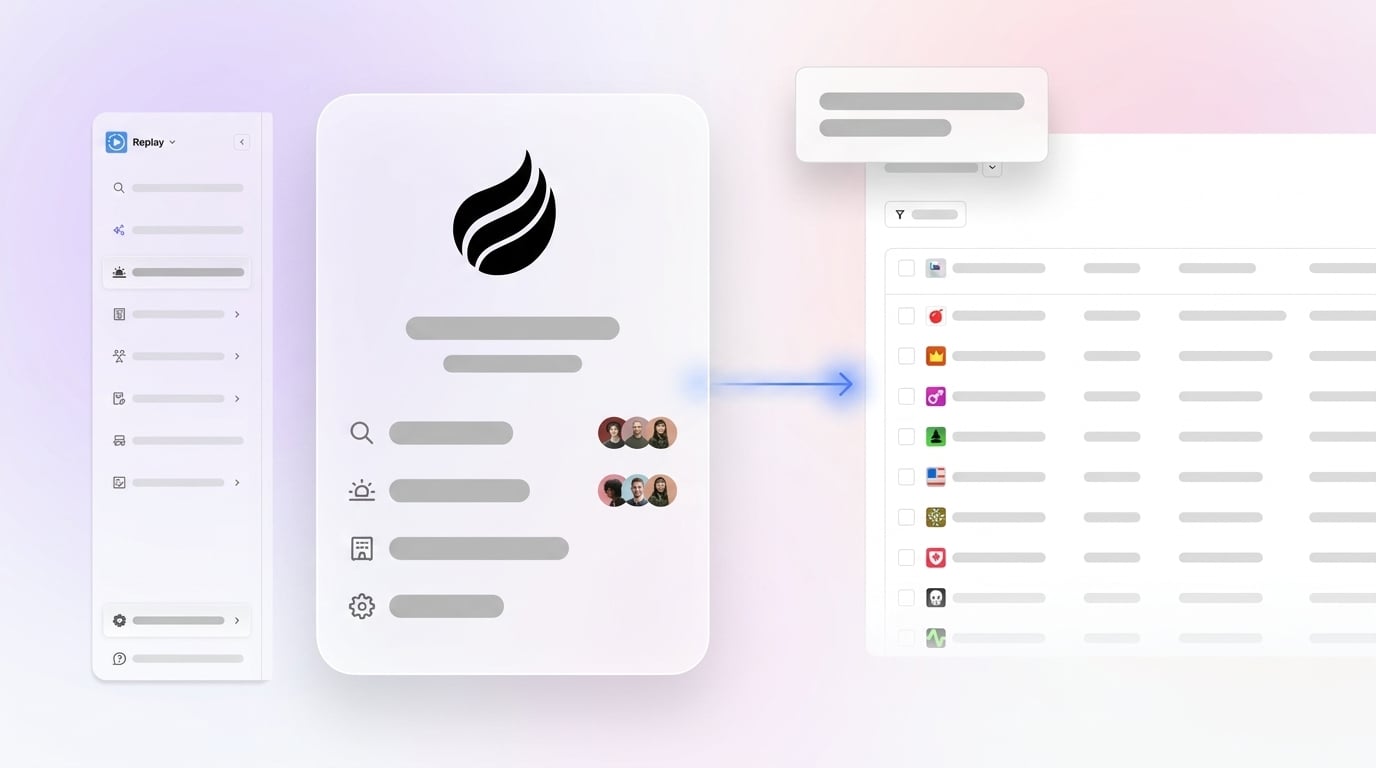
Coffee closes that loop inside a single agent. The workflow runs in four stages.

- Visitor Identification: A single tracking pixel infers name, title, email, LinkedIn profile, company, pages visited, time on site, and first versus returning visit. Real-time Slack notifications surface high-fit visitors, and one click adds the prospect to Coffee with enrichment pre-filled.
- Suggested Leads: Where RB2B and Warmly show the company or a raw people list, Coffee uses your buyer persona to recommend the two or three specific people inside that visiting company to contact and surfaces their LinkedIn profiles for instant outbound.
- Lead Finder: Natural language search such as “Find me VPs of Sales at SaaS companies with 50–200 employees” builds targeted prospect lists from Coffee’s own database, acting as a built-in alternative to ZoomInfo or Apollo.io.
- Campaigns: AI-generated multi-step email sequences send from the rep’s own mailbox. Stop-on-reply stays on by default, and built-in send throttling protects sender reputation.
Coffee works as a standalone AI-first CRM or as a Companion App on top of Salesforce or HubSpot. It is SOC 2 Type 2 and GDPR compliant, and data is not used to train public models.

EU And GDPR Traffic: What Changes
In the EU, person-level identification must clear consent under ePrivacy rules for anything read from or stored on a visitor’s device, plus a lawful basis under GDPR for processing the data. Many vendors clear neither requirement and instead block EU traffic.
The EDPB’s guidelines on Article 5(3) of the ePrivacy Directive, adopted on 7 October 2024, confirm that the consent rule covers IP-based and cookieless tracking. DLA Piper’s January 2026 GDPR fines and data breach survey reports EUR 7.1 billion in cumulative GDPR fines since May 2018, with EUR 1.2 billion in 2025 alone.
In the EU and UK, GDPR’s consent requirement effectively limits vendors to company-level identification. Any tool that offers person-level names on EU traffic should be treated as a compliance red flag rather than a feature, which is why EU-first vendors like Dealfront and Albacross focus on company-level by design. Breakout also serves this space for teams that need global de-anonymization without a US-only constraint.
EU-built visitor identification tools such as Leadfeeder, Leadinfo, and Albacross rely on GDPR-native processing instead of US-style person-level reveal, which makes them strong options for GDPR-sensitive European traffic.
Which Should You Trial
Three common scenarios map cleanly to three starting recommendations.

- US-focused team that wants identification and outreach in one system: Trial Coffee. It is the only option that carries a visitor from pixel hit to named contact to CRM record to live campaign without stitching together additional tools.
- EU-first or global team that needs GDPR-compliant company-level tracking: Trial Dealfront. It is GDPR-native, covers DACH and broader EU markets, and integrates with Salesforce, HubSpot, and Pipedrive.
- Team evaluating RB2B Pro+ for higher match rates: Run a controlled same-traffic test before committing. RB2B Pro+ should be purchased only when a controlled, same-traffic test shows that the additional usable records justify the price difference.
Frequently Asked Questions
How Long Does Implementation Take?
Coffee’s tracking pixel installs in minutes. You drop a custom-generated script into the head tag of your site and Coffee begins identifying visitors immediately. RB2B’s pixel installs in under five minutes, and Warmly and Dealfront follow similar quick-install patterns. CRM sync and enrichment setup varies by tool: Coffee works as a standalone CRM or authenticates directly with Salesforce or HubSpot, while RB2B relies on Zapier or webhook configuration for any CRM routing beyond Slack and Teams.
What Internal Expertise Is Required?
Company-level identification tools require minimal expertise. You install the pixel, connect the CRM, and review the feed. Person-level identification tools that output to Slack need someone to monitor and act on alerts in near real time, which adds operational load for small teams. Tools that close the loop from identification to outreach, such as Coffee, benefit from a sales ops or RevOps owner at setup to configure buyer personas, campaign sequences, and routing logic, then reduce ongoing manual work once running.
What Integration Considerations Matter Most?
As noted earlier, RB2B’s Slack delivery is native and everything else is DIY. Coffee works as a standalone CRM or as a Companion App on top of Salesforce or HubSpot, with direct authentication instead of middleware. Warmly’s CRM integrations cover HubSpot and Salesforce. Dealfront offers CRM connectors for Salesforce, HubSpot, and Pipedrive. For teams already running Salesforce or HubSpot, Coffee’s Companion App model routes identified visitors directly into existing records without a separate integration layer.
How Do I Assess Data Quality?
The same skepticism about match-rate claims applies here, because vendor dashboards often overstate rates compared to downstream CRM validation. Run a free trial on your own traffic for at least two weeks. Count recognizable target accounts rather than total identifications; fewer than roughly twenty target accounts in a week means your traffic is not yet a reliable signal source. Validate identified traffic against CRM outcomes, not against the vendor’s identification count. For person-level tools, ask the vendor what percentage of matches are wrong and how they measure that, since most publish match rates but not match error rates.
What About Security And Compliance?
Coffee’s SOC 2 Type 2 and GDPR compliance, noted earlier, covers security and data handling expectations, and Coffee does not use customer data to train public models. Dealfront is GDPR-native and built for European data requirements. RB2B is CCPA and CPRA compliant, and its person-level identification is described as a US technology resolving US data subjects. Leadinfo is ISO 27001 certified with EU data residency on AWS servers in Ireland and Frankfurt. For any team with EU traffic, confirm that the vendor will sign a Data Processing Agreement and disclose data residency before deployment.
Conclusion
RB2B identifies US visitors at the person level and delivers them to Slack. That signal helps, but it stops short of a workflow. RB2B identifies visitors and delivers them to Slack, and everything after that, including CRM sync, enrichment, and outreach, must be assembled from other tools at additional cost.
The alternative you choose depends on three factors: where your traffic comes from, whether you need the person or the company, and whether you want identification alone or identification plus outreach. For teams that want all three resolved in one system, Coffee fits that need. It is the only option that carries a visitor all the way to a booked meeting without a separate enrichment subscription, a separate sequencer, or a Zapier workflow holding the stack together.