Written by: Doug Camplejohn, CEO & Co-Founder, Coffee | Last updated: August 31, 2026
Key Takeaways for RB2B Replacements
- RB2B’s person-level identification covers only U.S. traffic and relies on probabilistic matching, which can produce inaccurate results.
- Most RB2B alternatives push visitor data into Slack or CRM activity logs without enriching records or creating leads your reps can work.
- Deterministic matching tools like Coffee deliver significantly higher accuracy (82%) than probabilistic approaches used by RB2B and Warmly.
- Coffee automatically enriches CRM records, recommends specific contacts, and saves reps 8–12 hours per week on data entry.
- Teams ready to turn anonymous visitors into CRM-ready pipeline should explore Coffee’s pricing today.
Why Teams Move Away From RB2B
RB2B popularized person-level website visitor identification, but its limitations have become clear. RB2B’s own support documentation confirms that person-level identification is limited to U.S. traffic, with international visitors reduced to company-level identification at best. Independent analyses put RB2B’s person-level coverage at roughly 5–20% of U.S. traffic on standard plans, with Pro+ reaching 35–45% through a premium resolution layer.
The deeper issue is how RB2B uses the data it collects. RB2B pushes identified visitor data to Salesforce and HubSpot as activity records, and the sync is directional. It logs visit activity instead of enriching account profiles or creating actionable person-level records. As Jimit Mehta at Abmatic AI puts it: “RB2B tells you who visited. It does not do anything with that information on your behalf.”
These gaps drive teams to look for RB2B alternatives:
- Person-level identification gaps for non-U.S. traffic
- Probabilistic matching that statistically guesses visitor identity rather than verifying it, which can return the wrong individual at the right company
- No outbound prospecting database, since RB2B only identifies people who visit your site
- CRM integration that requires manual exports or lacks bidirectional sync
- Overage charges of 25–45 cents per resolution on high-traffic sites, with credits that do not roll over
Top RB2B Alternatives Compared
The table below compares leading RB2B competitors on the factors that matter most for B2B sales teams. Notice the pattern: only Coffee combines deterministic person-level identification with deep CRM integration, while most others stop at company-level data or rely on probabilistic matching.
| Tool | Best For | Starting Price | Identification Level |
|---|---|---|---|
| Coffee | Teams needing deterministic person-level matching with deep CRM integration | Seat-based; see pricing page | Person-level (deterministic) |
| Warmly | Teams wanting real-time AI chat alongside visitor identification | ~$10,000/year | Person-level (probabilistic) |
| Leadfeeder | EU-focused teams prioritizing GDPR comfort and company-level data | €79/month (Discover); free Lite tier | Company-level only |
| Visitor Queue | Budget-conscious teams needing basic company identification | $39/month | Company-level only |
| 6sense | Enterprise ABM teams with six-figure budgets | Six-figure contracts | Company + intent signals |
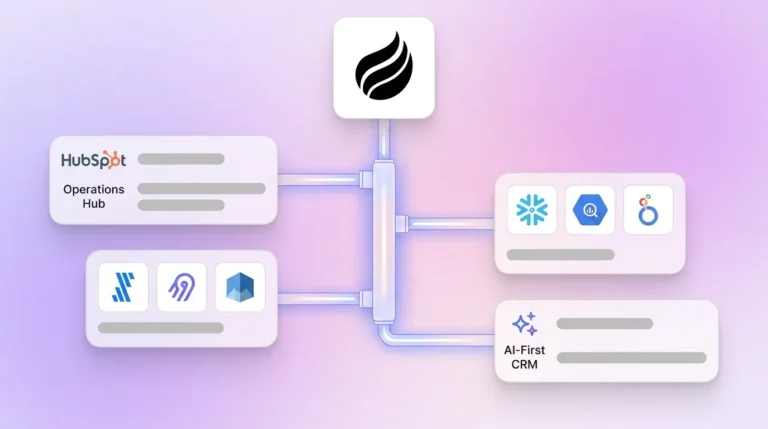
Coffee is a CRM agent that includes visitor identification as one capability within a broader system. Unlike standalone visitor ID tools, Coffee identifies named individuals and writes that data directly into your CRM. It can run as a companion app on top of Salesforce or HubSpot, or as a standalone AI-first CRM. This integration enables its Suggested Leads feature, which goes beyond raw visitor lists. Coffee uses your buyer persona to recommend two or three specific people inside a visiting company and surfaces their LinkedIn profiles for immediate outbound.
Warmly processes over 9 million website visits per month and claims a 15–30% identification rate on B2B traffic. However, Warmly relies on probabilistic matching, statistically inferring identity from weak signals like IP address and device characteristics rather than confirming against verified data. HubSpot has announced an acquisition of Warmly.
Leadfeeder (now part of Dealfront) is a company-level identification tool with strong EU coverage. It is the most GDPR-comfortable option in this category because it has no person-level reveal, no cookie graph, and no third-party data partnership for identity enrichment. The tradeoff is clear: you get company names, not named individuals.
Visitor Queue is an entry-level company-only identification tool. Its IP-to-company database is meaningfully smaller than Leadfeeder or Clearbit, which results in lower identification accuracy.
6sense is an account-based marketing platform that combines visitor identification with predictive intent data. It targets large enterprises and is not a practical option for small or mid-market teams.
Person-Level vs. Company-Level Identification: Why It Matters
Person-level identification gives you a very different picture than company-level data. Company-level data tells you “Acme Corp visited your pricing page.” Person-level data tells you “Jane Smith, VP of Sales at Acme Corp, visited your pricing page and spent time on the integration docs.”
Roughly 97% of B2B website visitors never fill out a form, while traditional lead capture converts only 2–3% of traffic. This reality means identification tools are often the only way to reach most of your visitors. Tools like Coffee and Warmly both offer person-level identification, but they approach it differently.
An independent, Gartner-certified accuracy test found that deterministic matching produced significantly fewer false positives than probabilistic approaches used by tools like RB2B and Warmly. As mentioned in the key takeaways, deterministic matching accuracy was measured at roughly 82%, versus roughly half that for the most aggressive probabilistic approaches. This accuracy gap matters for outbound teams. Probabilistic systems are designed to always return a result even when confidence is low, which can lead to reps emailing the wrong individual and damaging domain reputation.
CRM Integration: Turning Visitor Data Into Pipeline
CRM integration determines whether visitor data becomes real pipeline or just another notification. Most RB2B alternative comparisons focus on match rate or price and ignore what happens after a visitor is identified. If visitor data lands in Slack and stays there, it remains a notification instead of a lead.
RB2B’s CRM sync is directional. It pushes visit activity to Salesforce or HubSpot but does not enrich account profiles or create person-level records that reps can act on. Leadfeeder requires credits to sync companies to CRM, with each export consuming one credit. Warmly offers CRM auto-sync, and its probabilistic matching means the person-level data flowing into your CRM may be inaccurate.
In contrast, Coffee takes a fundamentally different approach. It is a CRM agent that handles data entry, enrichment, and activity logging automatically. When Coffee identifies a website visitor, it does more than send a Slack alert. It creates or enriches the contact record in your CRM, associates the visit with the right account, and surfaces the prospect’s LinkedIn profile for immediate outreach. As noted earlier, Coffee’s agent saves reps 8–12 hours per week on data entry alone.
Coffee’s dual model is unique in this category:
- Companion App: Deploy Coffee on top of your existing Salesforce or HubSpot instance. The agent syncs data, enriches records, and writes insights back to your primary CRM automatically.
- Standalone CRM: Use Coffee as your system of record, with the agent managing everything from visitor identification to pipeline intelligence.
See Coffee’s pricing to learn how deep CRM integration turns visitor data into pipeline your reps can act on today.
Pricing and Total Cost of Ownership
RB2B’s pricing tiers break down as follows:
- Starter at $79/month: 300 monthly credits, LinkedIn URLs pushed to Slack, no CRM integrations, no business email addresses
- Pro at $149/month: business email addresses and full integrations including HubSpot, Salesforce, Clay, Zapier, and Webhook
- Pro+ at $199/month: 35–45% person-level coverage through premium resolution, identity graph waterfall, and additional domains at $99/month for up to 5 domains
- Overage charges run 25–45 cents per resolution, and credits do not roll over between billing cycles
For comparison, Warmly starts around $10,000 per year, which positions it as an enterprise tool. Leadfeeder starts at €79/month for Discover, with Activate at €369/month and Scale at €599/month. Visitor Queue starts at $39/month.
Coffee uses simple seat-based pricing. You pay for human seats, and the agent’s unlimited labor is included. There is no credit system, no complex metering on LLM usage, and no overage charges. This structure keeps total cost of ownership predictable when you compare RB2B pricing with tools that meter usage differently.
How to Choose the Right RB2B Alternative
This decision framework helps you match your situation to the right tool:
- Small team on HubSpot or Salesforce needing person-level data: Coffee is the best fit. Its companion app enriches CRM records automatically, and its deterministic matching keeps the person-level data your reps act on accurate.
- Enterprise ABM team with a six-figure budget: 6sense offers predictive intent data and account-based marketing at scale.
- EU-focused team prioritizing GDPR compliance: Leadfeeder’s company-level identification is the most GDPR-comfortable choice because it avoids person-level reveal entirely.
- Budget-conscious team needing basic company identification: Visitor Queue or Leadfeeder’s free Lite tier work for simple use cases.
- Team wanting real-time AI chat alongside visitor ID: Warmly combines person-level identification with on-site engagement, but expect enterprise pricing and note the pending HubSpot acquisition.
Frequently Asked Questions
Which B2B data provider is the best?
The right provider depends on whether you need person-level or company-level data, your geographic focus, your CRM stack, and your budget. For person-level identification with native CRM integration, Coffee leads the category by combining deterministic matching with automatic record enrichment. For company-level data with strong EU coverage, Leadfeeder is a reliable choice. For enterprise-scale intent data, 6sense is the standard option. The most useful comparison focuses on which tool turns identified visitors into records your reps can act on without manual work.
Is RB2B worth it?
RB2B is worth it for a specific profile: U.S.-focused companies with meaningful traffic volume, an SDR team that lives in Slack, and a budget for Pro or Pro+ tiers where person-level coverage becomes meaningful. Teams with international traffic, teams that need CRM records rather than Slack alerts, or teams that want deterministic instead of probabilistic matching will see a better fit with alternatives like Coffee or Leadfeeder. RB2B’s free tier lost contact-level data in January 2026, which has narrowed its appeal for teams evaluating it as a low-cost entry point.
How do RB2B alternatives compare in terms of data accuracy?
Accuracy varies significantly by identification method. Deterministic matching tools like Coffee verify identity against confirmed data sources and produce significantly fewer false positives. Independent testing found deterministic matching accuracy at approximately 82% correct identifications, versus roughly half that for the most aggressive probabilistic approaches used by tools like RB2B and Warmly. For outbound teams using AI-assisted sequencing, this gap is consequential. A probabilistic guess can become a hyper-personalized email sent to the wrong person, which damages sender reputation and wastes SDR time. Match rate is a vanity metric, while correct-match rate determines whether identified visitors become real pipeline.
What is the most effective platform for B2B marketing when it comes to visitor identification?
Effectiveness depends on how the platform handles the full workflow from identification to action. A tool that identifies a visitor but leaves the data in Slack still requires manual effort before it becomes useful. The most effective platforms close the loop automatically. They identify named individuals, enrich CRM records, and surface actionable next steps without human data entry. Coffee is designed around this principle. Its agent identifies visitors, writes person-level records into Salesforce or HubSpot, and recommends the specific contacts inside a visiting company that match your buyer persona, ready for LinkedIn outreach or automated email sequences.
Conclusion: The Best RB2B Alternative for CRM-Driven Teams
The best RB2B alternative is the one that turns identified visitors into CRM-ready, person-level records your reps can act on immediately. While RB2B only tells you who visited, Coffee acts on that information on your behalf by identifying named individuals, enriching your CRM automatically, recommending the right contacts to reach out to, and saving your reps 8–12 hours per week on data entry.
Teams evaluating RB2B alternatives because visitor data keeps landing in Slack and never making it into their CRM will find that Coffee solves exactly that problem. You can deploy it as a companion app on your existing Salesforce or HubSpot instance, or as a standalone AI-first CRM.
Start your Coffee trial and turn your anonymous website traffic into pipeline your team can work today.