Written by: Doug Camplejohn, CEO & Co-Founder, Coffee | Last updated: September 22, 2026
Key Takeaways
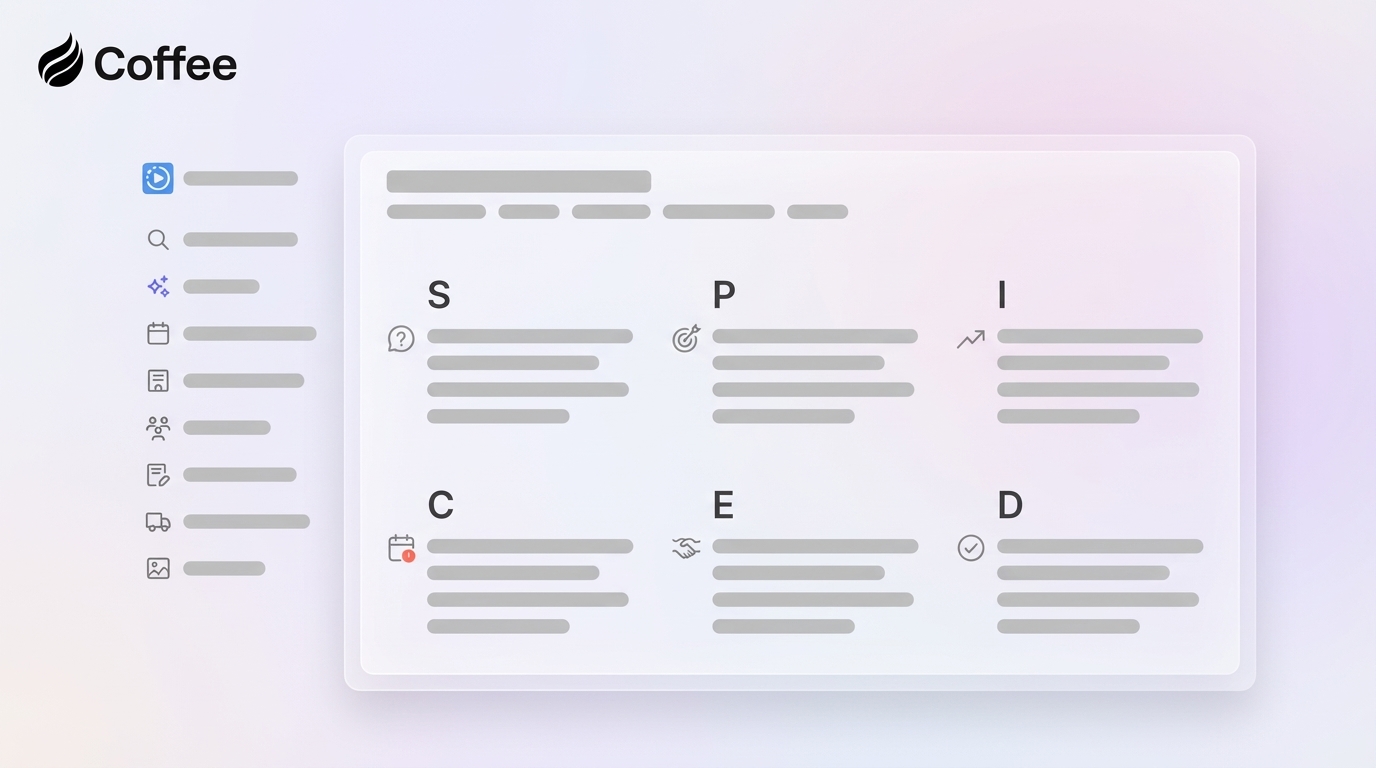
- SPICED is a five-element sales qualification framework (Situation, Pain, Impact, Critical Event, Decision) that replaces rep confidence with documented CRM evidence.
- Revenue gains come from higher conversion rates, larger deals, and shorter cycles when every opportunity carries complete SPICED data before advancing stages.
- Manual data entry is the primary adoption barrier; AI-powered capture from calls and emails pushes field completion above 80 percent versus 30–40 percent manually.
- Stage gates should block progression on missing evidence, especially a buyer-owned Critical Event date, instead of relying on subjective rep judgment.
- Coffee automates SPICED evidence capture and CRM field population so teams can run disciplined pipeline reviews and accurate forecasts without relying on rep discipline.
Step 1 (Days 1–7): Assess Your Baseline Before You Touch The CRM
Revenue = Pipeline × Conversion Rate × Average Contract Value. A $10M pipeline at a 20% conversion rate yields $2M. Shifting that conversion rate to 25% through qualification discipline adds $500K with no new pipeline created. That arithmetic explains why the SPICED revenue operating model exists. It moves the conversion-rate lever by ensuring every deal in the pipeline is backed by evidence rather than optimism.
The hidden cost strengthens that case. Manual entry of SPICED data takes 15–20 minutes per call, so reps often skip it entirely. 71% of sales reps say they spend too much time on data entry, and only 35% of their time goes to selling. Assume a rep spends 15 hours a week on manual reporting at a $75 loaded hourly rate. That is more than $58,000 in lost annual selling capacity per rep.
The six metrics that govern board revenue reporting are ARR/revenue versus plan, net new ARR, net revenue retention, pipeline coverage for the next one to two quarters, efficiency (CAC payback or magic number), and a forecast for the next quarter or two with an explicit confidence level. SPICED supports these metrics by improving qualification, forecast accuracy, and post-sale outcomes across the funnel.
Monday Action: Calculate your own pipeline × conversion rate × average contract value. Write down which of the six metrics you are actually trying to move this quarter.
Common Mistake: Treating SPICED As One-Time Training
A methodology taught once in onboarding and never inspected decays back to pitch-first habits within weeks. The failure mode comes from behavior under quota pressure when the CRM does not enforce the framework. Coffee’s Agent captures SPICED evidence automatically from calls, emails, and transcripts, so the framework persists without depending on rep discipline.
Step 2 (Days 8–21): Build SPICED CRM Fields And Stage Gates
This step turns SPICED from theory into system behavior. Winning by Design’s SPICED Operating Model specifies that every opportunity carries the same five fields with clear criteria for what must be true before a deal advances. The table below shows the key point: each SPICED letter maps to one CRM field group with a specific, checkable evidence threshold, which makes stage gating objective instead of a matter of rep judgment.
| SPICED Letter | CRM Field | Required Evidence To Advance |
|---|---|---|
| Situation | Situation Summary (Long Text) | Documented current state: tech stack, team structure, key constraints, and trigger for change, in the buyer’s words. |
| Pain | Primary Pain + Pain Type (Picklist: Qualitative / Quantitative) | Named friction or inefficiency with at least one quantitative dimension, such as hours lost or revenue missed. |
| Impact | Business Impact + Impact Type (Picklist: Rational / Emotional) | A buyer-supplied number connecting the pain to cost, revenue, risk, or a strategic outcome. |
| Critical Event | Critical Event (Text) + Critical Event Date (Date) | A named, buyer-owned deadline like contract expiry, board review, or product launch. Field stays required for advancement past mid-funnel. |
| Decision | Decision Process (Text) + Decision Committee (Text) + Decision Criteria (Text) | Named economic buyer confirmed, steps from evaluation to signature documented, and stated criteria captured in the buyer’s words. |
Stage gating works when progression depends on evidence instead of rep confidence. Legacy CRMs like Salesforce and HubSpot rely on fallible human data entry and lose historical context when fields are updated. Their relational database architecture struggles with unstructured data such as call transcripts or email threads. Manual SPICED workflows typically achieve 30–40% field completion. AI-powered extraction often pushes field completion above 80%.
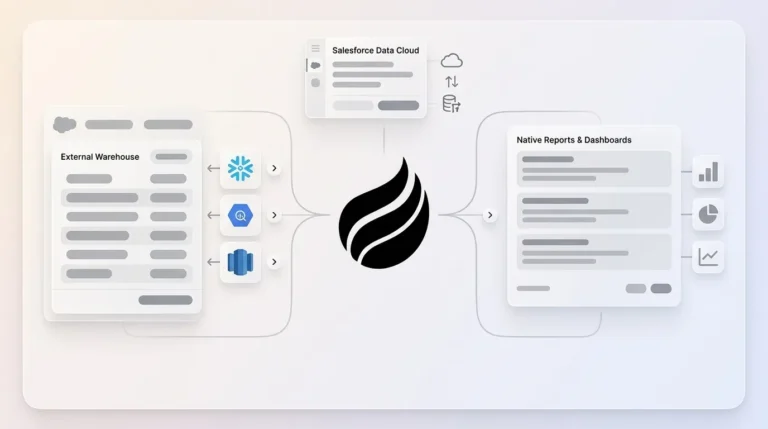
Coffee’s Agent addresses this gap. The Coffee Agent auto-creates and enriches contacts, logs activities, and structures notes according to SPICED, so evidence enters the CRM without reps acting as data entry clerks. Coffee operates in two models: a Standalone AI-First CRM for SMBs replacing tools like HubSpot or Pipedrive, and a Companion App that deploys the Agent as an intelligent layer on top of existing Salesforce or HubSpot instances. Teams on either stack see the same outcome: SPICED fields populated from calls, emails, and transcripts automatically.

Monday Action: Create the five SPICED fields and add one validation rule that blocks stage advancement when Critical Event Date is blank.
Common Mistake: Advancing Stages Without Evidence
A stage backed only by “the rep ran a great demo” overstates progress, while a stage backed by a quantified Impact and a dated Critical Event confirmed by the buyer reflects where the buyer truly stands. When reps control stage advancement through subjective judgment, pipeline reviews turn into interrogation sessions and forecasts drift away from reality. Required CRM fields enforced at the moment of stage advancement, rather than retrospectively, provide a durable structural fix.
Step 3 (Days 22–45): Run Discovery That Produces SPICED Evidence
Discovery questions exist to generate the evidence your CRM fields require. Impact and Critical Event carry the most leverage. Reps who uncovered Impact sold 53% more against the same opportunity volume than reps who stopped at Pain. 68% of reps never ask Critical Event deadline questions, which leaves qualified-looking deals stalled for months.
Representative questions by letter:
- Situation: “Walk me through how your team currently handles [process]. What tools are involved and who owns each step?”
- Pain: “Where does that process break down most often? What does a bad week look like?”
- Impact: “If that problem persists for another 12 months, what does that cost you in revenue, in time, or in risk?” and “What would it mean for your team if this were solved?”
- Critical Event: “Is there a date by which this needs to be resolved, such as a board review, a contract renewal, or a product launch, where the cost of not having a solution becomes real?” and “What happens internally if that date passes without a decision?”
- Decision: “Who else is involved in evaluating this? What does your process look like from here to a signed agreement?”
Coffee’s AI meeting bot joins Zoom, Teams, and Meet calls, transcribes them, and drafts summaries and follow-ups. Notes can be structured according to SPICED, so discovery evidence is captured automatically and written back to the appropriate CRM fields without rep effort.

Monday Action: Put the Impact and Critical Event questions at minute 25 of your discovery call template. Reps reach them while time still remains on the call.
Step 4 (Days 46–70): Run A SPICED Pipeline Review
A SPICED pipeline review replaces probability guesses with evidence questions. The agenda below supports a weekly rhythm and keeps the focus on buyer actions.
Pre-Read Requirements Before The Meeting
- Every deal owner updates stage, close date, SPICED field status, next action, and forecast category in the CRM before the meeting.
- The manager reviews Coffee’s Pipeline Compare feature to see week-over-week changes such as progressed deals, stalled opportunities, and new additions, without exporting a spreadsheet.
Deal-By-Deal Evidence Check For Exception Deals
- “What has the buyer done in the last two weeks that tells us this deal is still real?”
- “Is the Critical Event date confirmed by the buyer, or is it a rep estimate?”
- “Who is the named economic buyer, and when did we last speak with them directly?”
- “What is the quantified Impact, in the buyer’s words?”
- “What are the decision criteria, and do we meet them?”
Once the evidence check is done, the Critical Event field becomes the deciding factor. Any deal missing a documented Critical Event is treated as unqualified and flagged for coaching instead of being committed to the forecast. That decision then turns into concrete work. Every open issue leaves the meeting with a named owner and a due date.
Coffee’s Pipeline Compare feature visualizes week-over-week changes and turns pipeline reviews from interrogation sessions into strategic discussions, because the evidence already lives in the system before anyone sits down.
Monday Action: Replace one probability question in your next pipeline review with “what has the buyer done in the last two weeks that tells us this is still real?”
Step 5 (Days 71–90): Run A Deal-Analysis Retrospective
Winning by Design’s SPICED Operating Model includes three deliverables: design workshops, role-based training workshops, and systems design specifications covering CRM field mapping and conversation capture configuration. The retrospective method is straightforward. Pull the last 20–50 won and lost deals and score each one against the five SPICED letters.
A common pattern looks like this. A cluster of closed-lost deals shows no documented Critical Event at any stage, while the deals that did have a buyer-owned Critical Event close at a noticeably higher rate. That single finding justifies a new required field and a new stage gate. Critical Event Date must be populated before a deal enters the proposal stage.
A second frequent pattern appears when deals are lost because Impact was never quantified. The rep accepted “this is a real problem for us” without attaching a number. 34% of reps fail to quantify Impact with metrics during SPICED discovery, which makes internal selling impossible for the champion and forecasting unreliable for management.
Each pattern produces a concrete change such as a new required field, a new stage gate, or a new discovery question added to the call template.
Monday Action: Pull your last 20 closed-lost deals and count how many had a documented Critical Event.
Review Coffee For Deal Retrospectives
SPICED Vs MEDDIC: Choosing The Right Framework For Your Deals
Your choice of framework shapes CRM fields, stage gates, and coaching. SPICED and MEDDIC serve different deal profiles and lifecycles.
SPICED is a diagnostic, value-first framework built for the full customer lifecycle, from first touch through expansion and renewal. It starts with the buyer’s situation and works outward, which fits B2B SaaS deals where retention matters as much as the initial close. SPICED is the default qualification framework for B2B SaaS deals with average contract values between $15K and $200K ACV, complex enough to require structured discovery but not so complex that they require full MEDDPICC overhead. Customer Success teams inherit SPICED context at handoff and use the same impact statement to drive adoption and renewal planning.
MEDDIC is a qualification and risk-reduction framework built for complex enterprise deals, originally created at PTC in 1996 to qualify $250K+ deals, and generally recommended for deals above $50K ACV. It forces reps to identify economic buyers and champions early and provides strong pipeline hygiene, yet it rarely maps cleanly to post-sale work and can feel like a checklist without sustained training. 73% of SaaS companies selling above $100K ACV now use some version of MEDDPICC as their qualification framework.
The practical rule is simple. If your deals sit in the $15K–$200K ACV range and renewal and expansion matter, SPICED should govern your stage gates. If your deals sit above $200K ACV with formal procurement, legal review, and multi-quarter cycles, MEDDIC or MEDDPICC usually fits better. The $150K–$200K range supports both, and deal complexity typically decides.
Monday Action: Decide which framework governs your stage gates and align your CRM fields and coaching to that single choice.
How To Measure Revenue Impact From SPICED
Measurement connects SPICED back to the six metrics named in Step 1. The metrics to track are ARR/revenue versus plan, net new ARR, net revenue retention, pipeline coverage, efficiency, and forecast confidence, and each maps to specific SPICED letters.
- Qualified Pipeline tracked by SPICED field completion rate per deal. A deal missing Pain or Critical Event does not count as qualified pipeline.
- Conversion Rate compared between deals with complete SPICED evidence versus incomplete ones. Deals with complete SPICED data close at 2.8x higher rates than incomplete ones.
- Deal Size tracked against Impact quantification. Reps who quantify Impact in discovery land 17% larger deals on average than reps who accept qualitative pain descriptions.
- Cycle Length tracked against Critical Event documentation. Deals with a named Critical Event close in 18% fewer days on average.
- Retention And Expansion tracked through CS handoff quality. A complete SPICED record at handoff gives Customer Success the buyer’s original pain, expected outcomes, and timeline, which forms the foundation for renewal and expansion conversations.
Accurate measurement requires reliable data. Coffee’s core thesis states that strong AI outcomes require strong underlying data. Legacy CRMs produce measurement that reflects what reps typed instead of what buyers said. Coffee’s Agent captures ground-truth data from emails, calls, and transcripts, both structured and unstructured, and writes it to the CRM fields that power these reports. That approach creates measurement that a board can trust.

Monday Action: Build one report comparing win rate on deals with all five SPICED fields populated versus those without. That single report makes the business case for instrumentation.
Frequently Asked Questions (FAQ)
This section answers common questions that go beyond the 90-day rollout and help you apply SPICED in real environments.
What Is The SPICED Sales Technique And How Does It Work?
SPICED is a five-element sales qualification and discovery framework created by Winning by Design for B2B recurring-revenue businesses. It stands for Situation, Pain, Impact, Critical Event, and Decision. SPICED starts with the buyer’s situation and works outward, which fits SaaS and subscription businesses where the initial sale is only the beginning and renewal and expansion are equally important stages.
The technique functions as an ordered diagnosis sequence rather than a checklist. Reps establish the buyer’s current context (Situation), identify the specific friction it produces (Pain), quantify what solving or not solving that friction means to the business (Impact), confirm a real buyer-owned deadline that creates urgency (Critical Event), and map how the decision gets made including stakeholders and criteria (Decision). Each element produces evidence that belongs in a dedicated CRM field, and stage progression pauses until that evidence exists. When the framework is instrumented this way, it operates as a revenue model rather than a training topic.
How Can I Increase My Sales Revenue With SPICED?
Revenue increases from SPICED come through four levers: higher close rates, larger deal sizes, shorter cycles, and better retention. The mechanism is evidence-based qualification. When every deal in the pipeline has documented Pain, quantified Impact, a named Critical Event, and a mapped Decision process, managers can distinguish real opportunities from optimistic ones, and forecasts reflect reality rather than rep confidence.
The 90-day rollout in this article operationalizes that mechanism in phases. Days 1–21 focus on building the five SPICED CRM fields and adding validation rules that block stage advancement when Critical Event is blank. Days 22–70 focus on discovery and pipeline reviews using SPICED questions and evidence checks. Days 71–90 focus on deal retrospectives and measurement, including the win-rate report comparing complete versus incomplete SPICED data.
Does SPICED Work With Salesforce And HubSpot?
SPICED works cleanly with both Salesforce and HubSpot. It is instrumented on the Opportunity object in both systems using custom fields for each letter, validation rules that block stage advancement when required fields are blank, and pipeline reports that surface SPICED completion rates by stage and rep. In Salesforce, validation rules on the StageName field prevent advancement when Critical Event Date is blank. In HubSpot, Pipeline Stage Requirements enforce the same logic natively.
The challenge centers on adoption rather than configuration. The same manual-entry burden described in Step 1, 15–20 minutes per call, is what drives reps to skip the fields. Coffee’s Companion App solves this directly. It deploys the Coffee Agent as an intelligent layer on top of existing Salesforce or HubSpot instances, auto-capturing SPICED evidence from calls, emails, and transcripts and writing it back to the appropriate fields without rep effort. Coffee is SOC 2 Type 2 and GDPR compliant, and data is not used to train public models, so security and compliance reviews stay straightforward. The result is substantially higher SPICED field completion than manual workflows typically achieve and pipeline data that supports accurate forecasting and coaching.
Conclusion
SPICED loses power when it lives only in a slide deck. Legacy CRMs force reps to choose between selling and data entry, and reps choose selling, which leaves the CRM empty and the framework theoretical. Pipeline reviews then rely on rep-reported probability, forecasts rest on optimism, and leaders cannot prove that qualification actually happened.
The fix is structural: required fields, enforced stage gates, and automatic capture. SPICED produces revenue when the evidence lives in the CRM as required fields, enforced at stage gates, and captured automatically rather than typed by reps. Coffee acts as the agent that puts the evidence there from calls, emails, and transcripts, so instrumentation depends on a system instead of rep discipline.
Teams ready to go further can use Coffee’s API to script bespoke briefings from their own SPICED data, as demonstrated in Coffee’s case study with a company generating tens of millions in revenue that used API access to build custom prompts from Coffee’s structured deal data. That layer of the SPICED revenue operating model focuses on using captured evidence to drive every customer interaction.
Talk To Coffee About SPICED Rollout