Written by: Doug Camplejohn, CEO & Co-Founder, Coffee | Last updated: September 12, 2026
Key Takeaways
- Enrichment works when a governed pipeline handles cleaning, verification, and explicit write-back rules before any spend.
- Separate company and contact enrichment passes, then run waterfall enrichment across multiple providers to lift match rates and data quality.
- Apply a write-back decision framework with blank-fill, preserve-trusted, verify-conflict, and discard-low-confidence rules to protect trusted data.
- Assign field-level refresh cadences based on data volatility and measure enrichment using match rate, accuracy, freshness, and cost per verified record.
- Stay compliant with GDPR and CCPA by verifying data provenance and deletion support before appending personal data.
Step 1: Clean And Standardize Before You Spend
Enrichment providers match against the data you give them. A CRM full of duplicate records, inconsistent company names, and malformed domains returns lower match rates regardless of which provider runs against it. Cleaning match keys before enrichment typically lifts a borderline match rate by 10 to 15 percentage points without changing the provider at all.
Before any field-level cleanup, deduplicate. The typical duplicate record rate runs 10% to 30% across contacts, leads, and accounts, while well-run data operations hold duplicates below 5%. Duplicates inflate the record count that providers match against and depress match rate before field hygiene even starts. Establish a canonical account ID, usually a domain-anchored identifier, before any enrichment pass runs. Field hygiene examples that matter in practice:
- Strip legal suffixes (“Inc.”, “LLC”, “Ltd”) from company name fields and store them separately
- Lowercase and normalize domains, and map free-mail domains (gmail.com, yahoo.com) to the correct person record rather than an account
- Standardize NAICS and SIC codes against a reference table so industry filters work consistently
- Map job title variants (“VP Sales”, “Vice President of Sales”, “VP, Sales”) to a normalized seniority taxonomy
Rule: No enrichment spend until the CRM has one canonical record per company and one per contact. Every field-hygiene item above only works if there is a single record to apply it to, otherwise the same company gets cleaned twice under two different names.
Step 2: Enrich Company Records And Contact Records As Separate Passes
A blended enrichment pass that runs company and contact fields simultaneously produces mismatched records because the match keys differ. Company records anchor on domain or DUNS number, while contact records anchor on email or LinkedIn URL. Running them together lets contact-level providers overwrite account-level firmographics with values sourced from a person record rather than a company record.
Run the company pass first. Priority fields for the account object:
- Firmographics: employee count, revenue range, funding stage, headquarters location
- Industry classification: NAICS and SIC codes from an authoritative source like Dun & Bradstreet, which anchors on the DUNS numbering system
- Technographics: technology stack from providers like BuiltWith or HG Insights
Then run the contact pass. Priority fields for the person object:
- Job title and seniority level
- Direct dial and mobile number
- LinkedIn URL
- Verified work email
Rule: Run the company pass first, then the contact pass, and never let a contact-level provider overwrite account-level firmographics. Sequencing the two passes by hand is where most teams lose the discipline, while an agent can enforce the order automatically.
Enrich Contacts And Companies Automatically — no manual stitching.
Step 3: Run Waterfall Enrichment Across Multiple Providers
Waterfall enrichment uses a fallback chain. You query one provider, pass only the unmatched or missing fields to the next, and continue until the record is complete or the provider list is exhausted. No single provider cleared both 95% quality and 90% coverage in Clay's 2025 benchmark of work email providers run against ground-truth verified data. Waterfall enrichment lifts right-person match rates from 51% with one provider to 66% with five. Each added provider contributes less than the one before, so the curve flattens fast.
Common providers to sequence: ZoomInfo for contact volume and firmographics, Apollo.io for email coverage at lower cost, Clay as an orchestration layer across 150+ underlying sources, People Data Labs for resume-level employment history, Cognism for phone-verified EU mobile numbers, and Clearbit-style databases (now HubSpot Breeze Intelligence) for firmographic enrichment. No single database wins on every field or every geography.
Verification must happen before write-back. For each field type:
- Email: SMTP-based verification to confirm deliverability, and reject catch-all unknowns from active sequences
- Phone: Right-person match validation, not just number existence, and a number listed for 99% of contacts verified to the right person for only 68%
- LinkedIn URL: Confirm the profile resolves to an active, matching record
Rule: Never write an unverified value into a CRM field.
Step 4: Apply A Write-Back Decision Framework
The most common enrichment complaint, “it overwrote my data,” usually traces back to the write-back policy rather than the provider. When multiple providers return different values for the same field, explicit conflict-resolution rules are required. Overwriting blindly destroys trusted data. Four explicit rules govern every field:
- Blank-fill: Write the enriched value when the CRM field is empty and the value passes verification
- Preserve-trusted: Keep a field already owned by a human entry or a previously verified source
- Verify-conflict: When two providers disagree, hold the value in a staging state until a third source or a human reviewer confirms it
- Discard-low-confidence: Drop any value whose match score or source quality falls below the defined threshold
Every enriched field must store its source and enrichment date. Field-level provenance is especially critical when multiple sources may contribute to the same CRM property, because it enables traceability so a person or system can judge the claim. This structure makes conflicts auditable and reversible and keeps write-back aligned with governance.
The table below shows why governance, not provider choice, separates the three approaches. Single-provider enrichment leaves write-back ungoverned, waterfall adds match rate but still requires manual policy, and an agent-executed pipeline is the only one that logs a source, date, and decision rule for every field.
| Approach | Typical Match Rate | Refresh Cadence | Write-Back Governance |
|---|---|---|---|
| Single provider | 51% | Manual or annual batch | No write-back rules |
| Waterfall (multi-provider) | 66% | Batch on schedule, no field-level cadence | Manual write-back rules |
| Agent-executed pipeline | 66% with continuous re-verification | Field-level, trigger-based, and scheduled | Automated write-back rules with per-field provenance |
Rule: No field is written back without a source, a date, and a decision rule that authorized it.
Step 5: Set Field-Level Refresh Cadence
Data types decay at different speeds, and a single annual refresh schedule treats all fields as equally stable. Email addresses decay around 3.6% per month and job titles around 2–3% per month. Both move faster than the blended 2.1% monthly rate for a full contact record. The U.S. Bureau of Labor Statistics recorded 3.2 million quits in June 2026. Each quit turns a contact record into an inaccurate one.
Assign refresh intervals by volatility class:
- Fast-decaying (monthly or real-time refresh): Work email, direct dial, mobile number, job title, LinkedIn URL
- Moderate-decaying (quarterly refresh): Employee count, funding stage, revenue range, department structure
- Stable (annual review): Industry codes (NAICS/SIC), headquarters location, legal entity name
Those volatility classes only hold if every field carries an expiry rule. Enriched data decays over time, so fields that support segmentation need refresh rules or expiry logic. Review those rules at least every six to twelve months. Every enriched field should carry a last-verified date so downstream consumers, including AI agents, know whether to trust the value or trigger a re-check.
Rule: Assign every enriched field a refresh interval and a last-verified date, and avoid full-database refreshes on a fixed annual schedule.
Step 6: Measure Enrichment Like A Pipeline
Enrichment spend without measurement becomes a recurring cost with no accountability. Four metrics govern a healthy enrichment pipeline:
- Match rate: Matched records divided by total records submitted, measured per field type rather than as a blended vendor figure. A blended 70% match rate might consist of 85% on postal, 72% on email, and 45% on telephone, the same field-level variation that the duplicate rate in Step 1 already showed.
- Field-level accuracy: The percentage of enriched records that are both correctly matched and deliverable in practice. Vendors define “match” inconsistently, so validate against your own accounts with a neutral third-party verifier.
- Freshness: The proportion of enriched fields whose last-verified date falls within the assigned refresh interval.
- Cost per verified record: Total enrichment spend divided by verified records written back, calculated per field, not per vendor contract. Individual enrichment API lookups range from $0.01 to $0.50 per record depending on provider and data type.
Free tools such as native CRM enrichment, manual LinkedIn lookups, and free email verification tiers can cover very small lists. They cannot solve refresh cadence because they have no scheduling layer, and they produce no field-level provenance, so past a few hundred records the manual work becomes a part-time job.
Rule: Track match rate and cost per verified record per field, not per vendor, and review them monthly.
Replace Manual Enrichment Tracking with an agent that measures and refreshes CRM data.
Step 7: Stay Compliant With GDPR And CCPA
Appending third-party personal data to CRM records triggers compliance obligations under both GDPR and CCPA. Third-party data broker enrichment services are an often-overlooked compliance risk: if a third-party enrichment tool appends data to CRM records, the controller must verify the source data was collected legally and that storing it in the CRM is consistent with the privacy policy.
Key obligations when enriching personal data:
- Lawful basis (GDPR): GDPR Article 6 provides six lawful bases for processing personal data. B2B enrichment typically relies on legitimate interests under Article 6(1)(f), which requires a documented three-part balancing test covering purpose, necessity, and balancing against data subject rights.
- Transparency (GDPR Article 14): When personal data is collected from a source other than the data subject, the controller must generally inform the individual within one month, subject to a narrow disproportionate-effort exception.
- Data subject rights (GDPR): GDPR grants rights of access, rectification, erasure, restriction, and portability.
- Data subject rights (CCPA): CCPA grants California residents rights to know, delete, correct, and opt out of the sale of personal information.
- Deletion workflows: Both regimes require enriched fields to be included in deletion and correction workflows and not left in disconnected tools.
- Vendor contracts: When selecting an enrichment vendor, teams must verify what data the vendor adds, where it comes from, whether fields can be deleted or corrected, and whether the vendor supports GDPR-conscious workflows.
Rule: Enrichment providers must contractually confirm data provenance, permitted use, retention limits, and deletion support before any personal data is appended to CRM records.
How Coffee Executes The Entire Enrichment Workflow
Coffee is an autonomous CRM agent, not a passive database. The seven steps above require stitching together ZoomInfo for data, Apollo for prospecting, Outreach or Salesloft for sequencing, and Gong-style call intelligence. Coffee consolidates all of that, including enrichment, Lead Finder, Campaigns, meeting summaries, and Pipeline Compare, into one agent that executes the governed pipeline automatically.
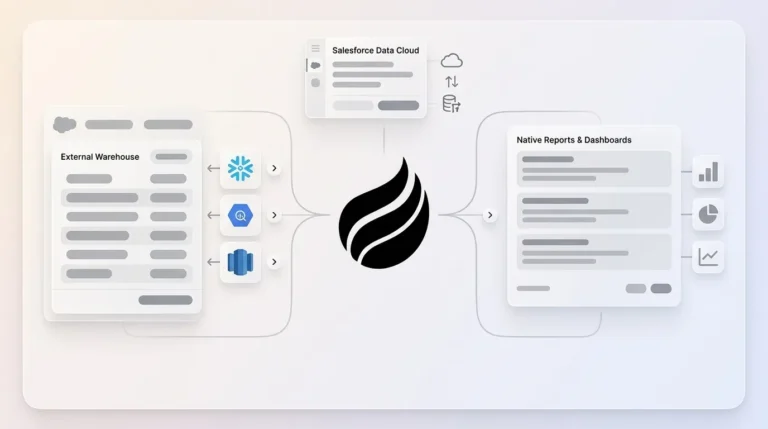
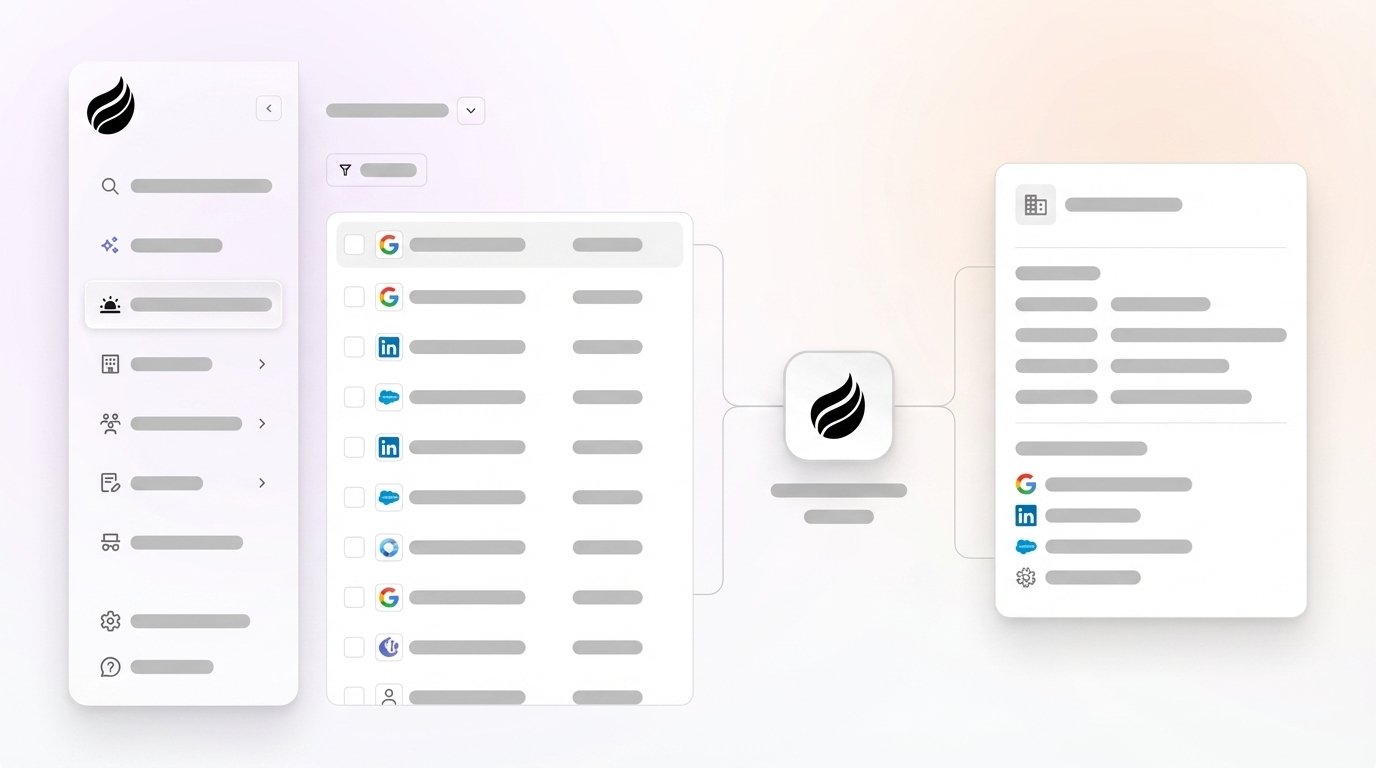
Upon connection to Google Workspace or Microsoft 365, the Coffee Agent immediately gets to work. It auto-creates contacts and companies from email and calendar signals, augments records with job titles, funding stage, and LinkedIn profiles via licensed data partners, and logs last and next activity autonomously. Verified values are written back with source context, the provenance and date that Step 4's write-back framework requires, without manual entry.
Coffee works in two modes. As the engine behind a standalone AI-first CRM, it serves small teams that have outgrown spreadsheets but find legacy CRMs to be expensive maintenance burdens. As a Companion App on top of Salesforce or HubSpot, it serves mid-market teams that are committed to their existing system of record but need an agent to handle the data-in problem. The Companion App writes enriched, verified data back into Salesforce or HubSpot with full source context. That closes the gap Step 4 describes, where enrichment runs in a separate tool and the write-back rules and provenance never reach the system of record.
The operational impact is measurable. Coffee saves reps 8–12 hours per week on data entry, directly addressing the reality that 71% of sales reps say they spend too much time on data entry, leaving only 35% of their time for selling. Coffee is SOC 2 Type 2 and GDPR compliant, and data is not used to train public models, which satisfies the vendor contract requirements that Step 7 demands.
Run The Seven-Step Enrichment Pipeline Automatically inside your CRM or on top of Salesforce and HubSpot.
Frequently Asked Questions
What Is CRM Data Enrichment?
CRM data enrichment is the process of appending missing contact and company attributes, such as job titles, direct dials, firmographics, and technographics, from external sources to existing CRM records. In a governed pipeline, enrichment also includes verification before any value is written back, explicit conflict-resolution rules that prevent good data from being overwritten, and field-level refresh cadence so records stay accurate over time rather than decaying between annual projects.
How Do I Enrich My Contacts In HubSpot?
HubSpot's native enrichment (Breeze Intelligence) covers firmographic company data, using the company domain as the identifying input to return business information such as industry, employee count, revenue, and location, while contact-level fields like direct dial, verified work email, and LinkedIn URL require a dedicated enrichment provider with its own match logic and verification layer. Coffee's Companion App connects to HubSpot via a simple authentication, enriches contact and company records through licensed data partners, and writes verified values back into HubSpot with source context, without manual CSV imports or field-by-field data entry.
What Are The Best Data Enrichment Tools For Salesforce?
ZoomInfo, Apollo, and Clay are among the most commonly deployed enrichment providers alongside Salesforce, while Cognism is a leading option primarily for teams selling into European markets, each with different strengths:
- ZoomInfo for contact volume
- Apollo for cost-effective email coverage
- Clay for waterfall orchestration across 150+ sources
- Cognism for phone-verified EU mobile numbers
The tool matters less than the sequence. A single provider running without write-back rules or refresh cadence will produce the same overwrite and staleness problems regardless of brand. Coffee's Companion App runs the waterfall, applies the write-back decision framework, and writes verified values back into Salesforce with full provenance, replacing the manual stitching described in Step 4.
Can AI Be Used For Data Enrichment?
AI can support enrichment across the full workflow. Agents can select providers dynamically based on record type, verify values before write-back, resolve conflicts using source authority and recency rules, and log provenance for every field update. Coffee does this autonomously from Google Workspace or Microsoft 365, handling the full enrichment pipeline, from auto-creating contacts and companies to refreshing fast-decaying fields like job titles and direct dials, without human intervention between steps.
Conclusion: Govern The Pipeline, Then Let The Agent Run It
Enrichment operates as a pipeline you govern, not a tool you buy once and forget. Clean first, separate company and contact passes, waterfall across providers, apply write-back rules, refresh by field volatility, measure cost per verified record, and stay compliant with GDPR and CCPA. Every step requires a rule at the end of it, and every rule requires an owner who enforces it consistently or an agent that enforces it automatically.
Coffee is that agent. Whether your team runs a standalone CRM or operates on top of Salesforce or HubSpot, Coffee executes the entire enrichment workflow autonomously: auto-creating records, enriching with verified data from licensed partners, writing back with source context, and keeping fields fresh without a quarterly CSV project.
Govern Your Enrichment Pipeline And Let The Agent Run It.