Written by: Doug Camplejohn, CEO & Co-Founder, Coffee | Last updated: July 30, 2026
Key Takeaways
- Automated data enrichment keeps CRM records current with firmographic, demographic, and intent data, which removes manual entry and slows data decay.
- Real-time enrichment triggers on record creation or events, while batch enrichment handles volume updates. Leads contacted within five minutes are 21 times more likely to qualify.
- Mid-market teams should compare platforms on automation depth, continuous enrichment, Salesforce or HubSpot integration, pipeline intelligence, and total cost of ownership.
- HubSpot, Apollo, and Clay each cover parts of the workflow, but only Coffee adds agent-led workflows that capture structured and unstructured data and write enriched insights back to existing CRMs.
- Get started with Coffee to recover significant rep time each week and remove manual CRM data entry.
Why Mid-Market Teams Are Replacing Passive CRMs
Manual data entry now shows up clearly in productivity numbers. The 2026 Salesforce State of Sales report found that the average seller spends only 40% of their time actually selling. Within that non-selling time, Salesforce’s State of Sales report indicates the average rep spends 5.5 hours per week on CRM administration. EverReady estimates that manual data entry into a CRM takes between 3 and 5 hours per week on average.
This burden pushes reps into shadow CRMs. They abandon the system of record for spreadsheets and Notion because the CRM demands more than it delivers. Fifty‑one percent of sales leaders with AI say tech silos delay or limit their AI initiatives, which reflects fragmented enrichment tools that add stack complexity without solving data-in. When input data is unreliable, every forecast, routing decision, and pipeline review built on top of it becomes unreliable as well.
How Automated Enrichment Works in a CRM
Automated enrichment relies on three core modes that each address a different latency problem.
Real-time enrichment fetches or verifies a record the moment it is needed through an API call triggered by events such as form submissions, CRM record creation, or webhooks. Batch enrichment processes records in bulk on a schedule, such as nightly, weekly, or monthly, and fits volume tasks like TAM list-building where no live decision depends on a single record. The urgency gap is significant. Leads contacted within five minutes are 21 times more likely to qualify than those contacted after 30 minutes, which only real-time enrichment can support.
Data decay makes enrichment cadence a high-stakes choice. Roughly 22.5% of B2B data goes stale every year due to job changes, title updates, and phone number shifts, and a Gartner report found that poor data quality costs organizations an average of $12.9 million per year. A one-time CSV import does not address this ongoing decay, so teams need enrichment that runs continuously in the background.

Evaluation Criteria for 10–50 Person Teams
Mid-market RevOps teams can compare contact management platforms more clearly by scoring them against seven criteria.
- Native automation depth. Enrichment should trigger automatically on record creation instead of relying on manual clicks or exports.
- Continuous background enrichment. Records need monthly or real-time refreshes without human action to counter data decay.
- Salesforce or HubSpot integration. The platform should provide bidirectional sync, conflict resolution, and deduplication as built-in capabilities.
- Pipeline intelligence output. The system should surface week-over-week pipeline changes without manual CSV exports or spreadsheet work.
- Time saved per rep. Vendors should document how many hours of research and data entry each rep recovers every week.
- Data quality parity with ZoomInfo or Apollo. Enrichment coverage should meet the RevOps benchmark of 85% or higher CRM record completeness.
- Total cost of ownership. TCO typically equals 2–3 times the license cost once integration setup, ongoing maintenance, training, and configuration time are included.
The comparison below evaluates platforms across the seven criteria above, plus three additional dimensions: visitor identification, meeting automation, and agent-led workflows that highlight Coffee’s approach.

Get started with Coffee to see how an agent-led CRM performs against every criterion above.
Side-by-Side Comparison: HubSpot, Apollo, Clay, and Coffee
| Criterion | HubSpot | Apollo | Clay | Coffee |
|---|---|---|---|---|
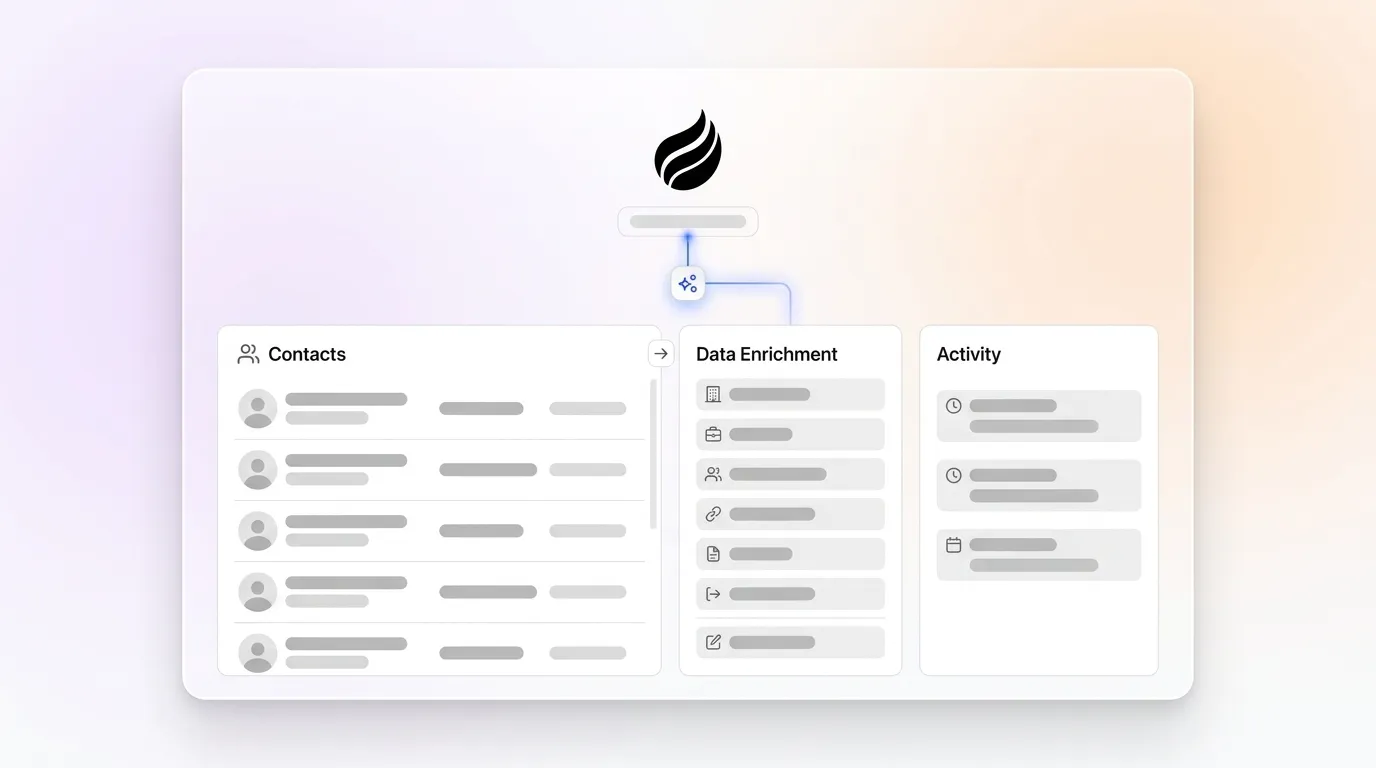
| Native Enrichment | Auto on new records, monthly continuous refresh for existing records | Database of 230M+ contacts with 65+ appended attributes | Waterfall enrichment across 75+ providers with coverage above 80% | Agent auto-creates and enriches contacts, companies, and activities from email and calendar, with built-in licensed data partners |
| Visitor Identification | Not available natively, requires third-party integration | Not available natively | Not available natively | Pixel-based visitor identification that surfaces named individuals and suggests two to three buyer-persona-matched contacts per visiting company |
| Meeting Automation | Meeting scheduler only, no native AI briefing or post-call summary | Not available | Not available | Pre-meeting briefings, AI meeting bot, automated summaries, action items, and follow-up drafts after each call |
| Pipeline Intelligence | Standard pipeline views with manual reporting or paid add-ons for change tracking | Pipeline views inside Apollo, but Apollo is not the system of record | Not a CRM and does not manage pipeline | Pipeline Compare feature that visualizes week-over-week deal changes from a built-in data warehouse without CSV exports |
| Pricing Model | Tiered seat-based pricing with enrichment credits that vary by plan | Seat-based pricing with credit consumption for exports and enrichment | Credit-based pricing per enrichment row. LLM-based enrichment can reach $0.30 per row. | Simple seat-based pricing with unlimited agent labor and no credit metering on enrichment or AI actions |
| Salesforce or HubSpot Companion Mode | Native for HubSpot records, but no companion mode for Salesforce | Integrates through native connectors. Enrichment pushes to the CRM but does not manage data-in workflows. | Connects through Zapier or Clay-to-CRM sync and requires configuration. It does not act as a companion agent. | Dedicated Companion App for Salesforce and HubSpot with bidirectional sync. The agent writes enriched data and insights back to the primary CRM. |
| Agent-Led Data-In Workflows | Not available, relies on human entry or third-party enrichment tools | Not available. Apollo functions as a prospecting and enrichment database, not a data-in agent. | Not available. Clay operates as a workflow builder, not a CRM agent. | Core architecture where the agent logs activities, enriches records, captures call transcripts, and structures data continuously without human input. |
Salesforce Enrichment: Integration Depth and Maintenance
Integration depth, not data coverage alone, determines whether enrichment tools keep CRM data clean without manual fixes. Bad enrichment integration creates duplicate records, overwrites data, and breaks workflows, which forces RevOps teams to spend hours on manual cleanup.
HubSpot’s native enrichment focuses on HubSpot records and does not extend to Salesforce. HubSpot’s continuous enrichment cycle runs monthly, which works for stable accounts but lags behind fast-changing B2B contact data. Apollo and Clay both connect to Salesforce through native connectors or Zapier, yet neither manages the full data-in workflow. They append fields but do not capture unstructured data such as call transcripts or email context.
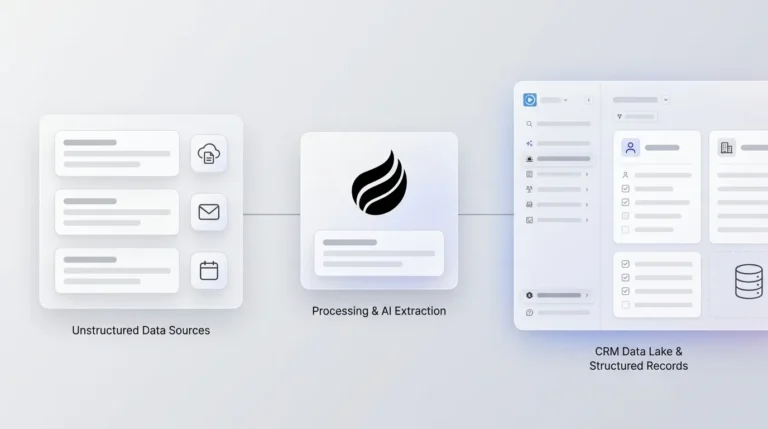
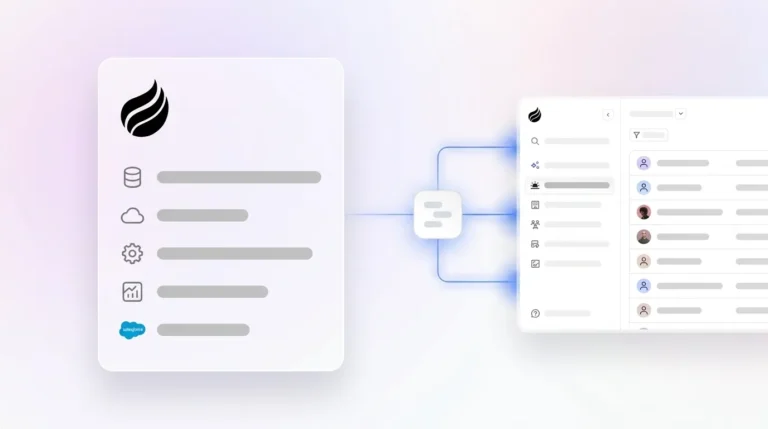
Coffee’s Companion App deploys the agent as an intelligent layer on top of an existing Salesforce or HubSpot instance. A simple authentication lets the agent sync data, enrich it, and write insights, including meeting summaries, next steps, and activity logs, back to the primary CRM. This approach shifts conflict resolution and deduplication upstream, so the agent handles data governance before writing to the system of record and reduces the cleanup burden on RevOps teams.

B2B Data Enrichment in 2026: Time Saved and Pipeline Accuracy
Automated enrichment improves productivity and accuracy for B2B sales teams. Teams that adopt it often reduce research time per rep, improve lead-to-opportunity conversion, and see higher reply rates on outbound sequences. Better enrichment also raises CRM field completeness, which directly improves reporting accuracy, lead routing, and forecasting.

Coffee’s agent-led model extends these gains. By capturing unstructured data such as emails, calendar events, and call transcripts alongside structured firmographic enrichment, the agent saves reps 8–12 hours per week. No evidence from Scalepoint sources shows CRM data completeness rising from 38% to 94% or weekly manual entry falling from 22 hours to 1.5 hours, as their materials describe only general reductions in manual entry without quantified results. Pipeline reviews move away from interrogation sessions that require manual CSV preparation and shift toward strategic discussions guided by the agent’s automated Pipeline Compare output.
Get started with Coffee and recover the research and data entry time described above.
Best-Fit Use Cases for Agent-Led Enrichment
Three team profiles consistently gain the most from agent-led contact management with automated enrichment.
- Early-stage teams outgrowing spreadsheets. Founders and early sales hires need automated contact creation and enrichment without the overhead of configuring HubSpot or Salesforce. Coffee’s Standalone CRM deploys the agent as the full system of record.
- Growing organizations committed to Salesforce or HubSpot. Mid-market RevOps teams with low CRM adoption and poor data quality need an agent to manage data-in while keeping their existing system. Coffee’s Companion App writes clean, enriched data back to the primary CRM.
- Teams tired of tool fragmentation. Organizations running separate tools for enrichment, prospecting, recording, and sequencing want a single agent that consolidates these workflows. Tool consolidation through integrated enrichment platforms can save 20–30% on tech stack budgets and improve rep adoption.
Operational Considerations and Risks
Automated enrichment still requires strong governance. Workflows need schema standards, field provenance tracking, and exception routing in place before any automation goes live. Teams that skip this design step inherit the same data quality problems they hoped to fix, only at machine speed.
Several additional risks deserve attention during planning.
- Change management. Reps who rely on manual processes or shadow CRMs need structured onboarding and clear expectations before they will trust and adopt an agent-led system.
- Data hygiene at migration. AI enrichment requires clean input data, because machine learning cannot correct misspelled names or incorrect domains.
- Hidden maintenance work. The 2–3 times TCO multiplier mentioned earlier becomes especially painful for platforms that require manual field mapping updates or vendor contract management for waterfall providers, which add ongoing RevOps overhead beyond the initial setup.
- Process dependency. Software cannot repair broken qualification or routing processes. Accurate enrichment improves data completeness, but teams still need clear ICP criteria and a defined sales methodology.
Decision Framework for Choosing a Platform
Teams can match platforms to their stack, size, and tolerance for manual work using a simple set of scenarios.
- No existing CRM, 1–20 person team. Choose Coffee Standalone CRM so the agent can manage the full system of record with zero manual data entry configuration.
- Existing Salesforce or HubSpot, 10–50 person team, low adoption. Choose Coffee Companion App so the agent enriches and writes data back to the primary CRM without replacing it.
- Need prospecting database only, no CRM replacement. Choose Apollo or ZoomInfo as point solutions, with the understanding that data-in workflows stay manual and TCO includes integration and maintenance work.
- Need highly customized waterfall enrichment across 75 or more providers, with engineering resources available. Choose Clay, recognizing that it functions as a workflow builder, not a CRM agent, and requires separate systems for pipeline management and meeting intelligence.
- Deep HubSpot investment, enrichment-only need. Choose HubSpot Breeze (Clearbit) for native auto-enrichment of contacts and form submissions, while noting its single-source limitation of 85–92% email accuracy and monthly continuous refresh cadence.
Get started with Coffee and select the model that fits your current stack and team size.
Frequently Asked Questions
How long does it take to implement Coffee and see value?
Coffee delivers value quickly for both deployment models. For the Standalone CRM, connecting Google Workspace or Microsoft 365 lets the agent start auto-creating contacts, logging activities, and enriching records immediately after authentication, often within a single session. For the Companion App on Salesforce or HubSpot, a short authentication flow lets the agent begin syncing and enriching data without a long implementation project. Most teams see the agent populating and enriching records on day one, with Pipeline Compare available once the agent has logged enough deal activity.
How difficult is it to migrate from spreadsheets or a legacy CRM to Coffee?
Migration difficulty depends on the starting system. Teams moving from spreadsheets face the least friction because Coffee’s agent builds the CRM from email and calendar history automatically, so the system fills itself instead of relying on a manual import. Teams migrating from a legacy CRM such as HubSpot or Salesforce can often avoid migration entirely by using Coffee’s Companion App model. In that setup, the agent layers on top of the existing system, enriches records, and writes data back without a full platform switch.
Teams that want Coffee as their standalone system of record can still import historical records through standard CSV. From that baseline forward, the agent manages enrichment and deduplication.
Is Coffee secure, and does it meet compliance requirements?
Coffee holds SOC 2 Type 2 certification and complies with GDPR. Customer data does not train public AI models. For most mid-market teams in regulated-adjacent industries, these certifications satisfy standard security review requirements. Coffee does not currently target heavily regulated industries such as healthcare or finance that require multi-year security reviews or custom data residency arrangements.
How does Coffee’s enrichment data quality compare to ZoomInfo or Apollo?
Coffee’s built-in enrichment, sourced through licensed data partners, delivers data quality roughly on par with ZoomInfo and Apollo for most mid-market needs. Coverage includes job titles, funding data, and LinkedIn profiles. The more meaningful difference is that Coffee enriches structured firmographic data and unstructured data such as email threads, call transcripts, and meeting notes at the same time. This combination creates a complete contact record that neither ZoomInfo nor Apollo provides alone.
Teams that require the deepest possible firmographic coverage for large-scale enterprise prospecting may still evaluate ZoomInfo as a point solution. For teams focused on CRM data quality and rep productivity, Coffee’s built-in enrichment usually removes the need for a separate enrichment subscription.
Can Coffee work alongside an existing Salesforce or HubSpot instance without replacing it?
Coffee’s Companion App model is designed specifically for this scenario. The agent authenticates with the existing Salesforce or HubSpot instance and operates as an intelligent data-in layer that captures activities, enriches contacts, logs call summaries, and writes structured insights back to the primary CRM. Salesforce or HubSpot remains the system of record, while Coffee handles the labor that previously fell on reps.
This model fits mid-market teams that have already invested in Salesforce or HubSpot infrastructure, including quotas, forecasting, and required fields, and now need an agent to improve data quality without a platform migration.