Written by: Doug Camplejohn, CEO & Co-Founder, Coffee | Last updated: August 13, 2026
Key Takeaways for B2B Visitor Identification
- Company-level reverse-IP identification typically delivers match rates of 30–60% of overall US B2B traffic, with 85–95% match rates on filtered corporate-office sessions, not the inflated 70%+ figures some vendors claim.
- Match rates vary significantly by traffic type, because mobile, VPN, and remote-worker sessions consistently underperform compared to corporate-network desktop traffic.
- Four suppression lists (customers, churned accounts, competitors, partners/job-seekers) should be maintained weekly and applied uniformly across all alert and CRM channels to keep noise out.
- Legitimate interest usually supports company-level processing under GDPR in B2B contexts, while ePrivacy still requires consent for cookies, and CCPA now treats B2B contacts the same as consumer data.
- Coffee autonomously converts identified visitors into enriched CRM records, eliminating the 8–12 hours of manual data entry that other platforms leave to humans—see Coffee’s pricing and start your trial today.
Realistic Match Rates for 2026 B2B Traffic
Industry analyses suggest company-level identification rates for US B2B traffic often range between 30% and 60% of total sessions before any filtering. That broad range exists because match rates vary significantly based on the traffic mix. Mobile B2B traffic, for example, tends to underperform desktop traffic because carrier IPs rarely map cleanly to a single employer. Similarly, SMB visitors usually yield lower identification rates than enterprise visitors on corporate networks, where IP-to-company mapping is more reliable.
Many sources suggest that 20–50% of B2B traffic becomes a realistic target for company-level identification after you filter for qualified, ICP-fit visitors. That narrower range represents strong performance in real-world conditions. Coverage continues to shrink as home-office, VPN, and mobile traffic displace corporate-network sessions, so planning around the filtered range matters more than chasing inflated headline numbers.
Plan around a realistic target based on your actual traffic mix after filters and ICP criteria are applied. Pipeline models built on higher assumptions will overstate opportunity and underdeliver against revenue targets.
Test Coffee against your traffic mix and see your actual match rate before committing to any workflow.
Practical Suppression Rules for Job Seekers and Competitors
Accurate match rates depend on clean data inputs. Before any visitor identification workflow can deliver value, you must filter out the noise from existing customers, competitors, partners, and job seekers that inflates volume without adding pipeline.
Leadpipe’s suppression guidance recommends maintaining four distinct suppression lists, and the implementation sequence matters as much as the lists themselves.
- Build four suppression lists: existing customers, churned accounts, competitors, and partners/agencies/job-seeker domains.
- Export each list from the CRM weekly, compare it against the prior version, and re-upload it to the visitor identification platform so exclusions apply uniformly across Slack alerts, webhooks, and CRM integrations.
- Route active customer visits to the CSM team rather than blocking identification entirely, because the visit is a retention signal, not a sales lead.
- Route competitor visits to a dedicated competitive-intelligence Slack channel for product and marketing teams.
- Demote personal-email domains (@gmail.com, @yahoo.com, @outlook.com) to a low-priority nurture tier rather than excluding them outright.
- Validate suppression weekly by confirming that zero sales emails go to active customer domains, competitor visits log to the intel channel, and CSM alerts fire on customer-domain visits.
The table below maps each suppression category to its routing action and refresh cadence, giving you a quick reference for operationalizing the workflow described above.
| Category | Exact Domain Examples | Routing Action | Refresh Cadence |
|---|---|---|---|
| Existing Customers | acmecorp.com, globex.io | Alert CSM, suppress from sales queue | Weekly CRM export |
| Competitors | rivalco.com, competitorhq.com | Log to competitive-intel Slack channel | Weekly manual review |
| Partners / Agencies | agencypartner.com, reseller.io | Route to partner manager, suppress from SDR queue | Monthly partner-list sync |
| Job Seekers / Universities | gmail.com, linkedin.com, .edu domains | Demote to Tier 3 nurture, no direct outreach | Static list, quarterly audit |
Legal Bases, Consent, and Documentation for GDPR/CCPA
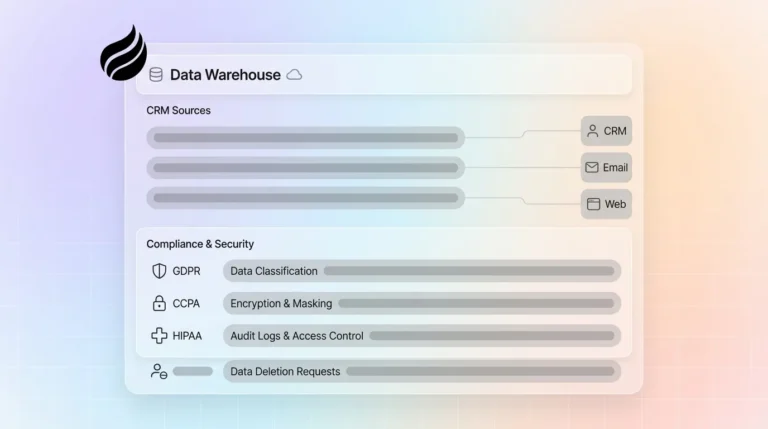
Under GDPR, only consent (Article 6(1)(a)) and legitimate interests (Article 6(1)(f)) are viable legal bases for visitor identification. Company-level IP-to-company matching can generally rely on legitimate interest in B2B contexts because the data is publicly available business information and the processing purpose, identifying prospective commercial partners, passes the three-part necessity and balancing test. Person-level identification almost always requires explicit consent.
The ePrivacy Directive applies separately and requires consent before placing non-essential cookies or similar tracking technologies on a visitor’s device, even when legitimate interest covers downstream data processing. Cookie-free methods such as server-side IP-to-company resolution avoid ePrivacy consent requirements because they do not read or write data to the visitor’s device, although GDPR disclosure obligations still apply.
Under CCPA, visitor identification operates as an opt-out regime rather than requiring affirmative opt-in, provided notice at collection and a working “Do Not Sell or Share My Personal Information” mechanism are in place. The former B2B exemption has expired, so business-contact personal information is now covered like any other personal information with no carve-out. Suppression of opted-out individuals must propagate to every downstream system, not just the website itself.
Required documentation includes a Legitimate Interest Assessment (LIA), Records of Processing Activities (ROPA), Data Processing Agreements (DPAs) with all tracking vendors, and consent records to demonstrate accountability under GDPR Article 5(2). GDPR Article 30 requires the ROPA to document each processing activity’s purpose, data categories, recipients, transfers, retention periods, and security measures. Beyond documentation, qualifying breaches must be reported to supervisory authorities within 72 hours, so incident-response planning becomes a core part of any compliant visitor identification program.
Turning Identified Visitors into CRM Leads Automatically
With compliance documentation in place, the next operational priority is converting identified visitors into actionable CRM records without manual data entry. Most visitor identification platforms stop at delivering a company name or a raw list of people. That hand-off still requires a human to evaluate the list, find the right contact, enrich the record, and enter it into the CRM, which creates the manual work described earlier that drains RevOps productivity. Coffee closes that loop autonomously.

The Coffee workflow runs as follows.
- Pixel fires. A single script in the site’s
<head>tag begins resolving anonymous sessions to named organizations immediately after installation. - Real-time Slack alert. High-fit visitors surface in Slack with company, pages visited, time on site, and first-versus-returning status, routed to a rep in under 60 seconds, which is the operational benchmark for visitor identification workflows.
- Suggested Leads. Where competitors like RB2B post individual LinkedIn profiles into Slack with no persona filtering, and Warmly surfaces undifferentiated people lists, Coffee uses the configured buyer persona to recommend which two or three humans inside the visiting company to contact, with LinkedIn profiles pre-surfaced for instant outreach.
- One-click autonomous CRM record. The Coffee Agent writes the enriched contact and company record directly to the CRM, including job title, funding, LinkedIn profile, activity log, and intent signals, with no spreadsheet, no Zapier chain, and no manual data entry.
The result is a closed pixel-to-CRM loop. High-quality data from the visitor identification layer produces accurate pipeline records and forecasts. RB2B and Warmly require a human hand-off at every stage of that sequence. Coffee’s agent handles it end to end.
Close the pixel-to-CRM loop with Coffee’s autonomous agent and eliminate manual data entry from your workflow.
Step-by-Step Implementation Checklist
- Install the pixel. Drop the Coffee-generated script into the
<head>tag of every page. Verify installation in the Coffee dashboard before you continue. - Configure ICP filters. Set company size, industry, geography, and job-title criteria so only ICP-fit sessions trigger alerts and CRM writes. Prioritize precision over raw volume.
- Upload suppression lists. Load existing customers, churned accounts, competitors, and partner or job-seeker domains. Confirm that exclusions apply across Slack alerts, webhooks, and CRM sync at the same time.
- Deploy a consent banner. Block non-essential cookies until consent is granted, allow granular accept or reject choices, and log consent records for audit trails. Use a recognized CMP such as Cookiebot, OneTrust, or Termly.
- Document legal basis. Complete a Legitimate Interest Assessment for company-level processing. Sign DPAs with Coffee and any downstream enrichment vendors. Add visitor identification to the ROPA.
- Configure buyer persona for Suggested Leads. Define the two or three job titles that represent your actual buyers so Coffee’s agent surfaces the right humans from each visiting company.
- Enable autonomous CRM sync. Authenticate Coffee with Salesforce or HubSpot, or use Coffee’s Standalone CRM. Make automated workflows the only path from identification data into the CRM and treat manual push as a break-glass exception.
- Set scoring thresholds. A two-axis model awarding 0–50 fit points and 0–50 behavioral points classifies Hot (80–100) for immediate outreach, Warm (60–79) for same-day email, Nurture (40–59) for marketing automation, and Monitor (0–39) for logging only.
- Run weekly hygiene audits. Re-export suppression lists from the CRM, re-upload updated domains, spot-check field completeness, and confirm email deliverability above 90% and duplicate rate below 5%.
Frequently Asked Questions
Which CRMs does Coffee sync with natively?
Coffee operates in two modes. As a Standalone CRM, it is the system of record and requires no external sync. As a Companion App, it authenticates directly with Salesforce or HubSpot and writes enriched contacts, companies, and activity logs back to those platforms without middleware. For other tools, Coffee connects via Zapier, with deeper native integrations on the roadmap. The agent handles field mapping, deduplication, and object routing automatically in both modes.
Is Coffee SOC 2 Type 2 and GDPR compliant?
Yes. Coffee is SOC 2 Type 2 certified and GDPR compliant. Customer data is not used to train public AI models. For visitor identification specifically, Coffee’s company-level reverse-IP processing is designed to operate under legitimate interest for B2B contexts, and the platform supports the documentation requirements, including LIA, ROPA, and DPAs, that GDPR accountability obligations demand. CCPA opt-out propagation applies across all downstream systems, including CRM records created by the agent.
How is Coffee priced?
Coffee uses straightforward seat-based pricing. Each human seat covers one user, and the agent’s labor, including data entry, enrichment, visitor identification, meeting management, pipeline intelligence, and CRM sync, is included without additional metering on AI usage or automated processes. There are no separate line items for LLM calls or workflow runs. Pricing details are available at coffee.ai/pricing.
What data sources power Suggested Leads?
Suggested Leads combines the visiting company identified by the reverse-IP pixel with Coffee’s enrichment layer, which draws on licensed data partners to surface job titles, LinkedIn profiles, and firmographics. The agent then filters that company’s personnel against the buyer persona configured in Coffee, typically two or three target job titles, and surfaces the two or three individuals most likely to be the right contact. This is the step that competitors like RB2B and Warmly skip, because they return either a company name or an unfiltered people list and leave persona matching and contact selection to the human rep.

Conclusion: From Match Rates to Autonomous Pipeline
Company-level reverse-IP visitor identification is table stakes for B2B revenue teams in 2026. The real value does not sit in the match rate itself, even though filtered corporate-office traffic can reach 85–95% match rates while overall unfiltered rates remain in the 30–60% range, but in what happens after identification. Suppression lists keep noise out. Compliance documentation keeps regulators out. An autonomous agent that enriches, persona-matches, and writes directly to the CRM keeps humans out of the data-entry loop.
Every other platform in this category, including RB2B, Warmly, and Leadfeeder, delivers data and then stops. The hand-off to a human, a spreadsheet, or a Zapier chain is where those hours of manual work disappear. Coffee’s agent closes that gap so the pixel fires, the Suggested Leads surface, and the CRM record is written, all without a human acting as a data entry clerk.
Good data in. Good data out. No manual steps in between. Start your Coffee trial and automate your visitor-to-CRM workflow today.