Written by: Doug Camplejohn, CEO & Co-Founder, Coffee | Last updated: September 24, 2026
Key Takeaways
- Prospecting Center retires in April 2026, with full end-of-support in April 2027, so teams must migrate workflows before access ends.
- The replacement stack of Sales Engagement, Sales Cadences, Work Queue, and Einstein Lead Scoring covers Prospecting Center workflows but depends on clean Salesforce data.
- Salesforce briefly rebranded Sales Cloud to Agentforce Sales in 2025, then reverted in 2026, which created naming confusion without changing functionality.
- Data quality is the main constraint: incomplete or stale records weaken Einstein Lead Scoring, intent signals, and every other tool in the new workflow.
- Coffee automates data entry, enrichment, and activity logging so the replacement prospecting stack runs on accurate records from day one.
See How Coffee Keeps Your Salesforce Data Clean
How Sales Prospecting Works In Salesforce Sales Cloud
Sales prospecting is the systematic process of identifying potential buyers, qualifying them against defined criteria, and starting outreach that leads to a sales conversation. In Salesforce Sales Cloud, that process runs on four core objects: Leads, Accounts, Contacts, and Opportunities.
Sales Cloud’s native prospecting provides workflow, sequence, and AI scoring on top of your data. The quality of every output depends on the quality of the data underneath. Sales reps spend 72% of their day on non-selling activities such as data entry, research, and administrative work, so the data layer often ends up incomplete, inconsistently logged, or stale. That bottleneck persists when teams move to the replacement tools.
Step-By-Step Prospecting Flow Inside Sales Cloud
- Lead Capture And Assignment: Leads enter via web forms, list imports, or manual entry. Lead assignment rules route them to reps or queues.
- Lead Qualification: Reps evaluate each Lead against ICP criteria. Einstein Lead Scoring surfaces a predictive score based on historical conversion patterns to help with prioritization.
- Cadence Enrollment: Qualified Leads move into a Sales Cadence. This structured multi-touch sequence of emails, calls, and social steps runs through Sales Engagement and appears daily in the Work Queue.
- Meeting Stage: A positive response triggers meeting scheduling. Coffee’s Companion App can handle pre-meeting briefings and post-meeting summaries automatically at this stage.
- Opportunity Creation: On conversion, Salesforce creates an Account, a Contact, and optionally an Opportunity. Salesforce retires the Lead record from active use while preserving it for historical reporting.
- Pipeline Close: The Opportunity advances through defined stages. Leaders track progress in real-time dashboards and pipeline reviews.
Salesforce Sales Cloud Naming In 2026
Sales Cloud is still called Salesforce Sales Cloud. Salesforce rebranded it to Agentforce Sales in October 2025 as part of a broader Agentforce naming push, then reverted to Sales Cloud on its website in August 2026. As of August 2026, Salesforce’s live sales page presents the product as Sales Cloud. Agentforce Sales appears further down as a capability descriptor rather than the product name.
The brief rebrand did not change core product behavior. Individual features and bundles, including Sales Engagement and Prospecting Center, keep their own names and lifecycles regardless of the top-level product label.
Prospecting Center: Role In Prospecting And April 2026 Retirement
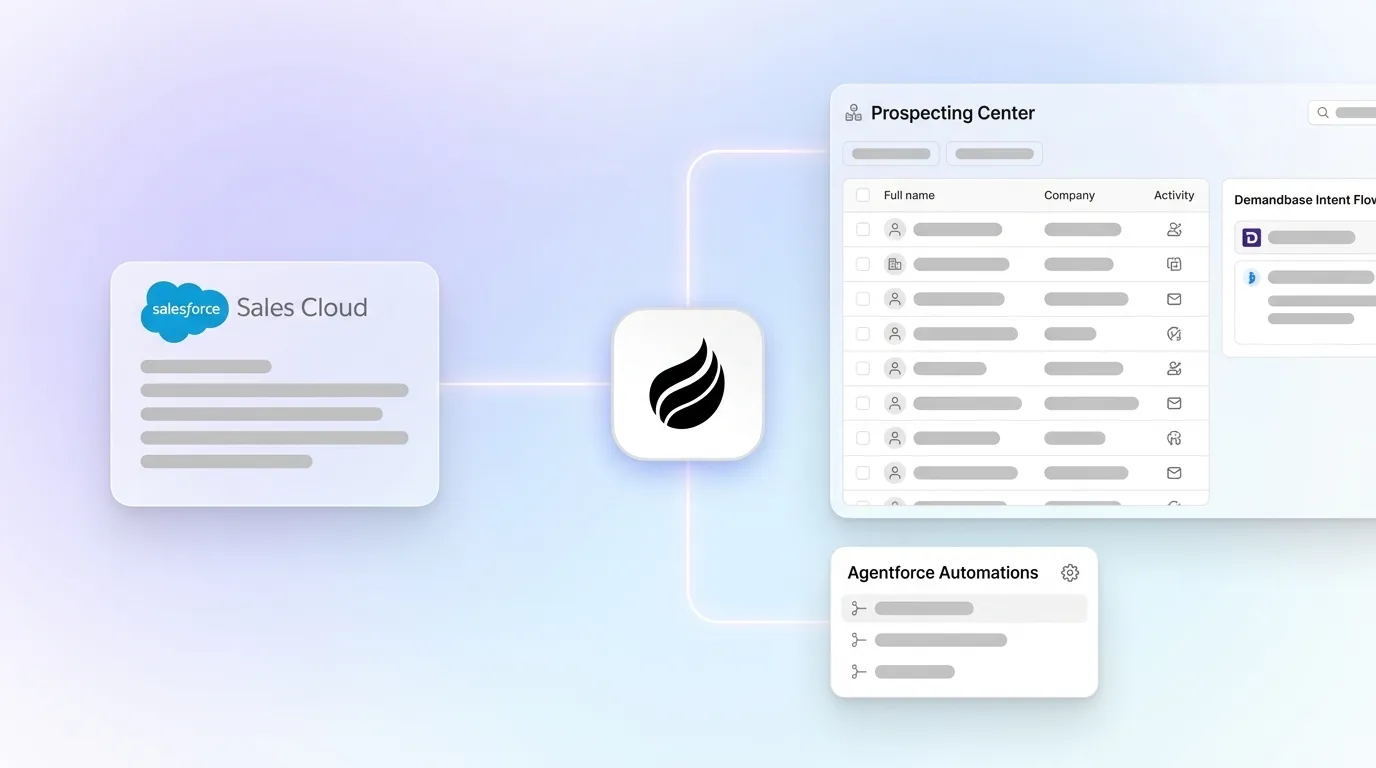
Prospecting Center was a Sales Cloud feature that gave sales teams a consolidated workspace for account-level prospecting. It combined Engagement Scores, Fit Scores, and an Intent Score to surface accounts most likely to be in a buying cycle. The Intent Score highlighted buyers showing strong purchasing intentions based on their actions in digital and physical channels, with a higher score signaling an account’s readiness to move forward.
The feature required Lightning Experience and was available with Sales Engagement, included in Performance, Unlimited, and Agentforce 1 Editions.
Prospecting Center is scheduled for retirement in all Salesforce orgs as of April 2026, and for existing customers it remains available until April 2027, after which it is fully unavailable. Salesforce’s Summer ’26 release lists Prospecting Center among retiring features, with the documented required action “Evaluate replacement prospecting tools.” Teams that rely on Prospecting Center for account prioritization, intent scoring, or daily rep workflow need a replacement before the retirement window closes.
What Replaces Prospecting Center In Salesforce
The replacement stack is a set of four interconnected tools that together cover the workflow Prospecting Center supported. These tools handle the workflow layer while relying on your existing data layer.
Salesforce Sales Engagement And Sales Cadences handle structured multi-touch outreach. Sales Engagement (formerly High Velocity Sales) provides the Work Queue, Sales Cadences, email templates with engagement tracking, and Lightning Dialer integration. A Sales Cadence is a defined sequence of touchpoints. Sales operations builds the sequence, such as email on Day 1, call on Day 3, and LinkedIn on Day 5, and reps execute it. Salesforce sales engagement cadences support conditional branching based on prospect behavior, so a lead who clicks a pricing email can route into a higher-touch sequence while an unresponsive lead moves to a longer-interval nurture track.
Work Queue is the rep’s prioritized daily task list. The Work Queue surfaces every prospect step due today, including emails to send, calls to make, LinkedIn messages, and follow-ups, with priority driven by cadence step due dates, lead score, and manual flagging. Reps work task-first rather than record-first, which represents a shift from Prospecting Center’s account-centric view.
Einstein Lead Scoring Salesforce provides the AI prioritization layer. Einstein Lead Scoring trains on an org’s own historical Lead data and assigns each Lead a score from 1 to 99 predicting likelihood to convert, with the model retraining automatically every 10 days. Each scored Lead surfaces a Top Positive Factors and Top Negative Factors panel so reps understand the reasoning behind the score. Einstein amplifies the signal that exists in your data, so poor data quality produces misleading outputs.
These tools replace the workflow layer. The data quality problem that undermined Prospecting Center’s Intent Score remains the primary operational risk for every tool in this stack. A fifth component, Demandbase intent data, often runs alongside this stack to fill the account-level intent gap Prospecting Center leaves behind.
Run The Replacement Stack On Accurate Records
Demandbase Intent Data In Sales Cloud Workflows
Demandbase now integrates with Salesforce in ways that extend beyond the Prospecting Center era. The Demandbase MCP on Agentforce brings real-time B2B engagement, person and account data, buying group signals, and intent data into the native Agentforce workflow so sales teams can access it without leaving the platform where they sell. Reps can query Demandbase using natural language and retrieve high-value contacts ranked by engagement, including visibility into which contacts and accounts show the greatest intent to buy.
Operationally, Salesforce Data Cloud pulls intent scores from Demandbase, combines them with website analytics, customer data, and company information, and creates a real-time unified account profile visible to sales. For example, it can surface a company with an Intent Score of 85/100, 20+ website visits, and 5 pricing page views. When a high-intent signal appears, Sales Cloud can automatically route the lead to the right account executive and surface all interaction history.
Intent data only delivers value when it attaches to a complete, accurate record. An account flagged as high-intent by Demandbase but linked to an incomplete or stale Salesforce record produces a false signal. The data quality problem sits upstream of the intent layer.
How To Migrate From Prospecting Center To Sales Engagement
Migration from Prospecting Center to the Sales Engagement stack works best as a sequenced project rather than a single cutover. The seven steps below move from discovery of current usage to enablement on the new workflow, with data validation acting as the gate that determines whether the rest of the migration succeeds.
- Inventory Current Prospecting Center Usage: Document which teams use Prospecting Center, which workflows depend on Intent Score, and which reps rely on the account prioritization view for daily work.
- Map Workflows To Replacement Tools: Match each Prospecting Center function to its replacement. Intent Score prioritization maps to Einstein Lead Scoring and Demandbase intent data. Account-level outreach maps to Sales Cadences. Daily task execution maps to Work Queue.
- Configure Sales Engagement And Cadences: A non-trivial SDR-team rollout of Sales Engagement typically takes three to six weeks. Start with two to three cadences such as Cold Outbound, Inbound Lead Follow-Up, and Reactivation, then add branching logic from day one.
- Validate Data Quality: Audit Lead records for missing fields, inconsistent values, and unlogged activities. Einstein Lead Scoring, Work Queue prioritization, and Demandbase intent matching all rely on complete data.
- Enable Einstein Lead Scoring: Turn on Einstein only after the data audit passes. Einstein Lead Scoring requires a minimum of 1,000 Leads created in the past six months with at least 120 converted to Opportunity, and the model will train on whatever is in the org, including gaps.
- Train Reps On The New Workflow: The shift from Prospecting Center’s account-centric view to Work Queue’s task-first model is a behavioral change. Plan structured enablement so reps understand how cadences, scores, and tasks fit together.
- Set A Cutover Date Ahead Of April 2026: Build in a parallel-run period so reps can validate the new workflow while Prospecting Center remains available.
Where Coffee’s Companion App Fits In The New Stack
Every tool in the replacement stack, including Sales Engagement, Cadences, Work Queue, and Einstein Lead Scoring, depends on clean, complete, consistently logged Salesforce data. Migrating workflows does not fix that dependency. Eliminating manual data entry does.

Coffee’s Companion App deploys an autonomous agent on top of an existing Salesforce instance. The agent handles data entry, contact and company enrichment, activity logging, and meeting summaries automatically, so the new prospecting workflow runs on accurate data without reps acting as data entry clerks. When a rep finishes a discovery call, Coffee logs the activity, generates a structured summary aligned to sales methodologies like BANT or MEDDIC, drafts the follow-up email, and writes the outcome back to the Salesforce record. The Lead Score Einstein calculates, the Cadence step the Work Queue surfaces, and the intent signal Demandbase delivers all become more reliable when the underlying record reflects reality.

Coffee’s core promise is good data in and good data out. For teams migrating off Prospecting Center, that means the replacement stack performs as designed from day one instead of degrading over time as manual logging gaps accumulate.

Start Your Migration With Clean Data
Frequently Asked Questions
What Happens To Prospecting Center In 2026?
Prospecting Center is scheduled for retirement in all Salesforce orgs as of April 2026, and for existing customers it remains available until April 2027, after which it is fully unavailable. Teams that currently use Prospecting Center for account prioritization, Intent Score configuration, or daily rep workflow need to move to the replacement stack of Sales Engagement, Sales Cadences, Work Queue, and Einstein Lead Scoring before the April 2026 retirement date. Salesforce’s Summer ’26 release documentation lists the required action as “Evaluate replacement prospecting tools.” Teams that delay migration lose the chance for a parallel-run period to validate the new workflow.
Does Einstein Lead Scoring Work Without Clean Data?
Einstein Lead Scoring trains on an org’s own historical Lead conversion data and assigns scores based on the patterns it finds. If the data is incomplete, with missing field values, inconsistent industry or title fields, or unlogged activities, the model trains on noise and produces scores that do not reflect actual conversion likelihood. The model’s data threshold, covered above, is the first gate. Below that threshold, or with poor data quality, scores become unreliable.
What Is The Demandbase Integration With Salesforce Sales Cloud?
Demandbase integrates with Salesforce Sales Cloud to surface buyer intent signals, including anonymous buying behavior tracked across third-party B2B publisher networks, review sites, and research platforms, directly inside the Sales Cloud workspace. The Demandbase MCP on Agentforce allows reps to query Demandbase using natural language and retrieve contacts ranked by engagement, buying group membership, and intent signals without leaving Salesforce. Salesforce Data Cloud pulls intent scores from Demandbase, combines them with first-party website analytics and CRM data, and creates a unified account profile that surfaces in list views and can trigger automated lead routing. The integration supports bidirectional data flow: intent and account data write into Salesforce records, and Salesforce activity data flows back into Demandbase workflows. The practical constraint is that intent data attaches to Salesforce records, so incomplete or mismatched records prevent the intent signal from reaching the right rep at the right time.
Conclusion: Salesforce Prospecting Changes And Next Steps
Three major shifts reshaped Salesforce Sales Cloud prospecting in 2025 and 2026. Sales Cloud was briefly renamed Agentforce Sales before reverting to Sales Cloud. Prospecting Center entered its retirement window with an April 2026 deadline. The replacement stack of Sales Engagement, Cadences, Work Queue, and Einstein Lead Scoring became the standard path for teams that relied on Prospecting Center’s account prioritization and intent scoring.
Operationally, teams that have not yet inventoried their Prospecting Center usage, mapped workflows to replacement tools, and validated data quality are behind schedule. The April 2026 retirement date functions as a hard cutoff, and after April 2027 the feature disappears entirely.
Next steps are clear. Begin the migration checklist, treat data quality as the first step rather than the last, and confirm that the replacement stack has the data foundation it needs to perform. Sales Engagement cadences, Work Queue prioritization, and Einstein Lead Scoring all deliver better outcomes when the underlying Salesforce records are accurate, complete, and current. Coffee’s Companion App addresses that requirement with an autonomous agent that handles data entry, enrichment, activity logging, and meeting summaries so the new prospecting workflow runs on good data from day one.
Start Your Migration With Clean Data