Written by: Doug Camplejohn, CEO & Co-Founder, Coffee | Last updated: September 21, 2026
Key Takeaways
- Sales reps spend 60% of their time on non-selling work, and 76% of organizations report incomplete CRM data. Choosing the right Salesforce companion app has a direct impact on revenue and reporting quality.
- Companion apps need to respect required fields, validation rules, quotas, forecasting, and mobile or offline behavior so they fit cleanly into any Salesforce org.
- Native Salesforce tools like Einstein Activity Capture and Agentforce provide a strong baseline but still leave meeting notes, enrichment, and opportunity hygiene as manual work.
- Third-party AI apps such as Coffee, SalesExt, Donna, and Outreach cover different slices of the workflow, and only a few support both structured and unstructured data write-back.
- Coffee stands out as the only solution that autonomously manages contact creation, enrichment, activity logging, meeting notes, and pipeline hygiene while writing clean data back to Salesforce.
Automate Your Salesforce Data Entry With Coffee
What Is A Salesforce Companion App?
A Salesforce companion app is a native or third-party tool that sits alongside a Salesforce org and automates tasks that the core platform leaves manual. There are three categories. First, native Salesforce tools such as Sales Cloud in Slack and Salesforce Mobile with Agentforce. Second, native automation features such as Einstein Activity Capture. Third, third-party AI companion apps that layer on top of Salesforce and handle data entry, enrichment, and activity logging autonomously.
- Native Salesforce Tools, such as Sales Cloud in Slack, Salesforce Mobile, and Agentforce, are built-in features included with or added to existing Salesforce licenses.
- Native Automation Features, such as Einstein Activity Capture, provide platform-level automation for email and calendar sync as an add-on.
- Third-Party AI Companion Apps, including Coffee, SalesExt, Donna, Outreach, and others, authenticate to Salesforce and write structured data back to Salesforce objects.
See Coffee’s Companion App Capabilities
How To Evaluate A Companion App Against Your Salesforce Org
A companion app only creates value when it writes accurate, complete data back to Salesforce. The criteria below line up with what a RevOps lead must answer before making a case to a CFO.
- Admin Task Eliminated: Start by naming the specific task the app removes, such as contact creation, activity logging, meeting notes, follow-up task creation, or opportunity hygiene. This clarity matters because an app that claims to “improve productivity” without naming the task cannot support a defensible ROI calculation.
- Salesforce Objects And Fields Written To: Confirm which objects the app updates, such as Contacts, Accounts, Opportunities, Tasks, or Events, and which fields. Salesforce enforces every active Validation Rule at save time regardless of which user is saving, so an app that cannot satisfy your org’s validation logic will either fail silently or throw errors.
- Required Field And Validation Rule Handling: Field-level required settings apply to every save operation, including API and managed-package saves, and no sync user or third-party app can bypass them. Ask vendors how they handle REQUIRED_FIELD_MISSING errors and whether they use the standard Custom Permission bypass pattern for validation rules.
- Quota And Forecasting Compatibility: Salesforce stores quotas on the ForecastingQuota object, with one record per user, period, and forecast type. Confirm that the app preserves Opportunity Stage and Close Date fields that feed Collaborative Forecasts.
- Mobile And Offline Behavior: Check whether the app requires a live connection or supports offline capture with sync when the device reconnects. This difference determines whether field reps can capture data at the moment of interaction.
- AppExchange Security Review Status: Salesforce’s AppExchange security review covers the entire managed package, including connected apps, web apps, REST APIs, mobile apps, browser plugins, and desktop apps. An app that has not passed this review has not been vetted against Salesforce’s data isolation and permission standards.
- Connected App Permissions And Scopes: Salesforce requires apps to apply the principle of least privilege when using OAuth scopes, and apps requesting web or full scope must submit a detailed justification. Ask for the permission set list before installation and confirm it matches the app’s stated behavior.
- Total Cost Of Ownership: Factor in license fees, implementation costs, and the admin time needed to maintain the integration. Salesforce typically charges $3,000–$10,000 for professional services to configure Einstein, and organizations should budget at least 0.25 FTE for a Salesforce admin to manage configuration and troubleshooting.
Compare Coffee’s Pricing To Your Current Admin Costs
Native Salesforce Options: What You Already Pay For
Sales Cloud in Slack automates Salesforce notifications, record update approvals, and deal alerts inside Slack channels. It surfaces pipeline summaries and lets reps update fields without leaving Slack. It functions as a notification and lightweight update layer and does not replace full data entry, meeting note capture, contact enrichment, or unstructured data processing.
Salesforce Mobile and Agentforce provide mobile access to Salesforce records and, through Agentforce, voice-to-CRM potential and agentic workflow automation. Salesforce reports that its native Agentforce platform had 18,500 customers and over 3 billion monthly agent workflows as of early 2026, priced at $50–$220 per user per month plus roughly $2 per conversation on top of an existing Sales Cloud license. Agentforce’s automation scope is expanding, yet it still focuses on enterprise workflow orchestration rather than immediate rep-level admin reduction.
Einstein Activity Capture automatically logs emails, calendar events, and contact interactions into Salesforce without manual entry. In a six-month test with a 35-person B2B sales team, Einstein Activity Capture saved an estimated 45–60 minutes per rep per week and improved data completeness from 64% to 89% of customer interactions logged. It does not write to every Salesforce object, can miss required fields on custom objects, struggles with some non-Gmail or non-Outlook providers, and occasionally syncs personal emails when work and personal accounts share a domain, which creates cleanup work. Offline support remains limited, so meeting notes, enrichment, and opportunity hygiene still rely on manual effort.
Best Salesforce Companion Apps To Reduce Sales Admin Work
Coffee
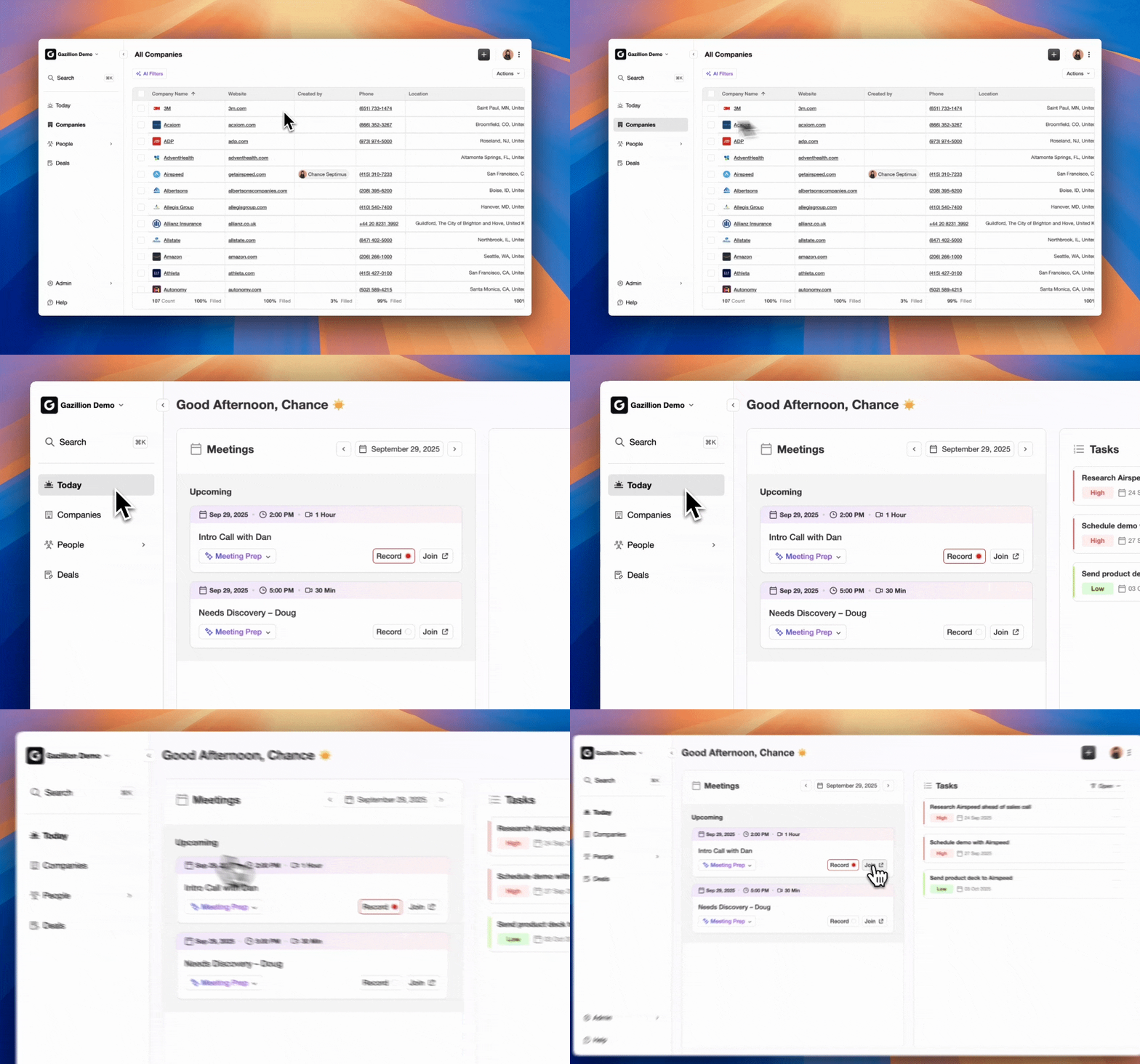
Coffee is an AI-native companion app that sits on top of Salesforce and uses an autonomous agent to handle the full data-entry lifecycle. It focuses on small to mid-market companies with 20–200 employees where the Head of Sales or RevOps owns Salesforce and wants one tool instead of multiple point solutions.

Admin Tasks Eliminated: Automatic contact and company creation, data enrichment, activity logging, meeting note capture and summarization, follow-up task and email drafting, and pipeline hygiene tracking.

Salesforce Objects And Fields Written To: Contacts, Accounts, Opportunities, Tasks, and Events. The Coffee Agent ingests unstructured data from emails and call transcripts and maps it to structured Salesforce fields, including custom fields. This approach covers both structured and unstructured data, which most native tools and point solutions do not address in a single product.

Strengths:
- After connecting to Google Workspace or Microsoft 365, the agent scans emails and calendars to create and enrich Contact and Account records, which can reduce reliance on separate enrichment tools.
- The AI Meeting Bot joins Zoom, Teams, and Meet calls to record, transcribe, and generate post-call summaries, action items, and follow-up emails. It structures notes using frameworks like BANT, MEDDIC, or SPICED so qualification data enters Salesforce consistently.
- Pre- and post-meeting briefings give reps attendee context and past interaction history, which cuts prep time without manual research.
- Pipeline Compare visualizes week-over-week Opportunity changes automatically and replaces manual CSV exports and pipeline review prep.
- Coffee is SOC 2 Type 2 and GDPR compliant and keeps customer data out of public model training.
Limitations: Deeper integrations beyond Google Workspace and Microsoft 365 currently run through Zapier, with more native integrations planned. Coffee does not target large enterprises with highly complex, custom Salesforce workflows that require multi-year security reviews.
Ideal Fit: Small to mid-market companies that rely on Salesforce, struggle with CRM adoption and data quality, and want one agent to replace several point solutions.

Pricing: Seat-based pricing with the agent’s labor included and no complex metering on LLM usage or processes. See coffee.ai/pricing for current tiers.
Implementation And Integrations: Simple OAuth authentication to Salesforce, email, and calendar. The agent starts working as soon as it connects, and standard setups do not require professional services.
See Coffee’s Plans For Your Team Size
Agentforce / Sales Cloud In Slack
Agentforce is Salesforce’s native agentic AI platform, embedded across Sales Cloud and accessible inside Slack. It focuses on enterprise workflow orchestration such as routing, approvals, and multi-step agent actions rather than everyday rep admin.
Admin Tasks Eliminated: Workflow routing, record update approvals, Slack-based field updates, and agentic task execution on configured triggers.
Salesforce Objects And Fields Written To: Any object that a Salesforce admin configures through Agentforce’s flow and agent builder, so scope depends on each org’s setup.
Strengths: Native to Salesforce with data staying inside the platform. It aligns with Salesforce’s permission model, validation rules, and object architecture. Agents running inside the CRM see deal context, account history, and engagement data natively.
Limitations: Requires significant admin configuration before reps feel value. Pricing sits at $50–$220 per user per month plus conversation fees on top of Sales Cloud licenses. It does not natively process unstructured data from call transcripts or external emails without extra configuration, so meeting note capture and enrichment often need separate tools.
Ideal Fit: Enterprise organizations with dedicated Salesforce admins that want native agentic automation and already use Sales Cloud Enterprise or Unlimited.
Pricing: Sold as an add-on to Sales Cloud with conversation-based billing.
Implementation And Integrations: Requires Salesforce admin configuration of agent topics, actions, and flows, and complexity grows with org customization.
Salesforce Mobile
Salesforce Mobile is the native iOS and Android app for Salesforce that gives field users access to records, dashboards, and basic data entry. It often appears in companion app evaluations because of mobile and offline needs, even though it is not a third-party app.
Admin Tasks Eliminated: Mobile record access and basic field updates. It does not automate data entry, enrichment, or meeting notes.
Salesforce Objects And Fields Written To: All standard and custom objects available to the user’s profile, subject to page layout and field-level security.
Strengths: Native offline mode for record access and basic edits, with sync when connectivity returns. It carries no extra license cost for Sales Cloud subscribers.
Limitations: Many legacy CRMs struggle in field scenarios because of inconsistent mobile functionality, slow interfaces, and limited offline access. Salesforce Mobile improves access but still relies on manual data entry.
Ideal Fit: Field sales teams that need mobile record access and are not yet ready to add a third-party automation layer.
Pricing: Included with Sales Cloud licenses.
Implementation And Integrations: Configured through Salesforce Mobile App Builder with no separate installation.
Einstein Activity Capture
Einstein Activity Capture is Salesforce’s native email and calendar sync feature that comes with the Einstein for Sales add-on.
Admin Tasks Eliminated: Manual logging of emails and calendar events to Salesforce Activity records.
Salesforce Objects And Fields Written To: Tasks and Events on related Contact, Lead, Account, and Opportunity records. It does not write to custom objects or populate custom required fields without extra configuration.
Strengths: As noted above, it saves an estimated 45–60 minutes per rep per week and significantly improves logged interaction completeness. It integrates cleanly with Gmail and Outlook.
Limitations: It does not capture meeting notes, generate summaries, or enrich Contact or Account records. Performance can be inconsistent with less common email providers, and personal email sync can occur when work and personal accounts share a domain. Offline support is limited. Total cost for a sales team typically lands at $125–$150 per user per month when you combine Sales Cloud Professional with Einstein for Sales.
Ideal Fit: Salesforce orgs that want a baseline activity sync layer and already run Sales Cloud Professional or higher.
Pricing: Included with Einstein for Sales at a $50 per user per month add-on price as of mid-2026.
Implementation And Integrations: Enabled in Salesforce Setup and completed with user-level email and calendar authentication.
Salesext
SalesExt is a browser extension and voice-to-CRM tool on the AppExchange that focuses on reducing post-call and post-meeting data entry through voice capture and structured field population.
Admin Tasks Eliminated: Post-call activity logging, voice-to-CRM field updates, and meeting note capture.
Salesforce Objects And Fields Written To: Tasks, Events, and configurable standard and custom fields on Contact, Account, and Opportunity records.
Strengths: Provides low-friction voice input for field reps. True voice-to-CRM assistants automatically populate structured CRM fields such as budget, decision process, and next steps, while simple voice memo apps only drop unstructured text into notes fields.
Limitations: Focuses on voice capture and logging and does not handle contact enrichment, pre-meeting briefings, or pipeline intelligence. Required field handling depends on org configuration and the vendor’s implementation of the bypass pattern.
Ideal Fit: Field sales teams with high call volume that want faster post-call logging and are not yet ready for a full AI companion layer.
Pricing: Subscription-based; see the AppExchange listing for current pricing.
Implementation And Integrations: Requires a browser extension install plus Salesforce OAuth, with moderate setup effort for custom field mapping.
Donna
Donna is an AI meeting assistant and voice-to-CRM tool on the AppExchange that focuses on post-meeting note capture and Salesforce field updates.
Admin Tasks Eliminated: Meeting note transcription, post-meeting CRM updates, and follow-up task creation.
Salesforce Objects And Fields Written To: Tasks, Events, and Notes on Contact, Account, and Opportunity records, with custom field mapping available depending on configuration.
Strengths: Built specifically for the post-meeting workflow. It reduces the 15–30 minutes of post-call admin that practitioner aggregations estimate at 3 to 7 hours per week for a rep with 10 to 15 external meetings.
Limitations: Does not handle contact enrichment, pre-meeting briefings, or pipeline analytics. Teams should verify offline behavior and required-field handling against their validation rules before rollout.
Ideal Fit: Teams whose main friction point is post-meeting note capture and CRM updates while other tools cover enrichment and pipeline intelligence.
Pricing: Subscription-based; see the AppExchange listing for current pricing.
Implementation And Integrations: Uses Salesforce OAuth plus a meeting platform integration such as Zoom, Teams, or Meet, with low setup complexity for standard objects.
Outreach
Outreach is a revenue orchestration platform with deep Salesforce integration that focuses on sales engagement sequencing, conversational intelligence, and pipeline management. Outreach reported 12x growth in AI credit consumption and 480% year-over-year AI ARR growth in the first half of 2026.
Admin Tasks Eliminated: Sequence execution, meeting recording and transcription through Kaia, pipeline stage updates, and follow-up drafting.
Salesforce Objects And Fields Written To: Contacts, Accounts, Opportunities, Tasks, and Events, with stage moves and next steps pushed back to Salesforce automatically.
Strengths: Provides enterprise-grade sequencing and conversational intelligence. Outreach became the first revenue orchestration platform available for private offers on Salesforce’s AgentExchange, which signals strong alignment with Salesforce’s ecosystem.
Limitations: Targets larger teams with dedicated RevOps support. Pricing and implementation complexity exceed those of focused point solutions, and contact enrichment does not match the depth of dedicated enrichment tools.
Ideal Fit: Mid-market to enterprise teams with at least 50 reps and a RevOps function that need sequencing, call intelligence, and Salesforce write-back in one platform.
Pricing: Enterprise subscription; contact Outreach for current pricing.
Implementation And Integrations: Requires a Salesforce managed package, admin configuration of field mapping, sequence templates, and governance rules.
Side-By-Side Comparison And Tradeoffs
After reviewing each app on its own, the differences become clearer when you compare them directly. The table below shows where each app focuses its automation and how it writes back to Salesforce, so you can see which tools cover your highest-friction admin work.
| App | Primary Admin Task Eliminated | Salesforce Objects Written To | Offline / Mobile Support |
|---|---|---|---|
| Coffee | Contact creation, enrichment, activity logging, meeting notes, pipeline hygiene | Contacts, Accounts, Opportunities, Tasks, Events | Mobile capabilities for note and activity capture |
| Agentforce / Sales Cloud In Slack | Workflow routing, Slack-based field updates, agentic task execution | Any object configured by admin | Salesforce Mobile app with offline support through Salesforce Mobile |
| Salesforce Mobile | Mobile record access and basic field edits | All objects per user profile | Native offline mode with sync on reconnect |
| Einstein Activity Capture | Email and calendar event logging | Tasks, Events on Contact, Lead, Account, Opportunity | Limited offline support |
| Salesext | Post-call voice logging, field updates | Tasks, Events, configurable standard and custom fields | Browser extension; mobile behavior depends on configuration |
| Donna | Meeting note transcription, post-meeting CRM updates | Tasks, Events, Notes on Contact, Account, Opportunity | Depends on meeting platform integration |
| Outreach | Sequence execution, call transcription, pipeline updates | Contacts, Accounts, Opportunities, Tasks, Events | Mobile app available with limited offline support |
Native tools such as Agentforce, Salesforce Mobile, and Einstein Activity Capture keep data inside the Salesforce trust boundary and avoid extra vendor security reviews. They trade that advantage for configuration overhead and limited coverage of unstructured data, so emails as text, call transcripts, and meeting notes still require manual work. SalesExt and Donna focus on voice and notes but leave enrichment and pipeline intelligence to other tools. Outreach covers sequencing and call intelligence at enterprise scale and introduces cost and complexity that many mid-market teams do not need. As noted in the takeaways, Coffee is the only solution here that handles both structured and unstructured data and can act as either the system of record or the agent feeding Salesforce.
Explore How Coffee Compares To Your Current Stack
What Is The Best App For Sales Reps Using Salesforce?
The comparison above shows that no single app wins on every dimension. The best choice depends on which admin task you want to eliminate first. Use this task-to-app mapping as a starting point.
- Automatic Data Entry And Enrichment: Coffee, which offers the most complete coverage for contact creation, enrichment, and structured write-back from unstructured sources.
- Slack-Based Record Updates And Workflow Routing: Sales Cloud in Slack and Agentforce.
- Mobile Record Access And Offline Field Edits: Salesforce Mobile.
- Email And Calendar Activity Sync: Einstein Activity Capture.
- Post-Call Voice Logging: SalesExt or Donna.
- Enterprise Sequencing And Call Intelligence: Outreach.
Match Coffee To Your Top Admin Pain Point
Salesforce Offline And Mobile Admin Capture
Offline data capture remains a major gap in many companion app evaluations. SPOTIO’s State of Field Sales survey found that field reps spend a median of five hours per week on CRM data entry alone, often reconstructing details from memory at the end of the day instead of capturing them in the moment.
Salesforce Mobile provides native offline access to records and basic edits, with sync when connectivity returns, but it still relies on manual entry. Einstein Activity Capture sits at the opposite end and requires a live connection for sync, with limited offline support. SalesExt and Donna fall in between and depend on their meeting platform integrations, so offline behavior varies by configuration.
True voice-to-CRM tools map speech to both standard and custom CRM fields and write directly to the CRM through a native integration with real-time, bi-directional sync. Tools that require manual export add another step instead of solving the offline problem. Coffee’s mobile capabilities support note and activity capture on the go and write data back to Salesforce when connectivity returns, which keeps deal state current without end-of-day data dumps.
See Coffee’s Mobile And Offline Workflow
Pre-Install Checklist: What To Check Before You Install
Trailblazer community complaints about companion app installs often mention permission conflicts, validation rule failures, and unexpected data overwrites. Use this checklist before installing any third-party companion app in a production Salesforce org.
- AppExchange Security Review Status: Confirm that the app has passed Salesforce’s security review. The review covers the managed package, connected apps, REST APIs, mobile apps, browser plugins, and desktop apps. An app that has not passed this review has not been vetted for data isolation or permission model compliance.
- Connected App Permissions And OAuth Scopes: Request the full list of OAuth scopes the app uses. Apps that request web or full scope must provide Salesforce with a comprehensive justification. Apply least-privilege access so an app that only writes Tasks and Events does not receive full org access.
- Required Field And Validation Rule Handling: Map every required field on the objects the app writes to. Salesforce enforces every active Validation Rule at save time and stops on the first failing rule. Ask the vendor whether they use the Custom Permission bypass pattern or expect you to change validation rules.
- Quota And Forecasting Compatibility: Confirm that the app preserves Opportunity Stage, Close Date, and Amount fields so Collaborative Forecasts and ForecastingQuota records stay accurate.
- Mobile And Offline Behavior: Test the app in a sandbox with no network connection and confirm whether it queues writes for sync or drops them.
- Data Residency And Compliance: Confirm where customer data is processed and stored, review SOC 2 Type 2 and GDPR documentation, and verify that the vendor does not use your data to train public models.
- Sandbox Test Before Production: Salesforce Dictionary recommends testing validation rule changes in a sandbox and deploying during off-hours because aggressive rules can block legitimate saves and trigger support tickets. Treat companion app installations with the same level of caution.
Review Coffee’s Security And Compliance Details
What To Automate First
Start with one high-impact automation, measure time saved per rep per week, and then expand. Most Salesforce orgs see the fastest gains from the four automations below.
- Meeting Notes To CRM: Post-call summaries and action items written directly to Opportunity and Contact records eliminate the 15–30 minutes of post-meeting admin that practitioner aggregations estimate at 3 to 7 hours per week for a rep with 10 to 15 external meetings.
- Voice-To-CRM Update: Voice-to-CRM updates typically take under 60 seconds of talking plus one tap, compared with 3–5 minutes of typing and clicking for manual entry. Target post-visit or post-call logging as the first workflow.
- Follow-Up Task Creation: Automated follow-up task and email drafting from meeting summaries ensures that next steps land in Salesforce Tasks immediately instead of being reconstructed from memory.
- Opportunity Hygiene: Automated pipeline tracking that flags stalled deals, missing close dates, and empty required fields replaces manual pipeline review prep and keeps forecast data current without a weekly cleanup pass.
Once one of these workflows shows measurable time savings and better data quality, expand automation to the next task on this list so your team builds momentum instead of facing a disruptive overhaul.