Written by: Doug Camplejohn, CEO & Co-Founder, Coffee | Last updated: September 14, 2026
Key Takeaways For Your 30-Day Plan
- Remove admin from the rep’s workflow by automating CRM data capture, meeting prep, follow-up, and reporting so more hours go to selling.
- Most sales reps spend only 28% to 30% of their week on direct selling, with 70% consumed by non-selling admin tasks like data entry and internal meetings.
- Apply a clear automate-versus-human decision rule: automate capture, formatting, and retrieval tasks while keeping humans on judgment calls and approvals.
- Consolidate fragmented sales tools into a single agent to cut context-switching, reduce tool fatigue, and shrink the average 10-tool stack reps currently manage.
- Measure selling hours rather than activity volume, and See How Coffee Reclaims Admin Time In 30 Days to prove productivity gains.
How Much Time Do Sales Reps Spend On Admin?
Non-selling activity totals roughly 70% to 72% of a B2B sales rep’s working week, leaving only 28% to 30% for direct selling activities such as calls, demos, and negotiations, according to Salesforce’s 2025 State of Sales report and a Forrester study of over 3,000 reps. This breakdown matters because it shows exactly which tasks your rollout must target.
- CRM data entry and pipeline updates: 17% of the week (6.8 hours)
- Internal meetings and syncs: 15% (6.0 hours)
- Email triage and admin: 14% (5.6 hours)
- Account research and call prep: 14% (5.6 hours)
- Scheduling and logistics: 12% (4.8 hours)
Start Reclaiming Admin Hours With Coffee and begin shifting that time back to selling this week.
According to market data shared by Coffee, 71% of sales reps say they spend too much time on data entry, leaving only 35% of their time for selling. The five admin categories this rollout attacks directly are CRM data entry, meeting prep, follow-up, reporting, and internal status updates.
Step 1: Audit Where Admin Time Actually Goes (Week 1)
Most admin-reduction efforts fail because teams automate before they measure. Without a baseline, there is no way to prove the work paid off.
The audit inventories time across the five categories above. The data sources are:
- Calendar data, with every block tagged as customer-facing, internal, prep, or admin
- CRM activity timestamps, including last activity and next activity per deal
- A one-week rep time log, self-reported and structured around the five categories
A calendar audit pulling 30 days of data for three to five reps and categorizing every event into customer-facing, internal, prep or research, and admin buckets flags any rep below 30% customer-facing time as a priority case. RevOps runs the audit and the sales manager validates the output, while reps contribute the time log that grounds it in reality. This baseline is the foundation every subsequent step depends on, because it anchors the before-and-after comparison of selling hours.
Step 2: The Automate-Vs-Human Decision Rule (Week 1)
Once the audit shows where the hours go, the next question is which of those tasks to hand off. The human-in-the-loop principle provides a clean decision rule: automate anything that is capture, formatting, or retrieval, and keep humans on judgment calls.
Reps review and approve work instead of creating or entering it. The machine lane handles repetitive steps, structured data handling, drafting, routing, reminders, and summaries. The human lane owns judgment calls, exceptions, approvals, sensitive communication, and anything that changes money, trust, or compliance exposure.
Applied to the five admin categories from the audit:
- CRM data entry: Automate contact creation, activity logging, and field population from email and calendar, because these steps require no human judgment.
- Meeting prep: Automate briefing generation, while the rep decides how to run the meeting.
- Follow-up: Let AI draft the follow-up email, and have the rep approve and send.
- Reporting: Automate pipeline change summaries, and let the manager interpret and act.
- Internal status updates: Automate activity logging so status stays current, and reserve human time for escalations and exceptions.
A GTM workflow is safe to automate when it is high-volume, rule-based, reversible, and does not trigger customer-facing financial commitments without a human review step. This rule removes guesswork about what to hand to an agent.
Step 3: Automate CRM Data Entry, Meeting Prep, And Follow-Up (Week 2)
With the audit complete and the decision rule in place, focus Week 2 on automating the worst three to five tasks surfaced. The target is the full admin surface, not only data entry.
This is where Coffee executes the plan. Coffee is the CRM Agent built to remove admin from the rep’s workflow entirely. Upon connection to Google Workspace or Microsoft 365, the Coffee Agent:
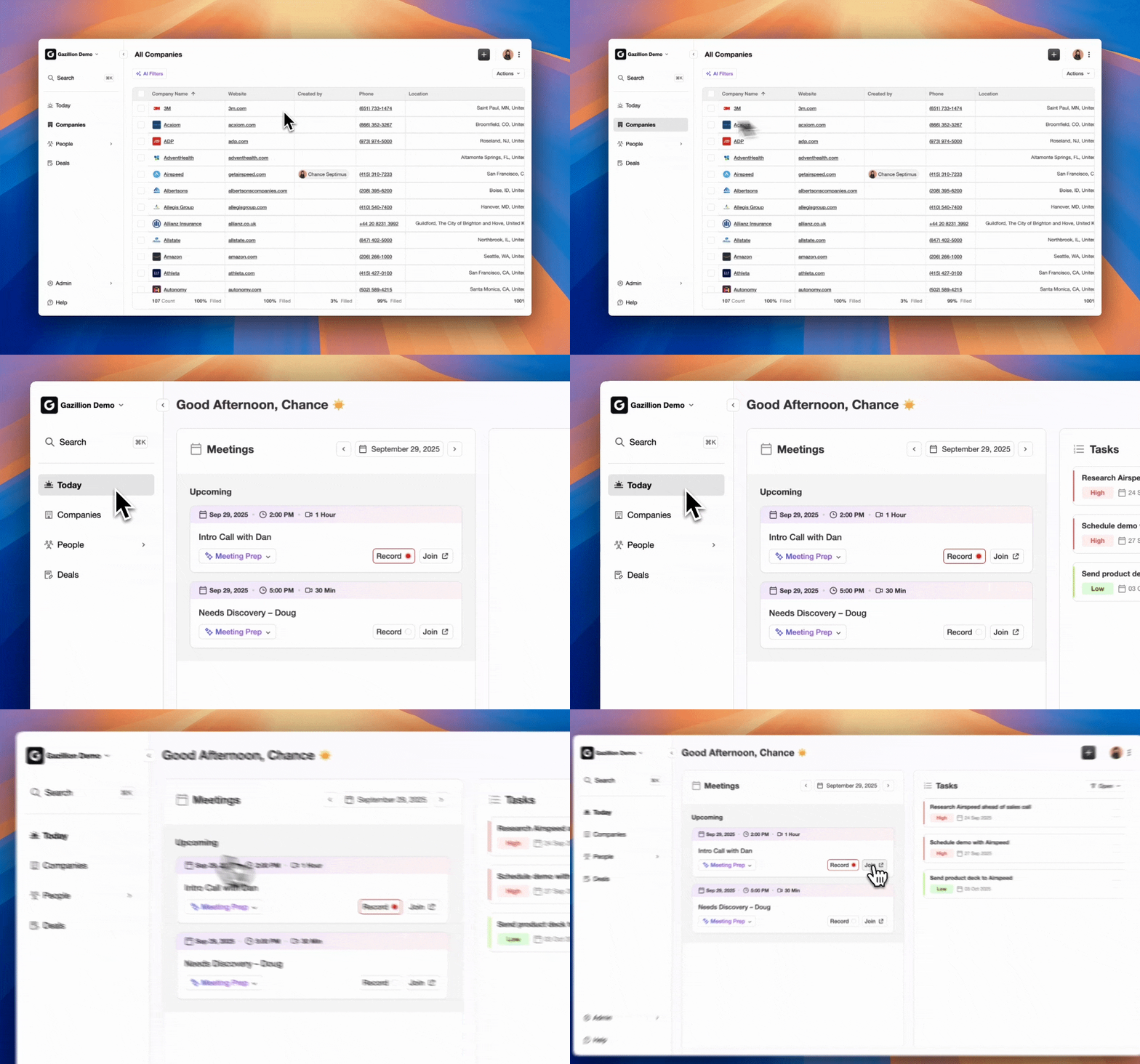
- Auto-creates and enriches contacts and companies from email and calendar, eliminating manual entry
- Logs last activity and next activity autonomously, keeping deal state current
- Preps reps with a “Today” briefing page covering attendees, roles, and past context
- Joins Zoom, Teams, and Meet calls to record and transcribe
- Drafts follow-up emails in Gmail for the rep to review and send
Coffee introduced Custom Meeting Briefings and Summaries in February 2026. Users can define exact formats and focuses, from high-level executive summaries to granular technical breakdowns. Improved summary templates released in November 2025 are customizable to match workflows and writable back to Coffee, HubSpot, or Salesforce.

Coffee structures notes to BANT, MEDDIC, or SPICED so qualification data enters the system consistently and reps do not need to interpret formats. Coffee’s AI search on deals, released in January 2026, answers natural-language questions such as “Which deals are stuck in negotiation?” or “What is closing this month?” This capability replaces manual pipeline interrogation.

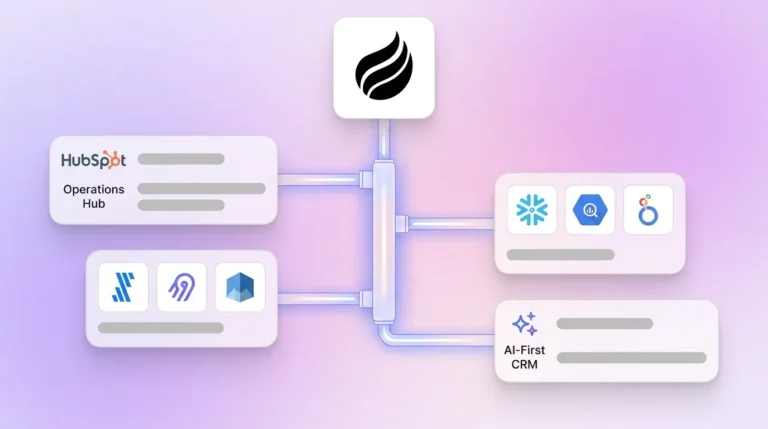
Coffee deploys as a standalone AI-first CRM for teams that want a modern system of record. It also deploys as a Companion App on top of Salesforce or HubSpot for teams already committed to those platforms. In both cases, the agent handles the data-in work so the system stays accurate without human effort.
Sellers using AI agents cut meeting preparation time by up to 50%, saving roughly 23 to 26 minutes per meeting, and reduce administrative work by 15 to 21 minutes per day. That is recoverable capacity, and it compounds across a full team.
Put The Coffee Agent To Work For Your Team This Week
Step 4: Consolidate The Stack To Kill Tool Fatigue (Week 3)
Automation only pays off when reps are not juggling ten logins to use it. Week 3 focuses on consolidation so the new workflows live in one place instead of across a fragmented stack.
The consolidation test is simple: count how many tools a rep touches to close one deal. The average B2B sales rep now touches an average of 10 tools to close a single deal, and each new tool added to fix a gap creates two new gaps: an integration problem and a training burden.
The typical fragmented stack uses a CRM for records, ZoomInfo for data enrichment, Salesloft for outreach sequencing, and Fathom for call recording. Each requires its own login, its own data export, and its own manual sync. Each transition between applications costs 15 to 25 minutes of productive focus as the brain re-establishes context, and a rep working across ten platforms can make 20 to 30 context switches per day.
Coffee consolidates these jobs into one agent:

- Lead Finder replaces standalone prospecting databases. Reps search for people and companies matching their ICP using natural language, and lists live directly in Coffee ready for enrichment and outreach.
- Campaigns replace dedicated sequencing tools. Multi-step AI-generated email sequences run natively from the rep’s own connected mailbox, with stop-on-reply enabled by default.
- Visitor Identification turns anonymous website traffic into named leads with Suggested Leads. Coffee identifies which specific individuals inside a visiting company match the buyer persona, not only the company itself.
- Pipeline Compare replaces manual CSV exports. The agent visualizes week-over-week pipeline changes automatically.
This framing centers on reducing context switching and cost. Fewer tools mean fewer logins, fewer data reconciliation tasks, and fewer subscriptions to justify at renewal.

Step 5: Measure Selling Hours, Not Activity Volume (Week 4)
Week 4 proves whether the rollout worked by shifting measurement from activity volume to selling hours. Activity volume, such as calls made or emails sent, is an input metric that shows effort but not time spent on work that moves deals.
The data sources for measuring selling hours match the Week 1 audit: calendar data and CRM activity timestamps. The focus for managers shifts from calls made and emails sent to hours spent selling and admin hours reclaimed. The 2024 Bridge Group report, tracking 312 SaaS teams, found that 71% of quota misses correlated with a selling-time drop in the preceding eight weeks. Selling-time share therefore acts as an early leading indicator of productivity decline.
Coffee’s Pipeline Compare visualizes week-over-week pipeline changes, including progressed deals, stalled opportunities, and new additions, so pipeline reviews become strategic discussions instead of interrogation sessions. Coffee’s Intelligence layer, introduced in February 2026, allows users to define and store deep context on business model, product specifics, ICP, and competitors for tailored AI suggestions and insights. The output of every review stays grounded in accurate, agent-captured data rather than rep memory.
What Is The 70/30 Rule In Sales?
The 70/30 rule in sales is a selling-time protection framework. The goal is to invert the current ratio, where 70% of the week goes to non-selling work, so the majority of the week goes to selling.
The Week 1 audit establishes the baseline. The automation and consolidation steps in Weeks 2 and 3 close the gap. Week 4 measurement confirms whether the inversion happened.
The 80/20 rule in sales is a prioritization framework: identify the 20% of accounts and activities that produce 80% of revenue, and let automation absorb the rest. Just 14% of sellers drive 80% of revenue, representing an 11x performance gap between top performers and everyone else. Automation narrows that gap by removing the work that prevents the other 86% from spending time where it matters.
The named framework to repeat to your team is the capture-prep-follow-up-report automation loop. Every task in those four categories is a candidate for the agent. Every judgment call stays with the rep.
Frequently Asked Questions
Why Admin Work Consumes So Much Sales Time
As noted earlier, roughly 70% of a B2B sales rep’s working week goes to non-selling work. The largest single category is CRM data entry and pipeline updates at 17% of the week. Coffee removes the capture, prep, follow-up, and reporting work from the rep’s plate by handling data entry, meeting briefings, call transcription, and follow-up drafting so reps spend their time selling.
How To Measure Sales Rep Productivity In Practice
The most reliable measure is selling hours as a share of the working week, tracked using calendar data and CRM activity timestamps instead of self-reported surveys. Pair selling-time share with pipeline generated per rep and quota attainment to connect time allocation to revenue outcomes. Coffee’s Pipeline Compare provides week-over-week pipeline visibility so managers can run strategic reviews grounded in agent-captured data. The baseline from the Week 1 audit gives you the before number, and the Week 4 measurement gives you the after.
What Should Be Automated Versus Left To Humans?
Automate anything that is capture, formatting, or retrieval, such as contact creation, activity logging, meeting briefing generation, call transcription, and follow-up drafting. Keep humans on judgment calls, including final send approval, pricing discussions, deal strategy, objection handling, and any decision that changes a customer commitment. The practical implementation is the draft-then-approve pattern, where Coffee drafts the follow-up email and the rep approves and sends.
How Coffee Works With Salesforce And HubSpot
Coffee deploys as a Companion App on top of Salesforce or HubSpot, syncing data, enriching records, and writing insights back to the primary CRM without replacing it. Teams already committed to Salesforce or HubSpot get the agent’s labor, including automatic contact creation, activity logging, meeting briefings, call transcription, and drafted follow-ups, without migrating their system of record.
Coffee also deploys as a standalone AI-first CRM for teams that want a modern alternative. Coffee is SOC 2 Type 2 and GDPR compliant, does not train public models on customer data, and uses simple seat-based pricing where the agent’s unlimited labor is included, avoiding complex metering on usage or processes.
Conclusion: Prove Selling Hours Went Up
The 30-day sequence is clear: audit where admin time goes in Week 1, apply the automate-versus-human decision rule in the same week, automate CRM data entry, meeting prep, and follow-up in Week 2, consolidate the stack to eliminate tool fatigue in Week 3, and shift measurement from activity volume to selling hours in Week 4.
Manual admin is a workflow design problem rather than a discipline problem. Coffee is the CRM Agent that executes this plan so reps review and approve work instead of creating and entering it. The agent handles capture, prep, follow-up, and reporting. The rep handles selling.
Prove Selling Hours Went Up With Coffee