Written by: Doug Camplejohn, CEO & Co-Founder, Coffee | Last updated: August 21, 2026
Key Takeaways for Sales and RevOps Leaders
- Manual CRM data entry consumes 8–12 hours per rep each week, leaving only 28% of their time for actual selling.
- The Coffee Agent ingests both structured and unstructured data to automate lead capture, enrichment, scoring, and activity logging.
- Seven core workflows, including AI lead scoring, zero-touch call summaries, and conditional follow-up sequences, can reclaim 8–12 hours per rep per week while driving 95%+ pipeline accuracy.
- Coffee supports both Companion App (Salesforce/HubSpot) and Standalone CRM deployments with unlimited agent labor on seat-based pricing.
- Eliminate repetitive CRM tasks and reclaim hours for selling—see the agent running live on your CRM in a focused 15-minute session.
Seven Coffee Workflows That Give Reps 8–12 Hours Back
Each workflow below includes a trigger, a Coffee Agent action, a stop-condition, and a quantified outcome. This structure gives every automation clear entry and exit rules and prevents runaway processes that spam prospects or corrupt data. Revenue Velocity Lab’s Q2 2025–Q1 2026 benchmark of 938 B2B companies found that AI-augmented reps generate 41% more revenue per rep while running 18% fewer activities per month. To capture similar gains, measure your rollout against these success criteria:
| Metric | Target | Measurement Window |
|---|---|---|
| Hours reclaimed per rep per week | 8–12 | 30 days post-activation |
| Pipeline data accuracy | 95%+ | Weekly pipeline review |
| Week-over-week pipeline variance | <5% | Rolling 4-week average |
Workflow 1: Automatic Lead Capture and Enrichment
Trigger: Inbound email, calendar invite, web form submission, or Visitor ID pixel hit.
Coffee Agent action: The agent scans Google Workspace or Microsoft 365, auto-creates the contact and company record, appends job title, funding data, and LinkedIn profile via licensed enrichment partners, and logs the originating interaction as the first activity.

Stop-condition: If the email domain matches an existing customer or active opportunity, the agent updates the existing record instead of creating a new one and flags the match for rep review.
| Outcome | Benchmark |
|---|---|
| Time saved on manual contact creation | 25% reduction in data research time |
| Enriched lead conversion lift | 20–30% better than unenriched leads |
Pro Tip: Coffee’s deduplication logic checks email, phone, and company name before writing any record. Any automation that creates contacts without a prior match check will generate duplicate records that corrupt downstream scoring, and Coffee prevents that by running this check automatically.
Workflow 2: AI Lead Scoring and Intelligent Routing
Trigger: New or enriched contact record in Coffee, Salesforce, or HubSpot.
Coffee Agent action: The agent structures qualification data against BANT, MEDDIC, or SPICED frameworks from call transcripts and email context, then assigns a fit tier and routes the lead to the correct rep, territory, or sequence.
Stop-condition: Leads missing key firmographic fields or flagged against suppression lists, such as existing customers or opted-out contacts, enter a hold queue for manual review instead of routing to sales.
| Lead Tier | Score Range | Routing Action | Outcome |
|---|---|---|---|
| Hot | 8–10 | Route to senior AE, send Slack alert | 2–3x more meetings per 100 contacts |
| Warm | 4–7 | Route to SDR, enroll in sequence | Standard SLA follow-up |
| Cold | 1–3 | Enroll in nurture campaign | Re-score on next intent signal |
Pro Tip: Coffee’s agent stores your ICP, buyer persona, and competitor context in its Intelligence layer, introduced in February 2026. Scoring criteria then update from a text field instead of requiring a code change.
Workflow 3: Conditional Follow-Up Sequences
Trigger: Lead tier assigned and no reply detected within the defined SLA window.
Coffee Agent action: The agent enrolls the prospect in a multi-step email sequence sent from the rep’s own connected mailbox with real sender signature. Built-in send throttling protects sender reputation.
Stop-condition: Stop-on-reply is on by default. The moment a prospect responds, the agent pauses the sequence so no automated email follows a live conversation.
| Condition | Agent Behavior |
|---|---|
| Prospect replies | Sequence paused immediately, rep notified |
| Prospect books meeting | Sequence paused, meeting briefing triggered |
| Prospect unsubscribes | Sequence cancelled, DNC flag written to CRM record |
| Step 4 sent, no reply | Lead downgraded to nurture tier, sequence ends |
Common Mistake: Commonly cited sales statistics show that 80% of sales require five or more follow-ups while 44% of reps give up after one, though these figures are attributed to sources such as Spotio rather than Salesforce. Coffee’s sequences run to completion without rep intervention unless a reply stops them.
Workflow 4: Zero-Touch Activity Logging and AI Call Summaries
Trigger: Call ends on Zoom, Teams, or Google Meet.
Coffee Agent action: The AI meeting bot records and transcribes the call, generates a structured summary with next steps mapped to BANT, MEDDIC, or SPICED, drafts a follow-up email in Gmail for rep review, and writes the summary back to the contact, account, and opportunity records in Salesforce or HubSpot.

Stop-condition: If identity resolution is uncertain, such as an unrecognized caller, the agent abstains from writing to a record and flags the call for manual association.
| Outcome | Benchmark |
|---|---|
| Post-call note entry time | Reduced from 15–20 minutes to under 2 minutes |
| Weekly hours saved on CRM logging | 6 hours per rep per week |
Pro Tip: Coffee’s improved summary templates, released November 2025, are customizable to match your workflow and write back to Coffee, HubSpot, or Salesforce. Map templates to Salesforce required fields during setup to prevent incomplete records from blocking pipeline stage advancement.

Workflow 5: Pipeline-Stage Automation and Risk Alerts
Trigger: Deal inactivity threshold crossed or stage-entry criteria not met within the defined window.
Coffee Agent action: Pipeline Compare visualizes week-over-week changes, including progressed deals, stalled opportunities, and new additions, without a CSV export. Risk alerts surface in Slack in real time so managers can intervene early.
Stop-condition: If a rep has manually flagged a deal as “on hold,” the agent suppresses risk alerts for that record for the defined hold period.
Common Mistake: A Bain report from April 2025 found that 70% of companies struggle to integrate sales plays into CRM and revenue technology, with more than half citing inadequate data foundations. Pipeline Compare works because Coffee’s agent keeps the data foundation accurate before any visualization runs.
Workflow 6: Native Multi-Step Campaigns from One Agent
Trigger: Lead Finder list built or new contact added to a dynamic list matching campaign criteria.
Coffee Agent action: The agent generates subject lines, body copy, and send delays for every step from a plain-English description. Dynamic lists auto-enroll new contacts as the campaign runs, and outreach sends from the rep’s own mailbox, not a bulk-sending domain.
Stop-condition: Stop-on-reply fires at the moment of any prospect response. Campaigns can be paused, resumed, or deleted at any time from the Coffee dashboard.
Pro Tip: This workflow replaces separate Outreach or Salesloft subscriptions. Per-step stats show emails sent and replies received, with click-through to see exactly who received each step, which closes the attribution loop inside one agent.
Workflow 7: Visitor Identification That Creates Named Prospects
Trigger: Anonymous visitor hits a tracked page and Coffee’s Visitor ID pixel fires.
Coffee Agent action: The agent infers name, title, email, LinkedIn profile, company, pages visited, time on site, and visit frequency, then surfaces a real-time Slack notification. Suggested Leads logic highlights the two or three specific individuals inside the visiting company who match your buyer persona, not just the company name.

Stop-condition: Visitors from existing customer domains are flagged as expansion opportunities and routed to the account owner instead of entering a new-business sequence.
| Outcome | Detail |
|---|---|
| Anonymous traffic converted | Named prospect with enrichment pre-filled, ready for LinkedIn outreach or campaign enrollment |
| Differentiator vs. RB2B / Warmly | Competitors surface company or raw people lists, while Coffee surfaces the specific humans matching your ICP |
Pro Tip: Deploy the Visitor ID pixel on paid landing pages to capture intent from ad spend that would otherwise disappear into anonymous traffic reports.
Watch all seven workflows run on your actual CRM data in a 15-minute session and see lead capture, scoring, sequences, and pipeline automation live.
Choosing Between Companion App and Standalone CRM
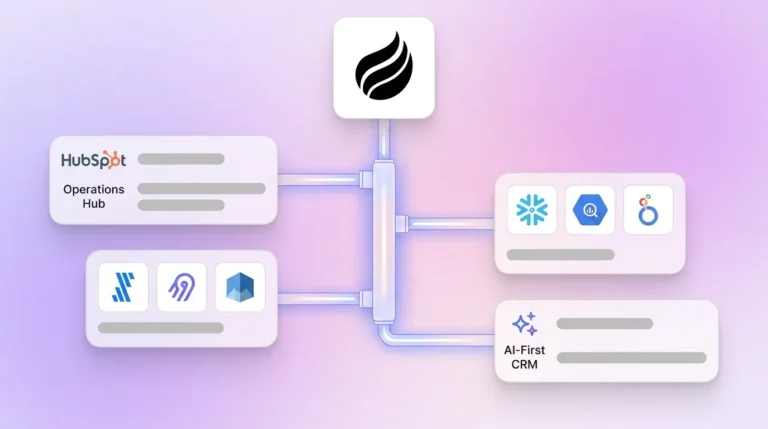
Now that the seven core workflows are clear, the next step is deciding where these automations will run. Coffee operates in two deployment models that align with your current stack and team maturity. If your team is committed to Salesforce or HubSpot, the Companion App writes back to your existing system of record. If you have outgrown spreadsheets but want to avoid legacy CRM overhead, the Standalone CRM becomes the system of record. Both models include unlimited Coffee Agent labor on seat-based pricing with no metering on LLM usage or automated processes.
| Dimension | Companion App | Standalone CRM |
|---|---|---|
| Company size | 10–200 employees committed to Salesforce or HubSpot | 1–20 employees, nascent or early sales team |
| Tech stack | Existing Salesforce or HubSpot instance | Replacing spreadsheets, Notion, or Pipedrive |
| Quota complexity | Multi-rep quotas, territories, forecasting hierarchies | Founder-led or small-team selling, simple quota structure |
| Ideal for | Head of Sales or RevOps needing data quality without migration | CEO or early sales hire wanting an automated system from day one |
| Agent write-back | Writes to Salesforce or HubSpot fields, required fields, and custom objects | Coffee is the system of record, no secondary CRM needed |
| Pricing model | Seat-based, unlimited agent labor included | Seat-based, unlimited agent labor included |
Coffee’s deep understanding of Salesforce and HubSpot integrations, including quotas, forecasting, and required fields, was built iteratively through product releases from August 2025 through February 2026. Newer alternatives like Day.ai and Clarify lack this integration depth, which creates friction for teams with established CRM configurations.
Advanced Configurations and How to Measure Impact
Once you have selected your deployment model and the seven core workflows are running, you can extend the agent’s capabilities further. These advanced configurations are optional, yet each one compounds the value of your existing workflows.
- Custom API prompts: Custom prompts let teams script bespoke briefing formats that pull data from multiple sources, such as combining deal history, competitor mentions from call transcripts, and open invoice status from the QuickBooks integration into a single pre-meeting brief. Coffee’s QuickBooks integration, launched February 2026, automatically syncs invoices and payment statuses into the CRM in real time.
- Forecasting model layering: Forecasting model layering replaces manual forecast roll-ups by letting leaders ask natural-language questions like “Which deals are stuck in negotiation?” or “What is closing this month?” Coffee’s AI search on deals, released January 2026, answers these questions instantly.
- Visitor ID on paid landing pages: Visitor ID on paid landing pages closes the loop from paid click to outbound sequence by converting ad spend into named prospects with enrichment pre-filled, all without leaving the agent.
To verify you are hitting the targets established earlier, which include 8–12 hours reclaimed and 95% accuracy, break the time savings into component categories. Revenue Velocity Lab’s 2026 benchmark shows that fully automated teams save 6 hours on CRM logging and notes, 4.5 hours on meeting scheduling, 3.4 hours on report and forecast generation, 2.5 hours on prospect research, and 1.8 hours on email drafting. Track these categories separately in your first 30 days; if one category falls short, that workflow needs configuration adjustment before you scale advanced configurations.
A 2026 Oliver Wyman and proSapient survey of 100 sales leaders already using agentic AI found that 89% reported a positive impact on sales growth and 87% on sales rep productivity. These gains depend on a clean data foundation before automation runs.
Frequently Asked Questions
How can I automate my sales process?
Sales process automation starts with identifying where reps lose the most time to repetitive, rule-based tasks such as contact creation, activity logging, follow-up sequencing, and pipeline reporting. The correct build order is data enrichment and hygiene first, then workflow automation such as lead routing and follow-up sequences, then predictive intelligence including lead scoring, and finally conversational interfaces such as AI-drafted emails and meeting summaries. This sequence works because each layer depends on the quality of the one before it, so lead scoring accuracy relies on clean enrichment data and AI-drafted emails rely on correct routing. Coffee’s agent handles all four layers by connecting to Google Workspace or Microsoft 365 and writing structured outputs back to Salesforce, HubSpot, or Coffee’s own Standalone CRM, which keeps the foundation solid before automation runs. The result is a sales process where reps focus on discovery conversations and negotiation, the judgment-based steps that cannot be automated, while the agent handles everything else.
What are examples of sales automation?
Practical examples of sales automation in 2026 include:
- Automatic contact and company creation from inbound emails and calendar events
- Real-time lead enrichment with firmographic, technographic, and intent data appended before the record reaches a rep
- AI lead scoring that assigns a fit tier and routes the lead to the correct rep or sequence without human intervention
- Zero-touch activity logging that writes call summaries, next steps, and email interactions to CRM records automatically after every interaction
- Multi-step email campaigns with stop-on-reply logic that pause the moment a prospect responds
- Pipeline Compare reports that visualize week-over-week deal changes without a CSV export
- Visitor identification that converts anonymous website traffic into named prospects with enrichment pre-filled
Coffee’s agent performs all of these natively, which removes the need for separate tools like ZoomInfo, Outreach, Salesloft, Gong, and RB2B and simplifies your stack.
Does CRM automation work with Salesforce?
Yes. Coffee’s Companion App deploys as an intelligent layer on top of an existing Salesforce instance. After a simple OAuth authentication, the Coffee Agent syncs data bidirectionally, enriches records, and writes call summaries, activity logs, and deal updates back to Salesforce fields, including required fields and custom objects, without rep input. Coffee has the deep Salesforce integration knowledge described in Workflow 2, including quota structures, forecasting hierarchies, and required field configurations, which distinguishes it from newer CRM alternatives that lack this depth. All automated writes are logged with a full audit trail, and field-level write rules can be scoped to prevent the agent from touching sensitive fields such as deal owner or contract value without human approval.
How do I stop automated emails when a prospect replies?
Coffee’s Campaigns feature has stop-on-reply enabled by default. The moment a prospect sends any reply to a sequence email, the Coffee Agent detects the inbound message, immediately pauses that prospect’s sequence, and notifies the rep. No additional configuration is required. The same logic applies when a prospect books a meeting, so the sequence pauses automatically. If a prospect unsubscribes, the sequence is cancelled and a do-not-contact flag is written back to the CRM record, which prevents any automated email from reaching a prospect after a real conversation has started and protects both sender reputation and the prospect relationship.
Conclusion: Turn Manual CRM into an Automated Sales Engine
Manual CRM entry is a solvable problem in 2026 when automation ingests both structured and unstructured data and writes back to your system of record without requiring reps to touch the interface. The seven workflows above, including lead capture and enrichment, AI scoring and routing, conditional follow-up sequences, zero-touch activity logging, pipeline-stage automation, native multi-step campaigns, and visitor identification, collectively return 8–12 hours per rep per week to selling time and drive pipeline accuracy to 95%. The Coffee Agent combines all seven workflows in a single platform that can run as a Companion App on top of Salesforce or HubSpot or as a Standalone CRM for early-stage teams, which removes the need for separate tools like ZoomInfo, Outreach, Salesloft, Gong, and RB2B.
See how Coffee reclaims 8–12 hours per rep in a live 15-minute session on your Salesforce or HubSpot data.