Written by: Doug Camplejohn, CEO & Co-Founder, Coffee | Last updated: August 8, 2026
Key Takeaways for B2B Visitor Tracking
- Real-time website visitor tracking identifies anonymous B2B traffic at the person level and routes enriched records into sales workflows within seconds.
- Person-level match rates of 10–25% are realistic. Tools claiming higher numbers usually rely on repeat visits or loose criteria.
- Automated CRM routing with deduplication and buyer-persona matching eliminates manual data entry and reduces duplicate records.
- Privacy compliance (GDPR/CCPA/SOC 2) and transparent pricing are essential evaluation criteria for any visitor identification platform.
- Coffee is the only agent that converts anonymous B2B traffic into named, persona-matched, enriched CRM records without a single manual entry. See pricing and start your trial.
How Real-Time Website Visitor Tracking Works
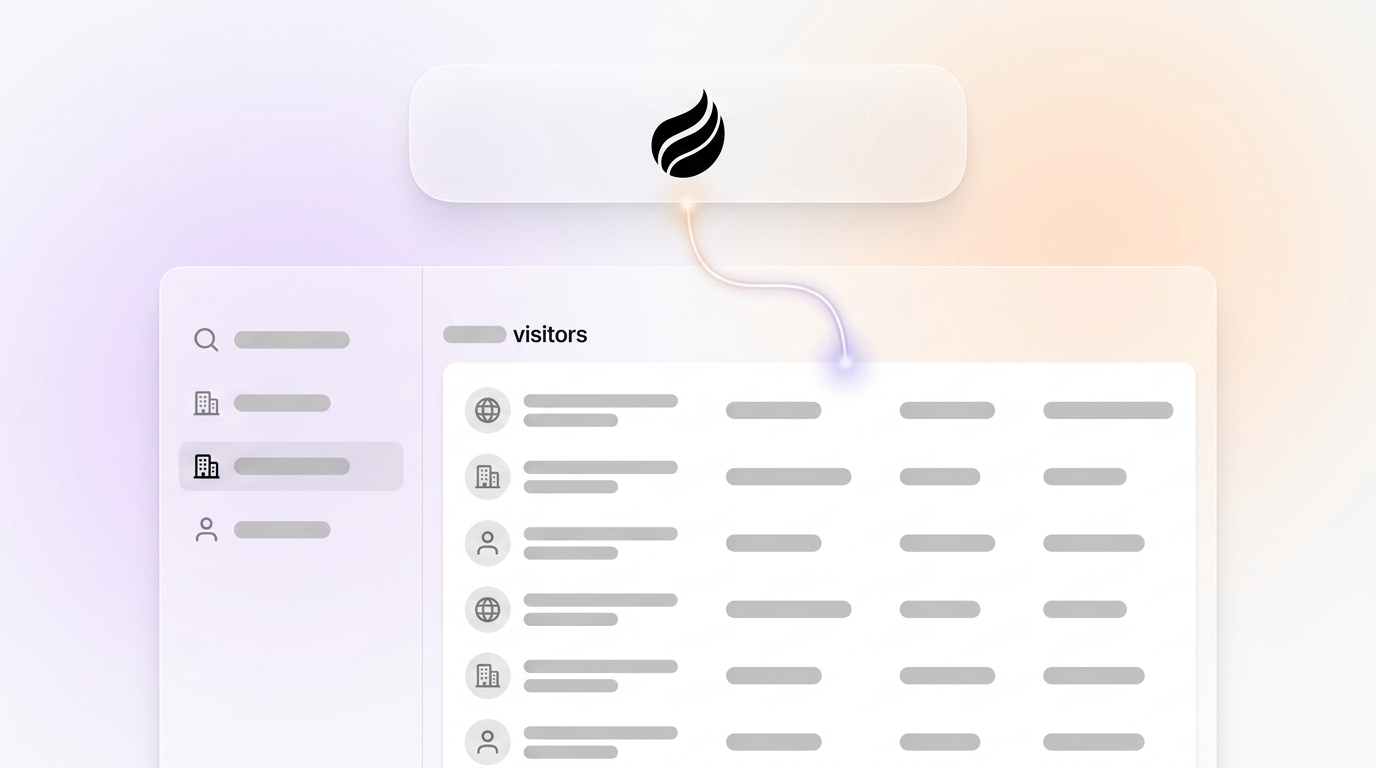
Real-time website visitor tracking identifies and records who visits a website while those sessions occur, then routes that intelligence into sales and marketing workflows before the visitor leaves. It operates across three layers: behavioral tracking (what happened), visitor identification (who was there), and marketing attribution (what that visit was worth in pipeline).
Here is the typical flow:
- A JavaScript pixel fires when a visitor lands on the site and captures session data including pages viewed, time on site, referrer, and visit frequency.
- The platform resolves the visitor’s IP address against a proprietary database of corporate IP ranges to determine the company.
- Person-level tools layer identity graphs, cookie sync, and deterministic email matching to return a named individual with job title, email, and LinkedIn profile.
- The identified visitor is scored against ICP criteria and behavioral signals such as pricing-page visits or return frequency.
- Qualified visitors are routed automatically into the CRM, a sales engagement sequence, or a Slack alert, without manual data entry.
Roughly 97% of B2B website visitors leave without filling out a form, so identification becomes the primary way to recover that traffic as actionable leads.
How to Evaluate Real-Time Visitor Tracking Tools
Heads of Sales and RevOps at B2B SaaS companies can evaluate real-time website visitor tracking software on five core dimensions.
- Person-level identification: Company-level resolution is table stakes. Person-level match rates realistically sit at 10–25% for US traffic. Vendors claiming 60% or more usually count repeat visits or use looser matching criteria. The real differentiator is whether the tool returns a named individual, not just a company logo.
- Real-time notifications: Platforms that deliver Slack alerts within seconds of an ICP-fit account visiting a high-intent page enable sales teams to respond within hours rather than days. Faster response times improve conversion rates in a measurable way.
- CRM routing without manual entry: Without automated matching logic, visitor identification tools can create new CRM records with high duplication rates. Automated deduplication and field mapping should be the default path, not a manual fallback.
- Privacy compliance (GDPR/CCPA/SOC 2): Company-level identification via reverse-IP lookup is generally permitted as legitimate-interest processing under GDPR Article 6(1)(f), but identifying individuals requires consent or another lawful basis. Any tool handling person-level data must be SOC 2 Type 2 certified and support consent management platform integration.
- Pricing transparency: Seat-based or session-based pricing with published tiers gives clear total cost of ownership. Opaque enterprise quotes make budgeting and comparison difficult.
Comparing Coffee, RB2B, Warmly, and Lead Forensics
The table below compares Coffee, RB2B, Warmly, and Lead Forensics on sales actionability metrics that matter most to B2B SaaS revenue teams. All identification rate figures reflect US traffic benchmarks.
| Capability | Coffee | RB2B | Warmly | Lead Forensics |
|---|---|---|---|---|
| Person-level match rate (US) | Person-level via identity graph and enrichment | 40–45% of US traffic | 15–25% of US traffic | Company-level only via reverse IP |
| Identification output | Named individual: name, title, email, LinkedIn, plus Suggested Leads matched to buyer persona | LinkedIn profile returned per identified visitor | Aggregates 20+ providers including Clearbit and Bombora, returns company and people list | Company name, firmographics, pages visited |
| Real-time Slack alerts | Yes, filtered to ICP-fit visitors on high-intent pages | Yes, Slack notification per identified visitor | Yes | Email alerts, Slack via third-party integration |
| Automatic CRM routing | Yes, one-click enrichment, auto-enrollment into Campaigns, deduplication built in | Zapier or webhook required for CRM push | Native HubSpot and Salesforce sync | Native Salesforce and HubSpot integration |
| Buyer-persona matching (Suggested Leads) | Yes, surfaces 2–3 specific contacts inside the visiting company matched to your defined buyer persona | No | No | No |
| Native CRM and outreach in one agent | Yes, Visitor ID, CRM, Campaigns, and Lead Finder in one platform | No, standalone tool | No, standalone tool | No, standalone tool |
| SOC 2 Type 2 | Yes | Not publicly confirmed | Yes | Yes |
The critical gap across all competitors is clear. None closes the loop from pixel hit to persona-matched outreach inside a single agent. Most teams currently assemble a five-tool stack, covering identification, enrichment, sales engagement, dialer, and prioritization, that does not integrate. Coffee removes that fragmentation.
From Pixel to Pipeline with Coffee
Coffee’s Visitor Identification workflow moves a session from anonymous to pipeline-ready in four steps, with no human data entry required at any stage.
- Pixel installation: Drop a single JavaScript snippet into the
<head>tag of the site. Once placed, Coffee verifies installation immediately and begins identifying visitors, so implementation finishes quickly with no additional engineering resources beyond that initial tag placement. - Real-time Slack alert: When a visitor matching the defined ICP lands on a high-intent page such as pricing, case studies, or a competitor comparison, Coffee sends a Slack notification. The alert contains the visitor’s name, job title, company, pages viewed, visit frequency, and a direct link to the enriched record.
- One-click enrichment and CRM routing: With a single click, the prospect is added to Coffee with all enrichment pre-filled, including job title, email, LinkedIn profile, funding data, and behavioral history. Deduplication logic checks for existing records by email, then by company domain plus name, before creating a net-new contact. This process prevents duplicate records that are common in manual workflows.
- Suggested Leads and auto-enrollment into Campaigns: Where competitors surface a company name or a raw list of employees, Coffee’s Suggested Leads feature uses the defined buyer persona to recommend the two or three specific individuals inside that visiting company most worth contacting. LinkedIn profiles appear for instant outreach. The identified visitor or the suggested contacts can be auto-enrolled into a multi-step email Campaign running from the rep’s own connected mailbox, with stop-on-reply enabled by default.
Connecting automated workflows from visitor identification to CRM can deliver improved lead quality and shorter sales cycles compared to manual, siloed processes. Coffee’s agent handles the entire chain of identification, enrichment, routing, and outreach inside one platform.
Start converting your anonymous traffic into enriched pipeline records automatically.
Privacy and Compliance Checklist for 2026 Deployments
The regulatory environment for real-time website visitor tracking tightened significantly in 2025 and 2026. In 2025, European regulators issued €1.2 billion in GDPR penalties, including a €325 million CNIL fine against Google for cookie consent failures. The checklist below covers the minimum requirements for a compliant B2B deployment.
- Consent before tracking: All non-essential cookies and tracking scripts must be blocked from executing before consent is obtained. Pre-ticked boxes and implied consent via browsing are invalid under GDPR Article 4(11).
- Symmetrical consent UI: Accept All, Reject All, and Customize options must appear with equal visual prominence on the first layer of the consent banner. The FTC’s 2022 report on dark patterns prohibits burying reject options or making opt-out multi-step while acceptance is one click.
- Lawful basis documentation: Company-level identification via reverse-IP lookup is generally permitted under GDPR Article 6(1)(f) legitimate interest, but a Legitimate Interest Assessment must be documented. Person-level identification requires consent or another explicit lawful basis.
- Global Privacy Control (GPC) compliance: California, Colorado, Virginia, Connecticut, Utah, Oregon, and Texas each require honoring GPC signals at the technical level, not just in policy language.
- Data Processing Agreements: Sign DPAs with every tracking vendor before deployment. Recommended consent management platforms include Cookiebot, OneTrust, and Termly.
- EU Digital Omnibus readiness: The EU Digital Omnibus, announced on 19 November 2025, proposes that accepting or refusing all cookies be equally easy in a single click and that websites read automated browser-level consent signals without re-prompting. Final adoption is expected by end of 2026.
- SOC 2 Type 2 vendor verification: Confirm that any visitor identification vendor holds a current SOC 2 Type 2 attestation. Coffee is SOC 2 Type 2 certified and GDPR compliant, and data is never used to train public models.
- Consent log retention: Consent management platforms must retain immutable consent logs for at least five years, recording timestamp, user identifier, category choices, policy version, and device information.
Choosing a Visitor Tracking Approach for Your Stack
The right visitor tracking approach depends on your company profile, current stack, and primary need. Coffee is the only option that satisfies all four common profiles without extra point solutions.
For 1–20 person SaaS companies with no CRM yet: Coffee Standalone CRM handles identification, enrichment, CRM, and Campaigns in one platform. This setup removes the need to assemble and maintain a multi-tool stack.
For 10–50 person SaaS companies committed to HubSpot or Salesforce: Coffee Companion App layers on top of the existing CRM. The agent writes enriched records back automatically and surfaces Suggested Leads matched to your buyer persona, so reps can act directly from their current tools.
For 10–50 person SaaS companies where company-level data is sufficient: Lead Forensics or Leadfeeder can provide account-level intent signals at lower cost. Leadfeeder’s bidirectional CRM integrations push company visitor data into Pipedrive, Salesforce, HubSpot, and Zoho, but person-level identification and Suggested Leads still require a separate tool.
For 10–50 person SaaS companies focused on person-level data and LinkedIn outreach: RB2B’s free tier returns a LinkedIn profile per identified visitor and supports real-time Slack alerts. The free plan covers up to 150 resolutions per month, with Pro from $149 per month. CRM routing requires Zapier, and buyer-persona matching is not included.
Coffee is the sole agent-led option in this landscape. Every other tool requires human intervention to push records into the CRM, select which contacts to pursue, or enroll prospects into outreach sequences. Coffee’s agent closes all three gaps autonomously.
Try Coffee free, real-time website visitor tracking built for B2B sales teams that cannot afford to lose the majority of their anonymous traffic.
Frequently Asked Questions
How long does Coffee’s Visitor Identification take to implement?
Implementation requires dropping a single JavaScript snippet into the <head> tag of the website. Coffee verifies installation automatically and begins identifying visitors immediately. For teams using Coffee as a Companion App on top of Salesforce or HubSpot, a simple OAuth authentication connects the agent to the existing CRM. The full workflow, including pixel live, Slack alerts configured, CRM routing active, and first Campaign enrolled, is typically operational within one business day, with no engineering resources required beyond the initial tag placement.
How does Coffee’s data quality compare to ZoomInfo or Apollo?
Coffee’s enrichment data is built into the agent and covers job titles, funding information, and LinkedIn profiles via licensed data partners, which removes the need for a separate ZoomInfo or Apollo subscription. For the use cases most common at 10–50 person B2B SaaS companies, such as identifying named visitors, enriching contact records, and building targeted prospect lists via Lead Finder, Coffee’s data quality is roughly on par with standalone enrichment databases. Coffee does not position itself as a replacement for enterprise-grade data warehouses serving large sales organizations with highly specialized segmentation requirements. For the majority of SMB and mid-market use cases, the built-in enrichment removes the cost and complexity of a separate data subscription.
What integration effort is required to connect Coffee to Salesforce or HubSpot?
Coffee’s Companion App connects to Salesforce or HubSpot via OAuth 2.0 authentication, so no custom API development or middleware configuration is required. Once authenticated, the Coffee Agent begins syncing data bidirectionally. It reads existing records to deduplicate incoming visitor identifications and writes enriched contacts, activity logs, and behavioral data back to the CRM automatically. Coffee has deep knowledge of Salesforce and HubSpot architecture, including quotas, forecasting, required fields, and custom objects. This depth distinguishes it from newer AI CRM alternatives that lack the integration maturity to serve established teams reliably. Additional integrations beyond Salesforce and HubSpot are currently available via Zapier, with deeper native integrations on the product roadmap.
Is Coffee compliant with GDPR and CCPA for person-level visitor identification?
Coffee is SOC 2 Type 2 certified and GDPR compliant, and data processed by the Coffee Agent is never used to train public AI models. For EU traffic, person-level identification requires a valid lawful basis, typically explicit consent, and Coffee’s pixel respects consent management platform signals, including Global Privacy Control. For US traffic, company-level identification via IP resolution generally qualifies as legitimate interest processing, while person-level identification operates within Coffee’s compliance framework. Teams should review their privacy policy and consult legal counsel before deployment, because the risk profile varies by geography and intended data use.
What makes Coffee’s Suggested Leads different from RB2B or Warmly lists?
RB2B returns the LinkedIn profile of the individual visitor identified during a session. Warmly aggregates data from multiple providers to return a list of people associated with the visiting company. Neither platform applies the customer’s defined buyer persona to filter or rank those contacts. Coffee’s Suggested Leads feature uses the buyer persona configured in the agent to recommend the two or three specific individuals inside the visiting company most likely to be the right prospect. It surfaces their LinkedIn profiles for immediate outreach or enrolls them directly into a Campaign. This shift moves the workflow from “here is a list of people at this company” to “here are the specific humans you should contact right now” and removes the manual qualification step that consumes 8–12 hours per week for many sales teams.
Conclusion: Turn Anonymous Traffic into Enriched Pipeline
Real-time website visitor tracking in 2026 functions as a revenue infrastructure decision, not a simple reporting feature. Cold outbound to intent-scored accounts from visitor tracking converts roughly 2–3x better than cold lists with no behavioral signal, and automated visitor-to-CRM workflows can deliver improved lead quality and shorter sales cycles compared to manual processes.
The evaluation criteria remain consistent: person-level identification, real-time alerts, automatic CRM routing with deduplication, privacy compliance, and transparent pricing. Tools that stop at company names or undifferentiated people lists leave the most valuable work, including persona matching, CRM enrichment, and outreach enrollment, to the human sales rep.
Coffee is the only agent-led solution that closes the entire loop. The pixel fires, the visitor is identified at the person level, Suggested Leads matched to the buyer persona are surfaced, enriched records are written to the CRM automatically, and outreach begins from the rep’s own mailbox without a single manual step. For Heads of Sales and RevOps at 10–50 person B2B SaaS companies, that difference separates a tracking tool from a pipeline engine.
See how Coffee works for your team and turn every anonymous visit into an enriched, persona-matched pipeline record automatically.