Written by: Doug Camplejohn, CEO & Co-Founder, Coffee | Last updated: August 13, 2026
Key Takeaways for Outbound Email Data in 2026
- Outbound sales email data quality drives both deliverability and replies. Top performers see 10.7%+ reply rates versus the 3.43% platform average.
- A Minimum Viable Dataset needs five Tier 1 fields: verified work email, full name, job title, company name or domain, and company size.
- Four-layer verification (syntax, MX, SMTP, risk flagging) cuts bounce rates by 75–85%. Unverified purchased or scraped lists create severe deliverability risk.
- Signal-triggered outreach using intent data reaches 15–25% reply rates. Funding announcements create a 48-hour peak response window.
- Coffee unifies sourcing, verification, and automated outreach inside one agent. Start building verified prospect lists in Coffee and enroll them in sequences without leaving your CRM.
Minimum Viable Dataset: 8 Fields and High-Value Intent Signals
A Minimum Viable Dataset (MVD) for outbound email separates non-negotiable fields from those that add incremental lift. Tier 1 fields protect deliverability and basic targeting. Tier 2 and Tier 3 fields unlock higher reply and meeting rates.
| Field | Tier | Accuracy Benchmark | Impact on Outreach |
|---|---|---|---|
| Verified Work Email | 1 — Must-Have | 92–98% with verification | Controls deliverability. Every other field loses value without a valid inbox. |
| Full Name | 1 — Must-Have | 99%+ | Enables personalization. Personalized subject lines and body copy together increase cold email reply rates by 142% (Woodpecker analysis of 1M+ emails). |
| Current Job Title | 1 — Must-Have | 85–92% | Confirms persona fit and routes each contact to the right sequence and messaging. |
| Company Name & Domain | 1 — Must-Have | 99%+ | Supports firmographic filtering and email authentication checks. |
| Company Size (Headcount Band) | 1 — Must-Have | 80–90% | Acts as the first ICP pass or fail gate and removes poor-fit accounts before SDRs spend any touches. |
| Direct Phone or Mobile | 2 — Should-Have | 40–65%; enables 3x connect rate | Supports multi-channel sequences. Switchboard numbers rarely convert. |
| LinkedIn URL | 2 — Should-Have | 90–95% | Enables parallel LinkedIn outreach. LinkedIn DMs achieve 10.3% reply rates vs. 5.1% for cold email. |
| Intent Signal / Trigger Event | 3 — High-Value Upgrade | Varies by signal source and recency | Signal-triggered outreach reaches 15–25% reply rates compared to the 3.43% average for generic cold email. |
The highest-value intent signals in 2026 are time-sensitive. Funding announcements create a 48-hour optimal outreach window before signal value degrades. New CRO or VP Sales appointments open an evaluation window while new revenue leaders reassess their tech stack.
Try Coffee’s Lead Finder to source and verify contacts without CSV exports.
Sourcing Channels Compared: Manual, Bulk, Database, and Agent
Four sourcing approaches dominate outbound list-building in 2026. Each option trades off accuracy, cost, data decay, and deliverability risk.

Manual free sourcing through LinkedIn search, company websites, and public directories produces highly targeted lists. The labor cost becomes prohibitive at scale. Manual lead sourcing and qualification can consume most of an SDR’s week. Accuracy depends on each rep’s diligence, and data starts decaying as soon as it is recorded.
Scraped or purchased bulk lists deliver volume at low upfront cost but create severe deliverability risk. Purchased or scraped email lists typically contain 30–50% invalid addresses plus spam traps and outdated entries, making them the leading cause of catastrophic bounce rates even after verification. Bulk static lists often show only 40–60% validity and create high deliverability risk. A single campaign against an unverified purchased list can trigger ISP throttling that damages the sender domain for months.
Paid verified databases such as Apollo and ZoomInfo provide pre-verified contacts with firmographic and technographic enrichment. High-quality providers that use waterfall enrichment across multiple sources deliver higher accuracy than single-source providers. The tradeoff is subscription cost and the extra step of exporting data into a separate sequencing tool, which adds another manual handoff.
Agent-sourced, in-CRM data removes the export and import cycle entirely. Coffee’s Lead Finder queries a built-in database using natural language, such as “Find me VPs of Sales at SaaS companies with 50–200 employees.” The resulting list lives directly alongside every other record, ready for enrichment and sequence enrollment without a CSV export. Building and verifying contacts on demand against a precise ICP outperforms buying bulk static lists. Coffee’s Visitor Identification feature adds a fourth sourcing layer by converting anonymous website traffic into named, enriched prospects in real time.

Verification Layers and Deliverability Best Practices
Verification protects sender reputation across every sourcing channel. Verification is a sequential four-layer process, and each layer catches different failure types. A passing syntax check does not guarantee deliverability; all four layers shown below are required.
| Verification Layer | What It Catches | Bounce Reduction Impact |
|---|---|---|
| Syntax Validation | Malformed addresses (e.g., name@gmial.com) | 10–15% of bounces |
| Domain & MX Record Check | Non-existent or misconfigured sending domains | 15–20% of bounces |
| SMTP Mailbox Verification | Non-existent individual mailboxes | 40–50% of bounces |
| Risk Flagging (catch-all, disposable, role-based, spam traps) | Addresses that pass SMTP but silently damage reputation | Prevents spam-trap hits that produce no bounce but destroy sender score |
Pre-campaign verification of an entire email list typically reduces bounce rates by 75–85%. Teams that verify before every campaign keep bounce rates under 1%.
Three authentication records are also non-negotiable. SPF, DKIM, and DMARC prevent servers from rejecting emails outright, and missing or misconfigured records directly cause bounces. New sending domains also need a warm-up period. Start at 50–100 emails per day in week one, double weekly while monitoring bounce rates, and pause if the rate exceeds 3% at any step.
Data decay compounds verification challenges. B2B email lists decay at roughly 22–23% per year according to recent data. A list verified six months ago has already lost more than one in eight valid addresses. Regular validation keeps contact data campaign-ready.
How Clean Data Fuels AI-Driven Outbound Sequences
Clean, verified data turns AI-driven outbound from a concept into a reliable pipeline engine. Manual workflows follow a fragmented path: export from a prospecting database, import into a verification tool, re-export a cleaned file, upload to a sequencer, and manually map fields before the first email sends. Each handoff introduces errors, delays, and additional data decay.
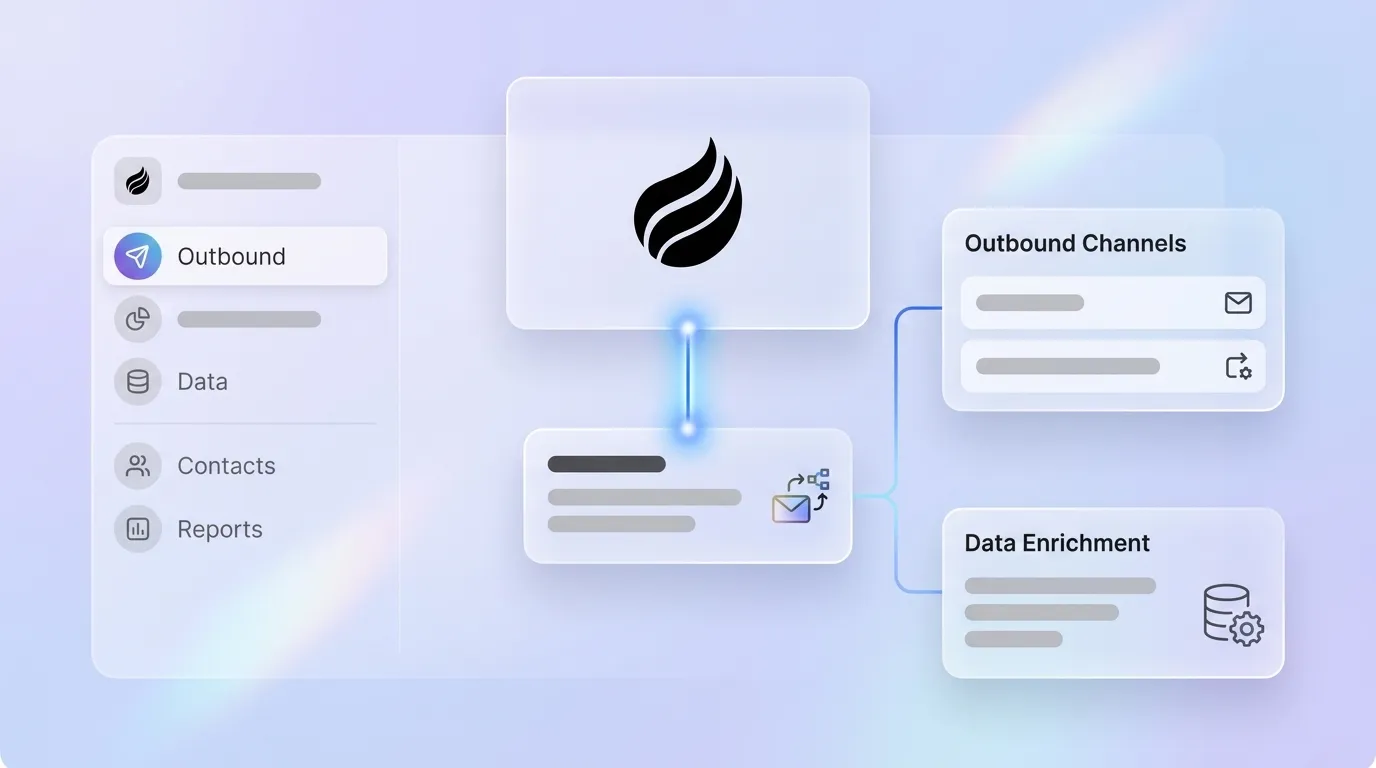
Coffee’s Agent collapses this stack into a single workflow. The Lead Finder sources contacts. The Agent enriches records with job titles, funding data, and LinkedIn profiles via licensed data partners. Campaigns then enroll verified contacts into AI-generated multi-step sequences inside one system, with no CSV exports between tools. Coffee’s Visitor Identification feature adds a real-time sourcing layer, where a single tracking pixel identifies anonymous website visitors by name, title, email, and company, and surfaces them as enriched prospects ready for immediate sequence enrollment.
Clean structured contact data feeds AI automation through a data source → enrichment and verification → CRM sync → sequencer stack. This flow removes manual CSV uploads so records move directly into personalized outbound sequences. Poor data quality costs organizations an average of $12.9 million annually, and agent-driven ingestion cuts that cost by ensuring clean data enters the system before any sequence fires.
For teams already on Salesforce or HubSpot, Coffee deploys as a Companion App. The Agent handles enrichment and writes verified data back to the primary CRM, so the system of record stays accurate without human effort. Inconsistent CRM inputs cause automation to route leads incorrectly, send follow-ups at the wrong time, or generate misleading reports. Coffee’s Agent prevents these issues by enforcing structured, verified data at ingestion.
See how Coffee unifies sourcing, verification, and outreach in one platform.
Common Data Mistakes and Their Revenue Impact
Poor outbound data creates direct, measurable revenue loss. High-bounce lists do more than waste send volume; they damage the sender domain that every future campaign depends on.
A list with a 5% or higher bounce rate triggers ISP throttling almost immediately. Email service providers may suspend high-volume sending if rates consistently exceed 5%. Recovery requires domain warm-up from scratch, which takes at least two to four weeks and produces no pipeline during that period.
Clean data improves campaign response rates and close rates. A team running 1,000 contacts per month at a 3.43% reply rate generates 34 replies. The same team running signal-triggered outreach to a verified list at much higher reply rates generates far more replies from the same send volume.
These bounce-rate disasters share common root causes. The most frequent data mistakes that produce high-bounce outcomes include:
- Using purchased or scraped lists without multi-layer verification
- Failing to re-verify lists older than 60 days before sending
- Ignoring catch-all domain flags that pass SMTP checks but hide invalid mailboxes
- Sending to role-based addresses (info@, support@) that route to shared inboxes and generate spam complaints
- Omitting SPF, DKIM, or DMARC records on the sending domain
- Reusing hard-bounced addresses without a global suppression list
Decision Framework Checklist for Evaluating Data Sources
This checklist helps you evaluate any outbound data source or platform before you commit budget or pipeline.
- Verification depth: Does the source run all four layers, including syntax, MX record, SMTP, and risk flagging, or only one or two?
- Accuracy SLA: Does the provider publish a verified accuracy rate? Waterfall-enriched providers deliver 85–97% match rates, while single-source providers deliver 50–65% match rates.
- Decay management: Does the platform re-verify records automatically, or does your team own that cadence manually?
- Field completeness: Are all eight MVD fields available, including verified email, full name, job title, company name, company size, direct phone, LinkedIn URL, and intent signal?
- Intent signal coverage: Can the source surface funding events, executive hires, and tech stack changes with timestamps?
- CRM integration: Do verified records flow directly into the CRM and sequencer, or does the workflow still require CSV exports?
- Compliance handling: Does the platform manage GDPR, CCPA, and CAN-SPAM suppression flags automatically?
- Bounce protection: Is there a global suppression list that prevents hard-bounced addresses from re-entering any campaign?
- Sender authentication support: Does the platform verify or assist with SPF, DKIM, and DMARC configuration?
- Sourcing-to-sequence loop: Can a contact move from discovery to enrolled sequence without leaving the platform?
Frequently Asked Questions
How long does it take to get Coffee’s Agent running on an existing Salesforce or HubSpot instance?
Setup finishes in a short authentication flow that connects Coffee to the existing CRM. Once authenticated, the Agent starts syncing data, enriching records, and writing verified insights back to Salesforce or HubSpot immediately. Most teams become operational within a single session without complex configuration or professional services. The Agent manages the data-in process from day one, so the system of record improves in accuracy as soon as the connection is live.
Is Coffee SOC 2 and GDPR compliant?
Coffee is SOC 2 Type 2 and GDPR compliant. Customer data never trains public AI models. For outbound sales email programs, this matters because compliance handling, including opt-out and suppression flags, must run continuously rather than only at list import. Coffee’s Agent maintains these flags as part of the enrichment and data-management workflow, which reduces the manual compliance burden on RevOps teams.
How does Coffee handle data quality compared to standalone tools like ZoomInfo or Apollo?
Coffee’s built-in Lead Finder delivers data roughly on par with standalone prospecting databases for most SMB and mid-market use cases. The key difference is that the data lives inside the same system that enriches it, runs sequences, and logs outcomes. This design removes tool-switching and CSV-export cycles that introduce errors and delays. For teams that need the deepest possible database coverage, Coffee also operates as a Companion App on top of existing Salesforce or HubSpot instances, so it can work alongside existing data subscriptions instead of replacing them.
Can Coffee’s Campaigns feature handle dynamic lists that auto-enroll new contacts?
Campaigns in Coffee support both static and dynamic People lists. Dynamic lists auto-enroll new contacts as they are added or as they meet the list criteria. A campaign targeting newly identified website visitors or freshly sourced leads from the Lead Finder automatically includes those contacts without manual intervention. Stop-on-reply is on by default, so no prospect receives an automated email after a real conversation starts. Built-in send throttling also protects the sender’s domain reputation throughout the campaign lifecycle.
What is the minimum viable dataset needed to start a Coffee outbound campaign?
An email-only campaign can run on Tier 1 fields alone: verified work email, full name, current job title, company name, and company size. Coffee’s Agent auto-creates and enriches contacts from connected Google Workspace or Microsoft 365 accounts, and the Lead Finder can source net-new contacts that meet these field requirements from the built-in database. Adding Tier 2 fields such as direct phone, LinkedIn URL, and industry improves reply rates and supports multi-channel follow-up. Intent signals, sourced through Visitor Identification or Lead Finder filters, deliver the highest lift and are available natively within the platform.
Conclusion: Turning Clean Data into Predictable Pipeline
Outbound sales email data quality in 2026 acts as the main lever between a 3.43% average reply rate and a 20%+ signal-triggered result. Verified fields protect deliverability. Intent signals control timing. The workflow that connects sourcing to verification to sequence enrollment determines whether a RevOps team spends its hours on strategy or on spreadsheets.
Coffee is the only platform that performs all three steps inside one CRM or as a Companion App on top of Salesforce and HubSpot. Lead Finder and Visitor Identification handle sourcing. The Agent manages enrichment and verification. Campaigns run automated outreach. There is no CSV export, no tool-switching, and no manual data entry between discovery and the first email sent.
Launch your first agent-driven outbound campaign in Coffee today.