Written by: Doug Camplejohn, CEO & Co-Founder, Coffee | Last updated: September 13, 2026
Key Takeaways
- MEDDPICC qualification breaks down when reps lack a clear call sequence, cannot separate strong answers from vague ones, or skip CRM capture.
- Open discovery with Metrics and Pain questions so you can quantify cost before you move to Economic Buyer, Decision Criteria, and Decision Process.
- Ask Paper Process and Competition questions near the end of the cycle, after trust is built and the prospect is already invested in change.
- Enterprise deals slip when the economic buyer stays on the sidelines or when procurement, legal, and security steps are not mapped early.
- Coffee captures every qualification answer automatically from emails, calendars, and call transcripts so deal reviews run on evidence instead of memory, not guesswork. See How Coffee Captures Qualification Data.
MEDDPICC Qualification Questions In Real Call Order
This sequence gives reps a practical call flow instead of an alphabetical checklist. Early questions earn the right to ask harder access and procurement questions later. Start with pain and metrics to establish credibility and urgency. Move to economic buyer and decision criteria once the prospect is engaged. Then map the decision process and paper process. Close by testing your champion and surfacing competitive risk.
- What is this problem costing you in revenue, time, or headcount right now?
- If you solved this completely, what would change on your P&L in the next 12 months?
- What does success look like to the person who signs the contract?
- Who signs the contract once you reach that stage, and have they signed similar deals before?
- What does your written shortlist say a vendor must do to be considered?
- Walk me through what happened the last time you bought something like this, including who was involved and in what order.
- Once you have a verbal yes internally, what are the procurement, legal, and security steps before a contract is signed?
- If I asked you to set up a 20-minute call with your CFO next week, could you make that happen?
- What alternatives are you evaluating, including staying with your current approach?
- What would have to be true for “do nothing” to win internally?
This order works because questions one and two establish quantified pain before you ask anything about budget or authority. Once a prospect has articulated a dollar figure tied to their problem, questions about the economic buyer and decision process feel like natural next steps. Questions about paper process and competition land last, when trust is established and the prospect is already thinking about how to get the deal done. The sections below break down each element in turn, starting with the two that open every call: Metrics and Identify Pain.
Metrics: Questions That Force A Number
First Call. Metrics are the quantified business outcomes the buyer wants to move, the numbers that make the pain real and the ROI defensible to a CFO.
- How are you measuring success today, and what does the number need to be?
- What is this problem costing you in revenue, time, or headcount right now?
- If you solved this completely, what would change on your P&L in the next 12 months?
Strong Answer Sounds Like: “We lose roughly three deals a month to slow follow-up. Our average deal is $40K, so that is $120K a month in missed revenue, about $1.4M annually.”
If It Is Vague, Ask: “You mentioned slow follow-up is hurting you. Can you help me put a number on what one lost deal costs the business?”
The conversion exercise matters here. To turn “we lose deals to slow follow-up” into a metric, multiply response time by deal value by loss rate. That math makes the pain defensible to a CFO and gives you a number you can revisit later. A number the economic buyer cannot repeat back unprompted remains a Stated metric. Keep it at Stated until it comes from the buyer’s own mouth or their own slide.
Economic Buyer: Questions That Test Real Authority
Mid-Cycle. The economic buyer is the single person who controls the budget line and can approve spend without needing anyone else’s sign-off. Enterprise deals without an economic buyer meeting in the first 30 days slip 67% of the time, and deals with economic buyer engagement within 30 days close 2.3x faster.
- Who signs the contract once you reach that stage, and have they signed similar deals before?
- What does the person who controls this budget care most about, such as cost reduction, revenue growth, or risk?
- If I asked you to set up a 20-minute call with your CFO next week, could you make that happen?
- Who else would weigh in on a decision like this, and what does each of them need to see?
Strong Answer Sounds Like: “That would be Sarah Chen, our CFO. She signed our last two SaaS contracts. I can get you on her calendar for next Thursday.”
If It Is Vague, Ask: “When you say ‘leadership needs to approve it,’ whose name appears on contracts at this dollar value?”
Deals that reach legal review without the economic buyer’s engagement fail at a rate three times higher than deals where the EB was involved by discovery call two. A champion who cannot or will not introduce the economic buyer lacks the organizational credibility to drive the deal. Treat continued gatekeeping as a qualification gap and address it directly.
Decision Criteria: Questions That Surface The Scorecard
First Call To Mid-Cycle. Decision criteria are the written or unwritten standards the buying committee uses to evaluate vendors, including commercial terms, security requirements, and integration needs, not just product features.
Ask: “What does your written shortlist say a vendor must do to be considered?”
If It Is Vague, Ask: “Besides the product capabilities, what commercial or security requirements would disqualify a vendor before you even get to a demo?”
Strong Answer Sounds Like: “We have a formal RFP with five scored categories: security posture, integration with Salesforce, implementation timeline, pricing model, and vendor references in our industry.”
Real criteria include payment schedules, indemnification terms, and data residency requirements, not just feature checkboxes. When your contact can only describe product requirements, the evaluation scorecard likely lives with someone else in the buying committee.
Decision Process: Questions That Map The Actual Steps
Mid-Cycle. The decision process is the literal sequence of steps, owners, and dates between a verbal yes and a signed contract. “No decision” almost always reflects an unmapped internal step rather than a competitor win.
Ask: “Walk me through what happened the last time you bought something like this, including who was involved and in what order.”
If It Is Vague, Ask: “After your team agrees internally, what are the specific steps before a contract gets signed, such as technical review, security, procurement, or legal?”
Strong Answer Sounds Like: “We do a technical evaluation with IT in weeks one and two. Security review runs in weeks three through five. Procurement runs the MSA negotiation, and legal signs off. The whole thing usually takes about 10 weeks from verbal agreement.”
Paper Process: Questions That Prevent Late-Stage Surprises
Pre-Close. The paper process covers every procurement, legal, and security step that sits between a verbal yes and a signed contract. This is consistently the thinnest section in competitor content and the area where deals most often die. The average enterprise SaaS security review takes 41 days end-to-end, per IANS Research’s 2024 benchmark. A full enterprise paper process packet includes the NDA, MSA, DPA, SOC 2 review, SIG questionnaire, and legal redlines. Run sequentially, it takes 68 to 137 days. Run in parallel from week one, the same packet takes 28 to 30 days.
- Once you have a verbal yes internally, what are the procurement, legal, and security steps before a contract is signed?
- Does your security team require a SOC 2 Type II report, and do you have a standard DPA template or will you need ours?
- Who owns the MSA negotiation on your side, procurement, legal, or both, and what are the typical redline areas?
- Is there a GDPR or data residency requirement we need to address before legal will engage?
Strong Answer Sounds Like: “Our legal contact is Marcus Webb. We use a standard MSA that usually takes two to three weeks to redline. Security review runs concurrently and needs your SOC 2 Type II report and a completed SIG Lite. GDPR applies because we have EU customers, so we will need your DPA.”
If It Is Vague, Ask: “Has your security team reviewed a SaaS vendor recently? What did that process look like, and how long did it take?”
Roughly 67% of B2B SaaS vendors hold a current SOC 2 Type II report, per Vanta’s 2024 State of Trust benchmark, so buyers now treat it as a baseline requirement. Coffee is SOC 2 Type 2 and GDPR compliant and does not train public models on customer data, which means the Coffee Agent clears the most common security review gates without adding weeks to your cycle.
Identify Pain: Questions That Quantify The Cost Of Inaction
First Call. Identify Pain means surfacing a specific operational problem and attaching a cost to leaving it unsolved. Pain that stays unquantified will not survive a budget conversation.
Ask: “What is the concrete impact of this problem on revenue, time, or headcount each month?”
If It Is Vague, Ask: “You mentioned the team is frustrated. Can you help me understand what that frustration is costing the business in concrete terms?”
Strong Answer Sounds Like: “Our reps spend about two hours a day on CRM data entry. That is 10 hours a week per rep, across 12 reps, 120 hours of selling time we are losing every week. At our average quota attainment, that is roughly $300K in pipeline we are not building.”
When the prospect agrees their situation is suboptimal but cannot quantify the cost, the pain lacks the weight needed for budget prioritization. Treat unquantified pain as a Stated metric and revisit it until the buyer owns the number.
Champion: Questions That Test Whether They Will Spend Influence
Mid-Cycle. A champion is an internal advocate with organizational power, a personal stake in the outcome, and a demonstrated willingness to sell on your behalf when you are not in the room. A friendly contact who answers every email behaves like a coach. A passive champion who says “let me take it to my team” and goes quiet is the leading cause of late-stage deal slippage.
- If I asked you to set up a 20-minute call with your CFO next week, could you make that happen?
- Who internally is most skeptical of this, and what is their objection?
- If this stalls in review, who do I need to win over, and will you help me do it?
- Can you walk me through how you would pitch this solution to your CFO?
Strong Answer Sounds Like: “I can get you on Sarah’s calendar by Thursday. The main skeptic is our IT director. He thinks integration will take six months. I have already pushed back on that internally and told him we have done this in four weeks with similar vendors.”
If It Is Vague, Ask: “If budget pushback came up in the next review, what would you say to make the case internally?”
A champion who is genuinely selling internally will know the objections because they have already encountered them. When your contact hesitates on these questions, downgrade their Champion score and treat the deal as single-threaded until proven otherwise. Enterprise deals with five or more stakeholder threads close 2.1x more often than single-threaded deals.
Competition: Questions That Surface The Status Quo
Mid-Cycle To Pre-Close. Competition in MEDDPICC includes named vendors, internal build options, and the decision to do nothing. The status quo wins more deals than any named competitor, and activity metrics never surface it; deliberate qualification does.
- What alternatives are you evaluating, including staying with your current approach?
- What would have to be true for “do nothing” to win internally?
- What are the other vendors saying that is landing with your team?
- If you had to rank your top three evaluation criteria, where do we stand against each alternative?
Strong Answer Sounds Like: “We are looking at two other vendors and we have talked about building something internally. The internal build option is losing appeal because our engineering team is already at capacity. Of the two vendors, you are ahead on the integration story but behind on pricing.”
If It Is Vague, Ask: “What would the person who prefers the status quo say is the biggest risk of moving forward?”
MEDDIC Vs. MEDDPICC Vs. BANT: Matching Frameworks To Your Deals
MEDDIC was built in 1996 by Dick Dunkel and Jack Napoli at Parametric Technology Corporation (PTC), where the sales team grew revenue from $300M to over $1B in four years. The original six-element framework, Metrics, Economic Buyer, Decision Criteria, Decision Process, Identify Pain, and Champion, spread across enterprise SaaS as PTC alumni moved into sales leadership roles at Salesforce, Snowflake, and Databricks. For a full comparison of the two frameworks, see the MEDDPICC Vs. MEDDIC Guide. Canonical framework resources are maintained at meddicc.com and meddpicc.net.
MEDDPICC extends MEDDIC by adding Paper Process, the legal, procurement, and security review path, and Competition, the alternative vendors and the status quo. Andy Whyte codified the MEDDPICC variant in his 2020 book, and it has become dominant in enterprise SaaS because deals increasingly die in procurement rather than in the evaluation.
BANT, Budget, Authority, Need, Timeline, was developed by IBM decades ago as a fast triage filter for transactional deals. It remains effective for high-volume inbound qualification and SMB deals with short cycles and single decision-makers. For complex enterprise deals, BANT’s single “Authority” criterion cannot map a buying committee that averages six to ten stakeholders, per Gartner research, and it has no equivalent for Decision Criteria, Champion, or Paper Process. The table below compares the three frameworks side by side so you can match them to your deal size and buying process.
| Framework | Best For | Key Elements | When To Use |
|---|---|---|---|
| BANT | High-volume inbound leads and transactional deals under $25K ACV with cycles under 90 days | Budget, Authority, Need, Timeline | SDR-layer triage; single decision-maker deals |
| MEDDIC | Complex B2B deals above $25K ACV with multi-stakeholder buying committees and cycles over 90 days | Metrics, Economic Buyer, Decision Criteria, Decision Process, Identify Pain, Champion | AE-level qualification from SQL through close; deals where procurement is a rubber stamp |
| MEDDPICC | Enterprise deals above $100K ACV with five or more stakeholders, cycles of three months or longer, and formal procurement | Metrics, Economic Buyer, Decision Criteria, Decision Process, Paper Process, Identify Pain, Champion, Competition | Any deal where procurement, security review, or legal redlines are part of the process |
Most outbound teams run a hybrid: BANT at the SDR gate, MEDDPICC from SQL onward. Pick a single variant for each team and instrument the CRM to match, so your forecast data stays comparable deal to deal and rep to rep.
How Qualification Answers Get Captured And Reused
MEDDPICC usually fails because answers never make it into the CRM, not because reps ask the wrong questions. 71% of sales reps say they spend too much time on data entry, leaving only 35% of their time for selling. When reps are buried in post-call admin, qualification data decays. Fields get skipped, answers get summarized into vague notes, and deal reviews run on memory instead of evidence.
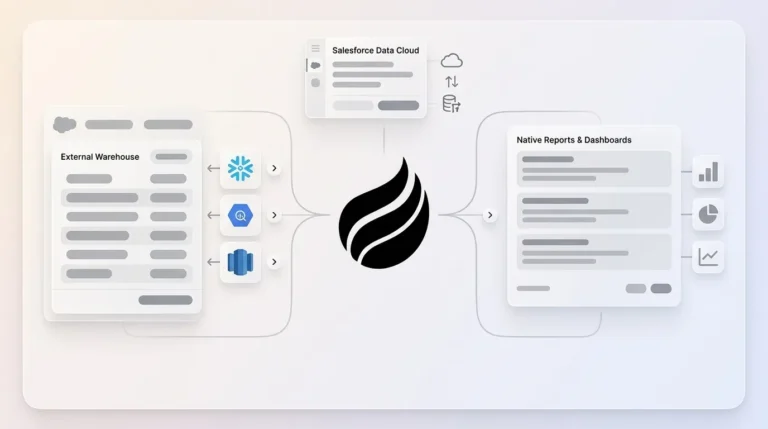
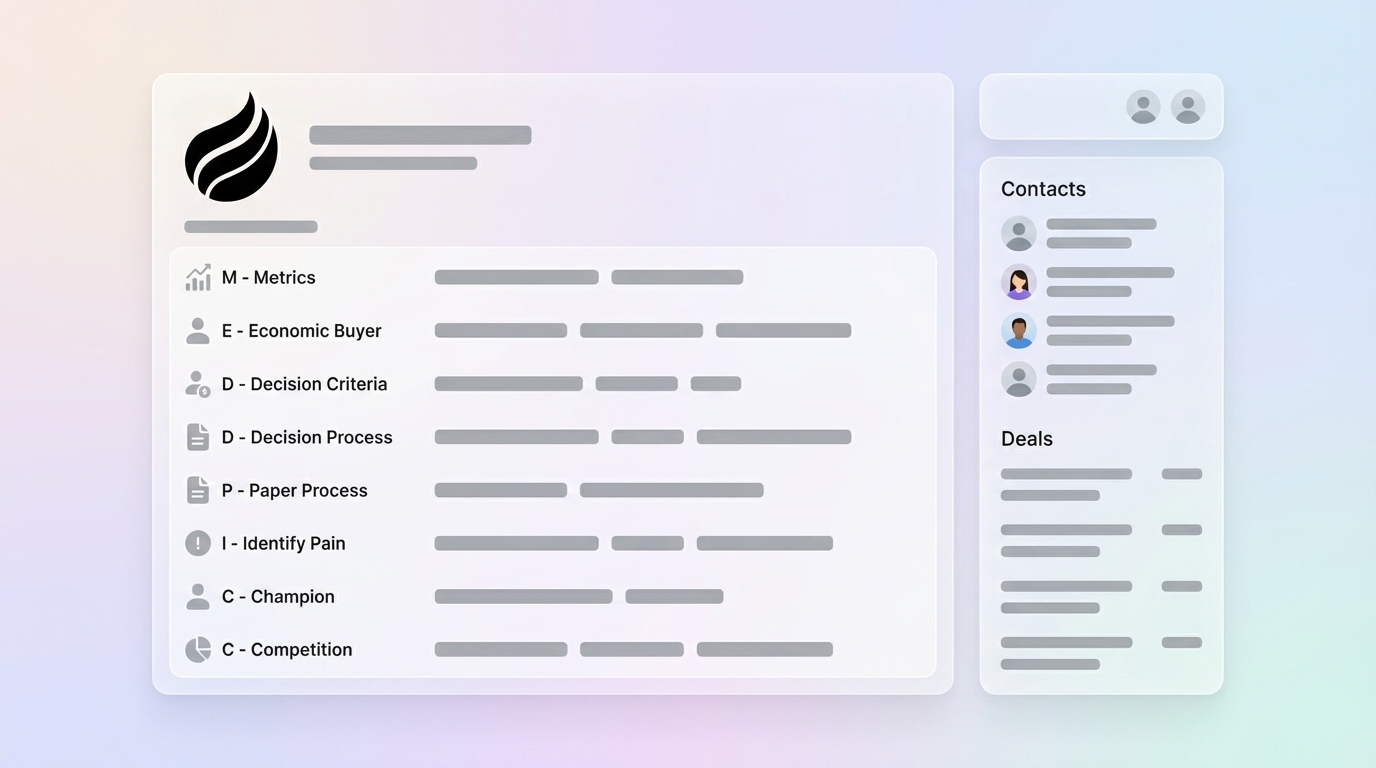
Coffee is the world’s best CRM Agent, an autonomous agent built to solve this problem. The Coffee Agent captures qualification data automatically from emails, calendars, and call transcripts, can structure its notes according to BANT, MEDDIC, or SPICED, and writes accurate records back to the system of record without manual entry. Deal reviews run on evidence because the data is already there.
Coffee works two ways. It runs as a Standalone AI-First CRM for small teams that have outgrown spreadsheets. It also runs as a Companion App on top of Salesforce or HubSpot for mid-market teams that need the Coffee Agent to handle the “data in” problem without replacing their existing stack. The Pipeline Compare feature turns that captured qualification data into week-over-week pipeline intelligence. It shows which deals progressed, which stalled, and where qualification gaps are opening before they cost you the quarter. As noted earlier, Coffee already clears the same security review gates your prospects are running on their vendors.
For reps who want a deeper question bank to complement this playbook, the 32 Best MEDDPICC Discovery Questions resource covers additional scenarios by role and deal stage.
Put Your MEDDPICC Data On Autopilot and see how the Coffee Agent structures every discovery call into MEDDPICC fields automatically so your next deal review runs on evidence, not memory.
Frequently Asked Questions
What Is The Difference Between MEDDIC And MEDDPICC?
MEDDIC is the original six-element framework, Metrics, Economic Buyer, Decision Criteria, Decision Process, Identify Pain, and Champion, developed at PTC in 1996. MEDDPICC adds two elements. Paper Process covers the legal, procurement, and security review steps between a verbal yes and a signed contract. Competition forces reps to name the alternatives the buyer is evaluating, including the status quo. The added letters cover the two areas where enterprise deals most often die. For deals above $100K ACV with formal procurement, MEDDPICC catches risks that plain MEDDIC misses.
Is MEDDIC Still Relevant Today?
MEDDIC and its extensions remain the dominant qualification framework for complex B2B deals in 2026. Roughly 73% of SaaS companies selling above $100K ACV run some version of MEDDIC or MEDDPICC, and the framework has outlasted every qualification trend of the last 30 years because complex deals have six checkpoints whether the rep tracks them or not. MEDDIC simply makes the tracking explicit. The framework is now the shared language of enterprise SaaS selling, used at Salesforce, Snowflake, MongoDB, and Databricks, among others.
How Do You Handle A Vague Answer To A MEDDPICC Qualification Question?
Use the follow-up probe paired with each question in this playbook. A vague answer is a signal to dig deeper, not a cue to move on. It usually means the prospect has not yet quantified the problem, does not have access to the information you need, or is not the right person to answer that question. When the answer stays vague after a follow-up probe, treat that as a qualification gap and score the element at Stated rather than Confirmed. Revisit it before advancing the deal to the next stage, because a gap that is invisible in discovery becomes a slipped quarter in close.
Conclusion: Turn Qualification Answers Into Pipeline Intelligence
A flat list of MEDDPICC qualification questions does not help in the room. What matters is the order you ask them in, what a strong answer sounds like versus a weak one, and whether the answers actually make it into your CRM. The playbook above gives you the sequence, the signals, and the follow-up probes. The remaining challenge is capture.
Coffee solves that capture problem. The Coffee Agent collects qualification data automatically from every email, calendar event, and call transcript, structures it to MEDDPICC, and keeps your system of record accurate without manual entry. Every deal review then runs on evidence instead of memory, and every pipeline call surfaces the gaps before they cost you the quarter.
Start Your Free Trial and put your MEDDPICC qualification on autopilot.