Written by: Doug Camplejohn, CEO & Co-Founder, Coffee | Last updated: August 9, 2026
Key Takeaways for Hybrid Prospecting
- Single-channel outreach is outdated, and coordinated LinkedIn-plus-email sequences generate up to 3.1x more replies than either channel alone.
- LinkedIn outperforms cold email on reply rate and meeting conversion, while email provides the volume needed for scale.
- Channel choice should follow ACV: LinkedIn-first for deals above $5k, email-first for deals under $5k, and a balanced mix for mid-range opportunities.
- Platform safety rules, deliverability requirements, and automation pitfalls must be respected to avoid account restrictions and domain burns.
- Coffee executes the entire hybrid sequence end-to-end, including visitor identification, enrichment, outreach, and CRM logging, without manual data entry; get started with Coffee today.
How This LinkedIn vs Email Comparison Works
This analysis compares two distinct B2B prospecting channels: LinkedIn outreach and cold email. LinkedIn includes connection requests, direct messages, and InMail. Cold email covers outbound sequences sent from a sender’s own domain to verified business addresses.
Both channels are evaluated against six fixed criteria.
- Reply-rate benchmarks: Average and top-quartile response rates in 2026
- Deliverability risk: Inbox placement rates and platform enforcement exposure
- Deal-size fit: ACV ranges each channel serves most efficiently
- Account-safety limits: Weekly volume caps and restriction triggers
- Data-capture quality: Richness and reliability of prospect data returned
- Automation effort: Manual overhead required to run sequences at scale
2026 Side-by-Side Performance Snapshot
| Criterion | LinkedIn Outreach | Cold Email |
|---|---|---|
| Average reply rate | 8–12% | 3.43% platform-wide |
| Top-quartile reply rate | 15–20% | 5–8% |
| Deliverability rate | 95–98% | ~83% on average, up to 87% |
| Weekly volume ceiling | ~100 (varies 100–200) | 1,000+ sends/day (multi-domain) |
| Reply-to-meeting conversion | 27% | 18% |
| Cost per booked meeting | $164 | $118 |
Reply-Rate Benchmarks Across Channels
LinkedIn outreach in 2026 averages a first-touch reply rate of 8–12%, with good campaigns reaching 18–25% and elite campaigns exceeding 30%. For B2B SaaS and tech, connection acceptance rates and reply rates shift with targeting quality and execution. A 2026 analysis of normalized B2B sequences examined LinkedIn InMail and connect-then-message outreach.
Cold email shows lower baselines. Smartlead’s 2026 State of Cold Email report, built on more than 850 million sent emails, shows the platform-wide average reply rate on a first cold email at 1.18%. Instantly’s 2026 Cold Email Benchmark Report places the broader average at 3.43%, with good campaigns reaching 5–10% and the top 1% of tight-ICP, signal-based campaigns reaching 15–25%.
The multichannel lift creates the real advantage. Multichannel sequences generate up to 3.1x more replies than single-channel outreach. A 4-touch email sequence followed by 2 LinkedIn touches and 2 phone calls produces 50–80% more meetings than 8 emails alone on the same list. Critically, filtering outbound lists to in-market accounts, such as site visitors or pricing page hits in the prior 14 days, roughly triples reply rates on both channels: email rises from 4.1% to 12–15% and LinkedIn rises from 11.6% to 28–34%.
Platform Limits and Safety Tactics
These reply-rate advantages only matter when accounts stay active and healthy. Both LinkedIn and email providers enforce strict limits and safety rules that can shut down outreach if ignored.
LinkedIn does not publish official numeric connection-request limits, and observed weekly caps in 2026 sit around 100 per rolling 7-day window, sometimes varying to 150–200. Limits are not uniform across account types. Sales Navigator does not raise this cap and instead provides benefits such as 50 InMail credits per month and advanced search filters. LinkedIn capped Open InMail sends to under 100 per month in late 2025, down from a practical limit of 800, which cut outbound capacity by roughly 87%.
Safe daily pacing matters as much as weekly totals. LinkedIn enforces a daily soft cap of approximately 20–25 connection requests across Free, Premium, and Sales Navigator accounts, with a uniform weekly limit of 100. Exceeding this volume reliably triggers throttling within 1–5 days even when staying under the weekly limit. A 14-day manual warm-up period before any automation is recommended for new or reactivated accounts, followed by light automation at 40% of thresholds in week 3, which reduces restriction probability from approximately 23% to 5–10%.
On the email side, Microsoft’s bulk-sender enforcement rules active since mid-2025 require DMARC authentication for high-volume senders and increase spam risk for email-heavy sequences. These rules make channel diversification a business necessity rather than a stylistic choice. Cold email inbox placement in 2026 reaches ~83% on average and up to 87% with strong domain health, warm-up, and setup.
Deal-Size Decision Tree for Channel Mix
Channel mix should follow ACV and TAM rather than personal preference. A 30-second decision framework recommends cold email as primary for ACV under $5k or TAM over 20,000 accounts, LinkedIn as primary for ACV over $50k or TAM under 2,000 accounts, and multichannel for mid-range ACV or TAM.
Under $5k ACV: Cold email wins on economics for deals under roughly $5,000 ACV. Under $5k ACV deals should receive 6–8 touches over 10–14 days, and sequences beyond 8 touches on smaller deals harm unit economics. Email-first with light LinkedIn reinforcement fits this band.
$5k–$50k ACV: For $5k–$25k ACV deals, a LinkedIn-first approach with a 70% LinkedIn and 30% email mix usually wins because these deals do not justify long email sequences. For $25k–$100k ACV deals, a multichannel default with a 50/50 LinkedIn-email split applies, using LinkedIn to start the relationship and email for detailed explanations and meeting handoff. A real campaign for a SaaS startup selling $30k ACV with a 70% LinkedIn and 30% email sequence achieved roughly 50% acceptance, 18% DM reply rate, and five meetings over four weeks.
$50k+ ACV: For $100k+ ACV enterprise deals, an email-first approach with a 30% LinkedIn and 70% email split is more reliable due to multiple stakeholders, longer review cycles, and formal internal forwarding. Enterprise deals over $100k ACV should receive 18–25 touches over 45–90 days.
Channel-Specific Mistakes to Avoid
The following mistakes are the most common causes of domain burns and LinkedIn restrictions for B2B SaaS teams.
LinkedIn mistakes:
- Sending connection requests from data-center IPs, at identical times, or with high ignored-invitation ratios triggers restrictions even when volume stays under the weekly limit.
- Roughly 40% of accounts running non-compliant automation tools including Expandi, Dripify, and Waalaxy received some form of restriction in Q1 2026.
- Skipping account warm-up before automation, and new accounts should start at 5–15 connection requests per day and ramp over four weeks.
- Letting pending invitations accumulate above 500 without withdrawing unanswered ones after 14 days.
- Using identical message templates at scale, even though blank connection requests to well-targeted prospects achieve 55–68% acceptance rates versus 30% for templated notes.
Cold email mistakes:
- Sending high volume from a primary domain without warming secondary sending domains first.
- Skipping DMARC, DKIM, and SPF authentication, even though these are required under Microsoft’s 2025 enforcement rules discussed earlier.
- Running 8 or more touches on sub-$5k ACV prospects, which destroys unit economics.
- Contacting the same prospect on both LinkedIn and email within the same hour, and teams should send email in the morning and the LinkedIn touch in the afternoon at the earliest.
- Using identical copy across both channels, which creates prospect confusion and reduces overall reply rates.
4-Step Hybrid Workflow Example
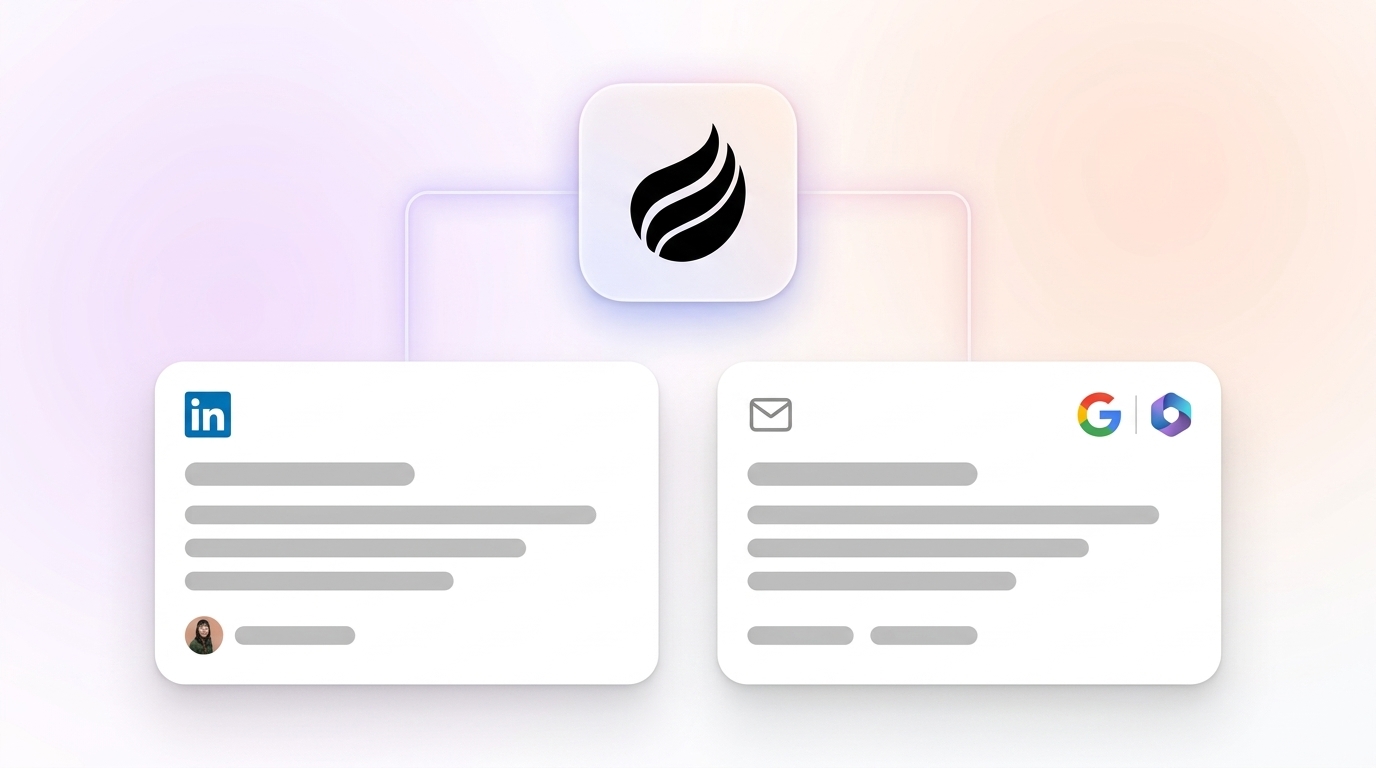
A coordinated hybrid sequence removes timing collisions and message inconsistency that appear when teams run LinkedIn and email as separate campaigns. Running LinkedIn and email as separate campaigns creates timing collisions, message inconsistency, and attribution confusion that reduce overall reply rates compared with a single unified sequence. The following four-step workflow shows how an autonomous agent executes a unified sequence without manual intervention.

- Visitor identification: A tracking pixel identifies anonymous website visitors by name, title, email, and LinkedIn profile. This real-time identification focuses outreach on prospects who already showed intent by visiting the site, which raises conversion compared with cold lists.
- Enrichment: The agent augments each contact record with job title, company funding stage, LinkedIn profile URL, and recent activity signals. This enrichment removes manual ZoomInfo lookups that would otherwise delay outreach by hours or days.
- Personalized LinkedIn connection: With enrichment complete, the agent drafts a personalized connection note on Day 1 under 300 characters that references a relevant trigger event. A personalized connection note under 300 characters referencing a prospect’s recent activity achieves a 45% acceptance rate, which sets up stronger performance for later touches.
- Follow-up email: After the LinkedIn touch creates name recognition, the agent sends a context-aware cold email from the rep’s own connected mailbox on Day 3–4. Every activity, including connection sent, email delivered, and reply received, is written back to Salesforce or HubSpot automatically so the sequence stays coordinated.
How Coffee Runs the Hybrid Sequence for You
Coffee unifies every step of this workflow inside a single system so teams can run hybrid outreach without extra headcount. The sequence runs as follows.

- Pixel captures anonymous traffic: Drop Coffee’s tracking script into the site’s
<head>tag. The agent immediately begins identifying visitors, including name, title, email, LinkedIn profile, pages visited, and time on site, and surfaces high-fit prospects in real-time Slack notifications. - Agent enriches the contact: With one click, the prospect is added to Coffee with enrichment pre-filled. Coffee’s Lead Finder also builds targeted prospect lists via natural language search, such as “Find me VPs of Sales at SaaS companies with 50–200 employees,” so the pipeline never depends on a single inbound signal.
- Agent drafts and runs outreach: Coffee’s Campaigns feature generates a multi-step sequence, including subject lines, body copy, and delays, from a plain-English description. Sequences send from the rep’s own connected mailbox with their real signature. Stop-on-reply is on by default, so no prospect receives an automated email after a real conversation starts, and built-in send throttling protects sender reputation.
- Agent logs everything to the CRM: Every activity, including LinkedIn connection sent, email delivered, reply received, and meeting booked, is written back to Salesforce or HubSpot automatically. Pipeline Compare then visualizes week-over-week changes, highlights stalled opportunities, and replaces manual CSV exports with accurate pipeline intelligence.
Get started with Coffee and eliminate the manual data entry that fragments your pipeline view.
Operational Requirements for Scaling Hybrid Outreach
Scaling hybrid outreach without adding headcount depends on three operational disciplines.
Cross-channel data hygiene: Every contact touched on LinkedIn and email must exist in a single system of record with a unified activity log. Without this single source of truth, LinkedIn and email run in separate tools, which causes attribution to break, reps to double-touch prospects, and pipeline forecasts to reflect tool data rather than deal reality. This fragmentation is why Coffee’s agent writes every interaction back to the CRM automatically so the record stays current regardless of channel.
Sender reputation management: Coffee’s Campaigns feature sends from the rep’s own connected mailbox, not a bulk-sending domain, and applies built-in send throttling. This approach preserves domain health as volume scales. On the LinkedIn side, Coffee’s visitor identification and enrichment workflow surfaces high-fit prospects before any outreach begins, which helps keep acceptance rates above the 40% threshold that LinkedIn treats as a healthy trust signal.
Scaling without headcount: Legacy tooling turns reps into data-entry clerks across LinkedIn, email, enrichment, and sequencing tools. Coffee consolidates visitor identification, lead finding, enrichment, campaign execution, meeting intelligence, and CRM logging into one agent. A 10-person sales team can then execute a coordinated hybrid sequence at the volume and consistency that previously required a dedicated SDR team and four separate subscriptions.
Decision Framework Matrix by ACV
| ACV Range | Recommended Channel Mix | Weekly Touch Volume |
|---|---|---|
| Under $5k | Email primary, LinkedIn light reinforcement | 6–8 touches over 10–14 days |
| $5k–$25k | 70% LinkedIn / 30% email | 8–12 touches over 14–21 days |
| $25k–$100k | 50% LinkedIn / 50% email | 12–18 touches over 21–30 days |
| $100k+ | 30% LinkedIn / 70% email | 18–25 touches over 45–90 days |
Frequently Asked Questions
How do you avoid LinkedIn account restrictions when running outreach at scale?
LinkedIn’s observed weekly cap in 2026 is roughly 100 connection requests per rolling 7-day window, with some accounts seeing 150–200. The safe daily pace is 20–25 requests for warmed accounts and 5–10 for accounts less than 30 days old. New or reactivated accounts should complete a 14-day manual warm-up period before any automation, then ramp to 40% of thresholds in week 3 before scaling further. Keeping acceptance rates above 40% provides the most reliable trust signal. Withdrawing pending invitations after 14 days keeps the ignored-invitation ratio from triggering throttling. Teams should avoid sending connection requests from data-center IPs, using identical message templates at scale, or running browser-extension-based automation tools, because LinkedIn’s detection flags all three. Cloud-based tools carry approximately 60% lower ban risk than browser extensions because they use dedicated IPs and randomized delays.
What are the most important email deliverability fixes for cold outreach in 2026?
The three non-negotiable technical requirements are SPF, DKIM, and DMARC authentication on every sending domain. Microsoft’s bulk-sender enforcement rules, active since mid-2025, require DMARC for high-volume senders and increase spam risk for non-compliant domains. Beyond authentication, the most impactful deliverability practices include warming new sending domains over 4–6 weeks before scaling volume and sending from the rep’s own connected mailbox rather than a bulk-sending domain. Teams should keep bounce rates below 2% by verifying lists before sending and use stop-on-reply sequencing so prospects never receive an automated email after a real conversation starts. Spreading volume across multiple warmed domains allows teams to scale sends without concentrating risk on a single domain. Personalization also matters for deliverability because highly templated messages at scale trigger spam filters at the content level, not just the volume level.
Do hybrid LinkedIn-plus-email sequences actually outperform single-channel outreach?
Evidence across multiple large-scale studies shows a consistent advantage for coordinated multichannel sequences. Coordinated LinkedIn-plus-email sequences generate up to 3.1x more replies than single-channel outreach, a figure replicated across analyses from Outreaches.ai, Omnisend, and Sopro covering millions of outreach attempts. Analyses of B2B sequences also find that coordinated LinkedIn-plus-email sequences achieve higher reply rates and meeting-booked rates compared with cold email alone. The lift comes from recognition, because a prospect who has seen a LinkedIn connection request is more likely to open and reply to a subsequent email when the sender’s name feels familiar. The qualifier is coordination, since uncoordinated sequences that use both channels without timing discipline produce lower reply rates because the touches feel disconnected and create prospect confusion.
Should LinkedIn or email come first in a hybrid sequence?
Channel order depends on ACV, ICP validation, and target persona. LinkedIn-first sequences work best for high-value prospects at Series B+ companies with VP+ titles and deals worth $10k+ ACV, where the social proof of a visible professional profile justifies a slower, lower-volume approach. Email-first sequences fit when the ICP is still being validated, when high volume such as 200+ touchpoints per week is needed to detect patterns, or when the target persona lives primarily in their inbox, such as finance, procurement, IT, and operations roles at 500+ employee companies. A practical rule states that if the message is off-target, a prospect will forget an email but remember a poorly targeted LinkedIn approach negatively. Teams can use email to validate ICP fit first, then layer LinkedIn once replies confirm the targeting is correct. For mid-market deals, a practical pattern uses a LinkedIn connection request on Day 1, a DM on Day 5, then email on Day 7. For enterprise, teams can start with cold email on Day 1 and follow with a LinkedIn connection request on Day 3.
Conclusion: Why Coffee Makes Hybrid Outreach Work
In 2026, the real challenge is not choosing LinkedIn or cold email, but running both channels in a coordinated sequence without turning sales reps into data-entry clerks. The benchmarks are clear, including the 3.1x multichannel advantage documented earlier and the in-market filtering advantage that triples reply rates. The deal-size decision tree is straightforward, and the platform limits are documented. Execution breaks when fragmented tooling forces reps to toggle between LinkedIn, email, enrichment, sequencing, and CRM while logging every activity by hand and losing historical context.

Coffee solves this at the agent level. The pixel identifies who is on your site. The Lead Finder builds the list. The agent enriches every contact. Campaigns run the hybrid sequence from the rep’s own mailbox with stop-on-reply protection. Every activity writes back to Salesforce or HubSpot automatically, so pipeline intelligence reflects reality rather than whatever a rep remembered to log. Legacy CRMs demand that humans serve the software, while Coffee’s agent serves the humans.
Get started with Coffee and run a unified hybrid sequence without adding a single manual step.