Written by: Doug Camplejohn, CEO & Co-Founder, Coffee | Last updated: August 13, 2026
Key Takeaways for B2B Teams
- Anonymous website visitors represent real pipeline that most B2B companies never capture because company-level tools rarely surface actionable contacts.
- Factors.ai’s waterfall model improves match rates but usually falls back to company-level resolution, so sales teams see organizations instead of named people.
- Realistic 2026 benchmarks show company-level identification at 30–65% of US B2B traffic, while person-level identification remains at 5–20% across leading vendors.
- Manual CSV exports and dashboard-first workflows create friction that keeps identified visitors out of sales reps’ hands and out of the CRM.
- Coffee’s agent-driven pixel and Suggested Leads workflow delivers person-level matches with one-click CRM handoff—see Coffee’s pricing and start identifying visitors today.
Website Visitor Identification in Plain Terms
Website visitor identification turns anonymous website sessions into named companies or people. The process matches a visitor’s IP address, device signals, or cookie state against identity graphs, reverse-IP databases, and firmographic data sources. Sales and marketing teams then receive contact information they can actually use.
How Factors.ai’s Waterfall Model Resolves Visitors
A waterfall model for website visitor identification queries multiple identity providers in sequence rather than relying on a single vendor. If the first source cannot resolve a visitor’s name, email, or title, the next source runs until the system finds the best available match or leaves the session unresolved. The process usually starts with IP reverse lookup, which maps the visitor’s IP address to a corporate network, then adds firmographic enrichment such as company size, industry, and revenue.
The structural limitation appears when matches from later fallback sources carry lower confidence than those from the primary high-fidelity source. Many waterfall implementations also default to company-level IP-to-company identification as the floor when person-level matching fails across all passes. Remote work has reduced IP-based company-level match rates by single-digit percentages compared to pre-2020 levels, though algorithms adapted to restore accuracy for remote and home-office locations. These adaptations define the practical ceiling for waterfall models today.
Match Rates Factors.ai’s Waterfall Model Can Realistically Hit
Company-level identification for US B2B traffic typically lands between 30% and 65% of total sessions, depending on the vendor and how strictly bots, ISPs, and consumer IPs are filtered out. Person-level identification, which means a named individual rather than just an employer, currently sits at 5–20% of US B2B traffic across the best-performing vendors in 2026. Waterfall architectures improve on single-source tools but do not move these ceilings in a meaningful way.
Where Waterfall Visitor Identification Data Originates
Waterfall models pull from consent-based identity graphs, IP-to-company databases, firmographic providers, and device fingerprinting networks. A strong waterfall implementation scores confidence tiers and routes only engaged sessions to sales reps, yet underlying data quality still varies by provider. Waterfall models rank data sources in a fixed order and accept the first successful result, which can increase visible matches but prioritizes availability over validation when sources conflict.
Company-Level vs. Person-Level Accuracy with 2026 Benchmarks
The gap between company-level and person-level identification determines whether a sales rep can send a personalized email or must guess which of 200 employees at a target account visited the pricing page. That gap shapes how much pipeline a team can realistically touch.
The benchmarks established earlier — 30–65% company-level, 5–20% person-level — reveal a fundamental gap that determines whether sales teams receive actionable contacts or just organization names. Some multi-provider aggregation approaches report 75%+ company-level match rates by combining multiple data providers, yet those figures do not translate into higher person-level resolution. Any vendor claiming 40%+ person-level match rates is either misleading buyers or conflating company-level and person-level statistics.
Demo environments for visitor identification tools usually show higher match rates than production traffic. Buyers should measure match rates on their own traffic during a trial and treat that as the only reliable benchmark.
| Metric | Company-Level Tools (e.g., Factors.ai waterfall) | Person-Level Tools (e.g., RB2B, Warmly) | Coffee (Agent-Driven) |
|---|---|---|---|
| US Company-Level Match Rate | 30–65% of US B2B sessions | ~65% (Warmly production data) | Person + company identification via pixel |
| US Person-Level Match Rate | 10–25% on US traffic | 15–25% (Warmly); 10–20% (RB2B) | Named individual with title, email, LinkedIn |
| CRM Integration Depth | Manual CSV export or webhook setup required | Dashboard-first, manual review required for CRM handoff | One-click CRM handoff, no CSV export |
| Suggested Leads Capability | Not available | Raw people lists, no persona filtering | Buyer-persona-matched recommendations with LinkedIn profiles |
Try Coffee’s person-level identification and turn anonymous visits into named, persona-matched prospects today.
Integration Friction with Salesforce and HubSpot
Most visitor identification data never reaches the CRM automatically, even when a tool returns a company name or a person’s details. Ninety percent of visitor identification data goes unused without CRM integration and follow-up workflows. Many tools ask a sales rep to log into a separate dashboard, review identified visitors, export a CSV, and import that file into Salesforce or HubSpot. That workflow introduces delay, duplication, and data loss.
The specific failure modes for sales teams compound at each stage of the workflow. Manual CSV exports overwrite existing contact records rather than enriching them, which erases historical context. This data loss extends to activity logging, so there is no record that a prospect visited the pricing page three times before the rep’s call. Without deduplication, repeated imports create duplicate contacts that corrupt pipeline reporting. Even when tools send real-time alerts, Slack notifications often fire without enough context for a rep to act immediately. Most critically, these systems rarely connect visitor behavior to the CRM’s lead scoring or sequence enrollment, so high-intent visits never trigger automated follow-up.
Dashboard-first visitor identification tools such as RB2B and Warmly require manual human review or fragile workarounds to feed data into automated CRM or AI agent workflows. For a Head of Sales managing a small team, that manual layer usually explains why identified visitors never receive outreach.
Coffee’s Pixel and Suggested Leads Workflow
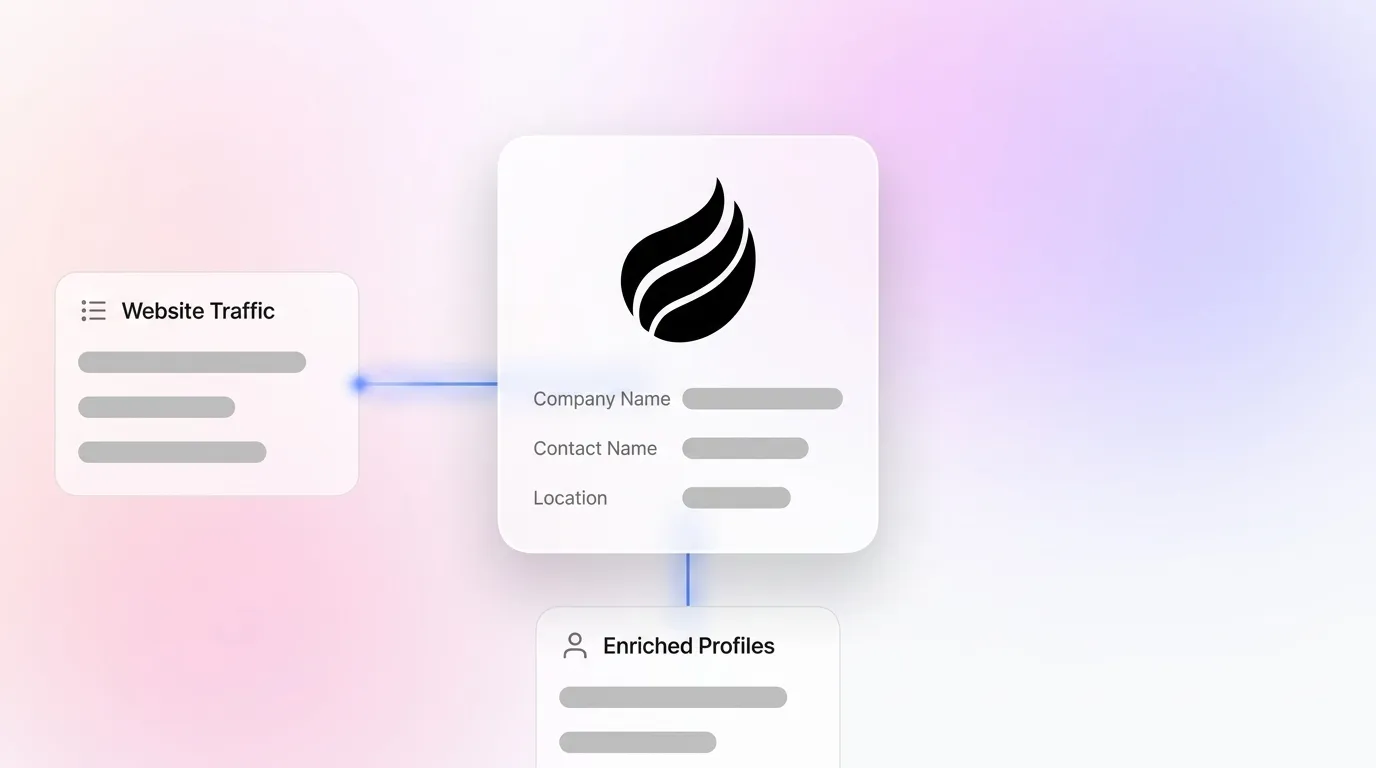
Coffee treats visitor identification as an agent-driven workflow instead of a reporting dashboard. A single tracking pixel, placed in the <head> tag of a website, starts identifying visitors immediately. Coffee infers the visitor’s name, title, email, and LinkedIn profile alongside the company they belong to, the pages they visited, time on site, and whether it was a first or returning visit.
The workflow from pixel hit to outreach removes manual steps:
- The pixel fires and Coffee identifies the visitor at the person level.
- A real-time Slack notification surfaces the high-fit visitor with full enrichment pre-filled.
- Coffee’s Suggested Leads feature applies the team’s buyer persona to recommend the two or three specific people inside the visiting company most worth contacting, not a raw list of everyone at the organization.
- One click adds the prospect to Coffee with all enrichment attached, ready for a LinkedIn connection request, an outbound email, or auto-enrollment into a Campaign sequence.
- The activity, including pages visited, time on site, and visit timestamp, is logged automatically to the CRM record with no CSV export required.
The Suggested Leads capability creates the critical gap between Coffee and standalone tools like RB2B and Warmly. Those tools surface either the company or an undifferentiated list of people at the organization. Coffee instead uses the team’s buyer persona to filter and rank which individuals are actually worth contacting. A Head of Sales at a 20-person SaaS company does not need 40 names from a visiting enterprise account. They need the two VP-level buyers who match their ICP, with LinkedIn profiles ready for immediate outreach.
Deploy Coffee’s pixel today and close the loop from pixel hit to personalized outreach without leaving the agent.
Privacy and Compliance for Visitor Identification in 2026
Website visitor identification now operates in a tightening regulatory environment. Any tool that deploys a tracking pixel must account for GDPR, CCPA, and a growing set of US state privacy laws.
On the US side, as of January 1, 2026, Indiana, Kentucky, and Rhode Island joined 17 other states with comprehensive privacy laws, bringing the total to 20 US states. Organizations deploying AI-driven visitor scoring tools must conduct an inventory of all automated decision-making features and third-party technologies to prepare for compliance with state automated decision-making disclosure and risk assessment rules.
In the UK, the ICO published finalized guidance on 29 April 2026 covering cookies, tracking pixels, device fingerprinting, and similar technologies under PECR. For EU traffic, person-level identification is effectively 0% under GDPR without affirmative opt-in, while company-level identification continues under legitimate-interest processing.
Coffee is SOC 2 Type 2 certified and GDPR compliant. Data ingested by the Coffee Agent does not train public models, and the platform’s visitor identification operates within these compliance boundaries for US-focused B2B SaaS teams.
Pricing and Total Cost of Ownership for Visitor Identification Stacks
The true cost of a visitor identification stack usually exceeds the line-item price of a single tool. A typical setup for a 10–50 person SaaS sales team includes separate subscriptions for visitor identification, CRM enrichment, sales engagement, and prospecting databases. Each product brings its own seat pricing, data limits, and integration maintenance overhead.
Common hidden costs in a multi-tool stack include:
- Separate visitor identification platform (e.g., Warmly, RB2B) billed per seat or per identified visitor
- Enrichment tool (e.g., ZoomInfo, Apollo) billed separately for contact data
- Sales engagement platform (e.g., Outreach, Salesloft) for sequence management
- RevOps time spent maintaining the integrations and deduplication rules described earlier
- Data quality degradation when tools fall out of sync, which leads to bad pipeline forecasts
Coffee consolidates visitor identification, enrichment, prospecting, CRM data entry, meeting intelligence, and campaign sequencing into a single agent with seat-based pricing. The agent’s labor, including identifying visitors, enriching records, logging activity, suggesting leads, and enrolling prospects into campaigns, is included without extra metering on processes or API calls. For a Head of Sales evaluating total cost, the relevant comparison is Coffee versus the full stack Coffee replaces.
Frequently Asked Questions
Realistic Person-Level Match Rates in 2026
Realistic person-level match rates for US B2B traffic in 2026 fall between 5% and 20% of total sessions across the best-performing vendors. Some tools report higher figures in demos or marketing materials, yet independent production testing consistently shows this range. Company-level match rates usually land between 30% and 65% of US B2B sessions, but company-level data alone does not support direct sales outreach because it identifies the organization rather than the individual. Match rates vary significantly based on traffic mix. Enterprise traffic from corporate networks identifies at higher rates, while remote workers on residential ISPs, mobile users, and VPN users reduce match rates substantially. The only reliable benchmark for any specific website comes from a trial measured against that site’s own traffic.
Coffee’s Data Sources for Visitor Identification
Coffee’s visitor identification combines a tracking pixel with identity graph matching to deliver the person-level enrichment described in the workflow section, including contact details, firmographic data, and session behavior. The pixel captures session signals such as pages visited, time on site, and first versus returning visit. Coffee’s agent enriches the record using licensed data partners, the same infrastructure that powers Coffee’s Lead Finder and contact enrichment features. Identified visitor records then enter the same system that manages enrichment, outreach campaigns, and CRM sync, with no data handoff between separate tools.
CRM Integrations Coffee Supports for Visitor Handoff
Coffee operates in two modes relevant to CRM handoff. As a Standalone CRM, Coffee becomes the system of record and visitor identification data flows directly into it. As a Companion App, Coffee sits on top of an existing Salesforce or HubSpot instance and writes enriched visitor records, including contact details, pages visited, and activity timestamps, back to the primary CRM automatically. This approach removes the manual CSV export and field-mapping steps that cause data loss in most visitor identification workflows. The one-click handoff from a Suggested Lead to a CRM-ready contact lives as a native action inside the Coffee agent, not a Zapier workaround.
Implementation Timeline for Coffee’s Visitor Identification
Implementation requires dropping a single custom-generated script into the <head> tag of the website. Coffee verifies installation automatically and begins identifying visitors immediately. Connecting Coffee to an existing Salesforce or HubSpot instance uses a simple authentication step. There is no lengthy onboarding, no custom field mapping project, and no separate enrichment tool to configure. For a Head of Sales at a small SaaS company, the full setup from pixel installation to first Slack alert usually takes minutes, not weeks.
How Coffee’s Suggested Leads Feature Compares to RB2B and Warmly
RB2B and Warmly surface either the visiting company or a list of people associated with that company. The sales rep then manually evaluates which individuals are worth contacting based on their own understanding of the buyer persona. Coffee’s Suggested Leads feature applies the team’s defined buyer persona automatically, filters the people at the visiting company, and recommends the two or three specific individuals most likely to be the right contact, with LinkedIn profiles attached for immediate outreach. This distinction matters most for small sales teams where rep time is the scarcest resource. Instead of reviewing a list of 40 names, the rep sees the two contacts Coffee’s agent has already determined match the ICP.
Conclusion: Turn Anonymous Visits into Named Prospects Today
Anonymous website traffic represents a revenue problem, not just a data problem. Company-level waterfall models return organization names when sales teams need individual contacts. Manual CSV exports create friction that ensures most identified visitors never receive follow-up. Standalone visitor identification tools that surface raw people lists still require a rep to perform persona-matching work manually.
Coffee closes every gap in that chain. The pixel identifies named individuals. The Suggested Leads feature filters by buyer persona and surfaces the right two or three contacts at each visiting company. Real-time Slack alerts deliver context the moment a high-fit visitor lands on the site. One click adds the enriched record to Coffee or writes it back to Salesforce or HubSpot, with pages visited, time on site, and visit history logged automatically. No CSV, no dashboard to check, and no separate enrichment tool to maintain.
For a Head of Sales at a 10–50 person SaaS company, that difference separates a visitor identification tool from a visitor identification agent.
Start converting anonymous traffic today with Coffee’s person-level identification and direct CRM handoff.