Written by: Doug Camplejohn, CEO & Co-Founder, Coffee | Last updated: July 28, 2026
Key Takeaways
- Intent data is abundant, yet it rarely reaches the CRM where reps work, so signals arrive late and stripped of context.
- First-, second-, and third-party signals play different roles, and combining all three creates higher-confidence account scoring.
- 98% of B2B visitors leave without filling forms, and Coffee’s cookieless pixel identifies them in real time and surfaces the right contacts.
- Automated scoring weighs recency, engagement depth, and ICP fit, then writes prioritized records directly into Salesforce or HubSpot without manual entry.
- Eliminate spreadsheets and delayed outreach: start your free trial to turn intent signals into pipeline automatically.
How Different Intent Signal Types Work Together in ABM
Mature ABM programs layer three categories of intent data: first-party signals from owned properties, second-party signals from trusted partner platforms, and third-party signals aggregated from external publisher networks. Each type differs in freshness, ownership, and its role in account scoring.
| Signal Type | Source | Freshness | Typical Use in ABM |
|---|---|---|---|
| First-Party | Your own website, CRM, email, product analytics | Real-time to minutes | Highest-confidence scoring, triggers immediate rep outreach on pricing-page visits and demo requests |
| Second-Party | Partner platforms such as G2, webinar registrations, review sites with consent-based data sharing | Hours to daily | More reliable than third-party aggregation, used to confirm vendor-evaluation activity before direct outreach |
| Third-Party | Publisher co-ops (Bombora), bidstream data, content syndication networks | Daily to weekly rolling windows | Early-stage discovery of accounts researching the category before visiting your site, treated as directional, not confirmatory |
ABM programs that connect intent data to their account strategy generate more pipeline per marketing dollar and achieve higher win rates. The compounding effect comes from layering all three signal types instead of relying on a single source.
Collecting First-Party Intent Signals and Identifying Website Visitors
As noted earlier, the vast majority of high-intent traffic leaves without filling forms, which means most buying signals stay invisible to revenue teams. Coffee’s visitor identification pixel closes that gap.
Setup uses a single script tag in the <head> of your site. Coffee immediately begins resolving anonymous sessions using cookieless identification methods, including IP-based indicators, on-site behavior patterns, and permissioned identity graphs, without relying on third-party cookies or fingerprinting. For each resolved visitor, Coffee surfaces name, title, email, LinkedIn profile, company, pages visited, time on site, and whether it was a first or returning session.
Competing tools such as RB2B and Warmly often surface only the company or an undifferentiated list of people. Coffee instead applies your buyer persona and recommends the two or three specific individuals inside that visiting company who most closely match your ICP, then surfaces their LinkedIn profiles for immediate outbound action.

High-intent behaviors trigger real-time Slack alerts so reps can act while the signal is fresh. The HBR Lead Response Management study found companies responding within one hour were seven times more likely to have a meaningful conversation than those that waited. Coffee’s agent makes that response window realistic without manual monitoring.
Key first-party signals Coffee captures and scores include:
- Pricing page visits, especially repeat visits within a rolling seven-day window
- Product demo requests and form completions
- Case study and ROI calculator downloads
- Multi-stakeholder engagement from the same account in the same week
- Return visits indicating rising intent velocity
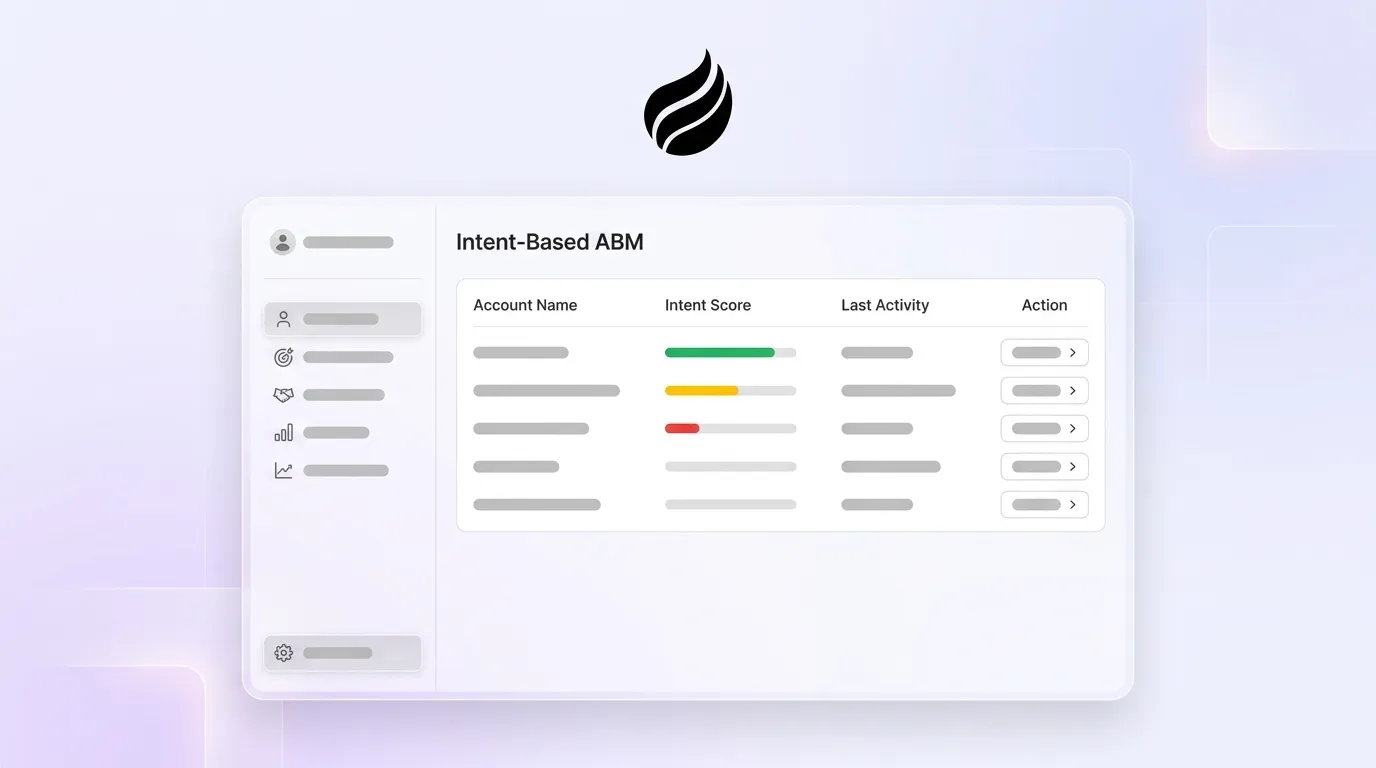
Once Coffee captures these signals, the platform can rank accounts by urgency and fit so reps know where to focus first.
Scoring Accounts with Combined Intent Data
Coffee’s agent applies three scoring dimensions automatically:
- Recency: A page visit from yesterday carries significantly more predictive value than the same visit from 30 days prior due to signal decay. Coffee applies decay curves so stale signals reduce account priority automatically.
- Depth: Signals receive weights based on engagement depth, so a pricing page visit scores higher than a blog read. Buying-committee engagement across multiple contacts at the same account compounds the score.
- ICP Fit: Intent signals function best as a prioritization filter rather than a qualification substitute, and an account with poor ICP fit showing high intent remains a poor target. Coffee gates scoring against firmographic and technographic fit before surfacing accounts to reps.
The output is a tiered account list that directs rep effort toward the highest-probability opportunities. Tier 1 accounts show both high first-party engagement and high third-party intent, which signals active buying behavior that warrants immediate outreach. Tier 2 accounts show high third-party intent but no direct engagement with your site yet, so they enter outbound sequences designed to convert research into conversation. Nurture accounts show first-party engagement but low third-party intent, which suggests early-stage interest that teams should monitor for escalation instead of pushing prematurely.

Syncing Intent Signals into Salesforce or HubSpot Automatically
The five-step Coffee Agent workflow removes every manual handoff between signal capture and CRM record creation.
- Pixel Capture: The Coffee tracking pixel resolves anonymous website visitors to named individuals and companies in real time, capturing page-level behavior, session depth, and visit frequency without form fills.
- Third-Party Enrichment: The agent layers third-party intent signals such as topic surge data, review-site activity, and competitive research onto the first-party visitor record, creating a composite account profile that includes firmographics, technographics, and funding data from Coffee’s licensed enrichment partners.
- Scoring: The agent applies the weighted scoring model described above, factoring recency decay, engagement depth, ICP fit, and buying-committee breadth to produce a single prioritized account score.
- Prioritized Record Creation: For accounts crossing the defined score threshold, the Coffee Agent automatically creates or updates the Company and Contact records in Salesforce or HubSpot, writing intent score, researched topics, signal source, last detected activity, and engagement tier into standardized CRM fields without a rep typing a single character.
- Pipeline Compare Activation: The agent enrolls the new record into the appropriate outreach sequence and flags it inside Coffee’s Pipeline Compare view so the account owner sees it in the next pipeline review with full context on what triggered the prioritization.
Connecting buyer signals to execution systems speeds conversion of intent-based leads compared to leaving them in isolated platforms. Coffee’s agent provides that connection.
Account Prioritization Playbooks that Replace Manual CSV Exports
Coffee’s Pipeline Compare feature visualizes week-over-week changes across every account in the pipeline. Because the Coffee Agent captures history in a built-in data warehouse, it can surface which accounts progressed, which stalled, and which new accounts crossed the intent threshold since the last review, all without a spreadsheet or a manual export.
Coffee supports three prioritization playbooks out of the box:
- New Intent Surge Playbook: Accounts that crossed the Tier 1 threshold in the past seven days appear as a prioritized outreach list each Monday morning, pre-enriched with the topics driving the surge and the specific contacts Coffee recommends engaging first.
- Stalled Opportunity Re-engagement Playbook: When external research spikes on a dormant opportunity, Coffee flags it and triggers a re-engagement workflow. Reps then gain a reason to reach out that is grounded in observed buyer behavior rather than arbitrary follow-up cadence.
- Competitive Research Alert Playbook: When an account in active pipeline begins researching competitor terms, Coffee adds a risk flag to the opportunity record and notifies the account owner, which enables proactive competitive positioning before the deal is lost.
Trigger-based approaches yield 4x higher conversions and 30% shorter sales cycles compared to static list-based outreach. Pipeline Compare replaces the static list with a live, agent-maintained priority queue.
Common Pitfalls that Break Intent-Driven ABM
Most intent programs fail for one of three reasons, and Coffee’s architecture is designed to eliminate each.
- Fragmented Tools: Teams sign contracts with Bombora, G2, ZoomInfo, and 6sense yet cannot produce a sales-call list anyone trusts because signals live in separate dashboards with no unified scoring layer. Coffee ingests first-party visitor data and enriches it with third-party intent inside a single agent, then produces one reconciled account score written into the CRM.
- Poor Data Quality: Nearly 75% of B2B marketers estimate at least 10% of their lead data is inaccurate, outdated, or non-compliant. Coffee’s agent applies confidence thresholds, deduplication logic, and continuous enrichment so every record written to Salesforce or HubSpot meets a quality standard before a rep sees it.
- Low CRM Adoption: Reps ignore intent signals when acting on them requires manual copy-paste from a third-party dashboard into the CRM. Many organizations use intent data for lead and account prioritization, yet most implementations stop at dashboard visibility instead of automated routing into rep workflows. Coffee eliminates this gap by automating the entire handoff from signal capture to CRM record creation.
Frequently Asked Questions about Coffee and Intent Data
Does Coffee integrate with Salesforce and HubSpot?
Coffee integrates directly with both Salesforce and HubSpot. It operates as a Companion App that sits on top of existing installations, and a simple authentication allows the Coffee Agent to read existing records, apply enrichment and intent scoring, and write prioritized account and contact records back into the CRM using standard field mappings. The agent respects existing ownership, territory rules, and required fields, so it works within the workflow your team already follows. Broader integrations with additional tools are available via Zapier, and deeper native integrations sit on the product roadmap.
Is Coffee SOC 2 Type 2 and GDPR compliant?
Coffee is SOC 2 Type 2 certified and GDPR compliant. Customer data does not train public models. Coffee’s visitor identification approach uses first-party signals collected from direct site interactions and permissioned data sources, which aligns with GDPR and CCPA requirements and continues to function regardless of user cookie preferences. Company-level identification is treated as legitimate interest under GDPR, while person-level identification relies on opt-in data sources and consent-based identity graphs.
How long does implementation take for a 20–100-person B2B SaaS team?
Implementation finishes quickly for teams in this size range. Connecting Coffee to Google Workspace or Microsoft 365 takes minutes and immediately begins auto-creating contacts and logging activity. Installing the visitor identification pixel requires a single script tag in your site’s head tag, and Coffee verifies installation and begins identifying visitors right away. Connecting to an existing Salesforce or HubSpot instance uses a standard OAuth authentication. Most teams capture, score, and push intent signals into their CRM on the same day they sign up, with no engineering tickets or professional services required.
How does Coffee’s visitor identification differ from tools like RB2B or Warmly?
RB2B and Warmly typically surface either the visiting company or an undifferentiated list of people associated with that company. Coffee goes further by applying your defined buyer persona to recommend the two or three specific individuals inside the visiting company who match your ICP, then surfaces their LinkedIn profiles for immediate outbound action. This approach closes the loop from pixel hit to personalized outreach without leaving the Coffee agent, and it writes the resulting contact and company records directly into your CRM with all enrichment pre-filled.
What happens to intent signals for accounts already in active pipeline?
Coffee’s agent monitors intent signals continuously against open opportunities, not just net-new accounts. When an account in active pipeline shows a spike in external research, particularly on competitor terms or decision-stage content, Coffee adds a risk flag to the opportunity record and notifies the account owner. When a dormant opportunity shows renewed research activity, Coffee triggers a re-engagement workflow. Pipeline Compare surfaces these changes week-over-week so pipeline reviews focus on strategic decisions rather than status updates.
Conclusion: Turning Intent Data into Revenue Automatically
Intent data creates revenue only when it lands in a system that acts on it. A signal that stays in a third-party dashboard or a spreadsheet does not function as a revenue asset, it remains noise. Intent-sourced leads often convert at higher rates to closed-won compared to cold ICP-match leads, but that advantage appears only when those signals reach reps in context, in the CRM they already use, before the buying window closes.
Coffee’s agent captures anonymous website visitors, layers third-party intent enrichment, scores accounts against ICP fit and signal recency, and writes prioritized records into Salesforce or HubSpot automatically. No manual exports. No copy-paste. No signals dying in a dashboard. The agent handles the data work so your team can focus on the conversations that close deals.
Turn intent signals into pipeline automatically, start using Coffee now.