Written by: Doug Camplejohn, CEO & Co-Founder, Coffee | Last updated: August 11, 2026
Key Takeaways for 2026 LinkedIn Prospecting
- Free LinkedIn prospecting tools cap you between 20 and 80 prospects per month, so campaigns stall unless you upgrade or stop.
- Browser-extension and cloud-based tools create measurable LinkedIn detection risk, including possible account restrictions or bans.
- Free tiers refresh data infrequently, which produces stale records, bounced emails, and wasted outreach.
- Manual CSV exports from free tools break workflow continuity and often create duplicate records inside CRMs.
- Coffee’s built-in Lead Finder removes every cap and delivers unlimited, CRM-native prospect lists — explore Coffee’s unlimited Lead Finder.
How This Guide Evaluates Free LinkedIn Prospecting Tools
Each tool in this comparison is measured against five criteria that reflect the real operational cost of a free tier.
- Monthly action limits: How many prospects you can realistically reach before a hard cap blocks further activity.
- LinkedIn detection risk: Whether the tool’s architecture triggers LinkedIn’s browser fingerprint, behavioral pattern, or network-analysis layers.
- Data accuracy: Whether contact records are verified and how frequently the underlying database refreshes.
- Workflow friction: Whether the tool forces CSV exports, manual re-imports, or constant context switching between platforms.
- Scalability: Whether the tool can grow with a team without forcing an immediate paid upgrade.
2026 Free-Tier Comparison: Skrapp, Waalaxy, Wiza, Dux-Soup
The table below reflects 2026-tested free-tier quotas from vendor documentation and community-reported limits. Every figure is cited inline.
| Tool | Monthly Free Credits / Actions | Hard Cap Behavior | Safety Notes |
|---|---|---|---|
| Skrapp | 50 email credits/month on free plan | Outreach stops, and an upgrade is required to continue | Email-finder only, no LinkedIn session injection, so browser-fingerprint detection risk stays low |
| Waalaxy | 80 LinkedIn invitations per month on free (Freemium) plan, but users cannot launch campaigns or sequences | Sequence queue pauses at the cap until the next billing cycle | Cloud-based platform, and LinkedIn scans over 6,000 browser extensions and uses script-injection detection as a primary fingerprint layer |
| Wiza | 20 verified email exports/month on free plan | Export blocks after 20 records, list-building continues but data is withheld | Requires Sales Navigator session, and extracting data out of LinkedIn Sales Navigator is deliberately painful by platform design |
| Dux-Soup | Profile visits and manual connection requests only on free “Starter” tier, automated drip sequences require a paid upgrade | Automation features stay fully gated, so the free tier functions as manual-assist only | Extension-based, and browser extensions inject scripts into LinkedIn pages, which creates a detectable DOM-access signal on every session |
The practical ceiling for the free tiers of Skrapp, Waalaxy, and Wiza lands between 20 and 80 usable prospects per month. This pattern aligns with the broader finding that free LinkedIn accounts carry the lowest relative safety level for automation among all account types.
Setup, Data, Automation, and Ban Patterns Compared
Setup effort. Dux-Soup installs as a Chrome extension, while Waalaxy is now fully cloud-based with no Chrome extension required. Wiza requires LinkedIn Sales Navigator for full functionality, while Skrapp works on both regular LinkedIn and Sales Navigator, so Wiza adds a licensing dependency that removes the “free” reality for most users.
Data quality. Apollo.io’s LinkedIn data is not always fresh, and the same staleness problem appears across free-tier tools that rely on scraped or rarely refreshed databases. Fast-moving prospecting programs suffer wasted outreach and damaged sender reputation when they rely on outdated records.
Outreach automation depth. Multiple tools including Hunter provide sequence automation on free tiers with limits such as 500 recipients per sequence or 50 sends per day. Free LinkedIn automation tools help users learn how automation works before investing in a proper setup, yet they fall short for production-scale outbound programs.
Account-ban patterns. A 2026 restriction wave specifically hit users of cloud-browser automation tools, and LinkedIn’s User Agreement broadly prohibits third-party software that automates activity on the platform. Forum reports reinforce this pattern, including one r/SaaS user in January 2026 who noted, “I got restricted on LinkedIn twice in 4 months while doing legit B2B outbound, and it was the overall pattern of my account looking ‘low-trust.’”
Zero-Budget Manual Stack Workflow for Safer Prospecting
Given these detection risks, some users prefer to avoid third-party tools entirely. A fully manual workflow avoids detection risk and keeps control inside LinkedIn and your CRM. The recommended sequence, drawn from practitioner playbooks, runs as follows.
- Define an ICP using 3–5 criteria such as industry, company size by employees or revenue, geography, seniority level, and core responsibility.
- Apply LinkedIn People Search filters for title keywords, industry, location, and headcount. Start from a target company’s “People” page and filter by role keyword, sorting by 2nd-degree connections to approximate Sales Navigator precision at zero cost.
- Send 20–25 connection requests per day to stay within LinkedIn’s safe activity limits. Include a note under 300 characters tied to a specific trigger such as a shared group or direct problem statement, which raises acceptance rates while keeping outreach personalized.
- On accepted connections, run a 3-step DM sequence. Send a short thank-you on Day 1, a specific observation or resource on Days 3–5, and a direct ask under 150 words on Days 8–10.
- Log every touch in a CRM or Google Sheet with columns for name, title, company, LinkedIn URL, company triggers, and a personalized outreach angle.
This workflow costs only time. The ceiling reaches roughly 400–500 prospects per month at 20–25 daily requests, assuming a connection acceptance rate above 25%.
When Manual Prospecting Works vs. When Teams Outgrow It
Solo founders operating under 200 prospects per month can sustain a manual workflow without hitting LinkedIn’s platform limits. The hidden cost is time, since daily active time runs 20–30 minutes for sending requests and managing the inbox sequence, which compounds across a full sales week.
Small SDR teams face a different constraint. CSV exports from free tools break workflow continuity, because every export requires a re-import into the CRM and often creates duplicate records and lost context. LinkedIn-only prospecting remains structurally incomplete for scaling outbound beyond platform-native engagement because it provides no email or phone data for multi-channel campaigns.
Eliminate CSV exports and workflow fragmentation — see how Coffee’s CRM-native agent works.
Objective Risks of Free LinkedIn Prospecting Tools
Three core risks apply regardless of which free tool you choose.
- Account restrictions: LinkedIn’s 2025–2026 detection updates include AI-powered behavioral sequence analysis that flags patterns such as viewing 20 profiles then sending 20 connection requests with uniform timing. Enforcement can range from soft warnings and temporary restrictions to permanent bans.
- Data staleness: Free-tier databases refresh infrequently. As discussed in the category analysis, free-tier databases refresh on slower cycles and receive lower-priority updates than paid tiers.
- The 50–100 prospect ceiling: As noted earlier, free-tier credit caps combine with LinkedIn’s platform limits to create a hard ceiling for most users.
Decision Framework: Matching Volume and Budget to the Right Option
Volume under 100 prospects per month with zero budget favors a manual workflow using native LinkedIn People Search as the lowest-risk path. No third-party tool is required, and account safety stays intact by remaining within the approximately 100 connection requests per week that free accounts support.
Volume between 100 and 500 prospects per month with minimal budget can stretch slightly with free-tier tools like Waalaxy or Skrapp, but the credit caps and detection risks described above still apply. Once campaigns start driving pipeline, account safety matters far more than saving a few dollars.
Volume above 500 prospects per month, or any team that needs lists to live inside a CRM without manual exports, exceeds what free tools can handle. The only option in this comparison that removes the cap entirely is Coffee’s Lead Finder, which delivers unlimited, CRM-native prospect lists without a separate subscription or CSV workflow.
Lead Finder Example: “Find me VPs of Sales at SaaS companies with 50–200 employees”
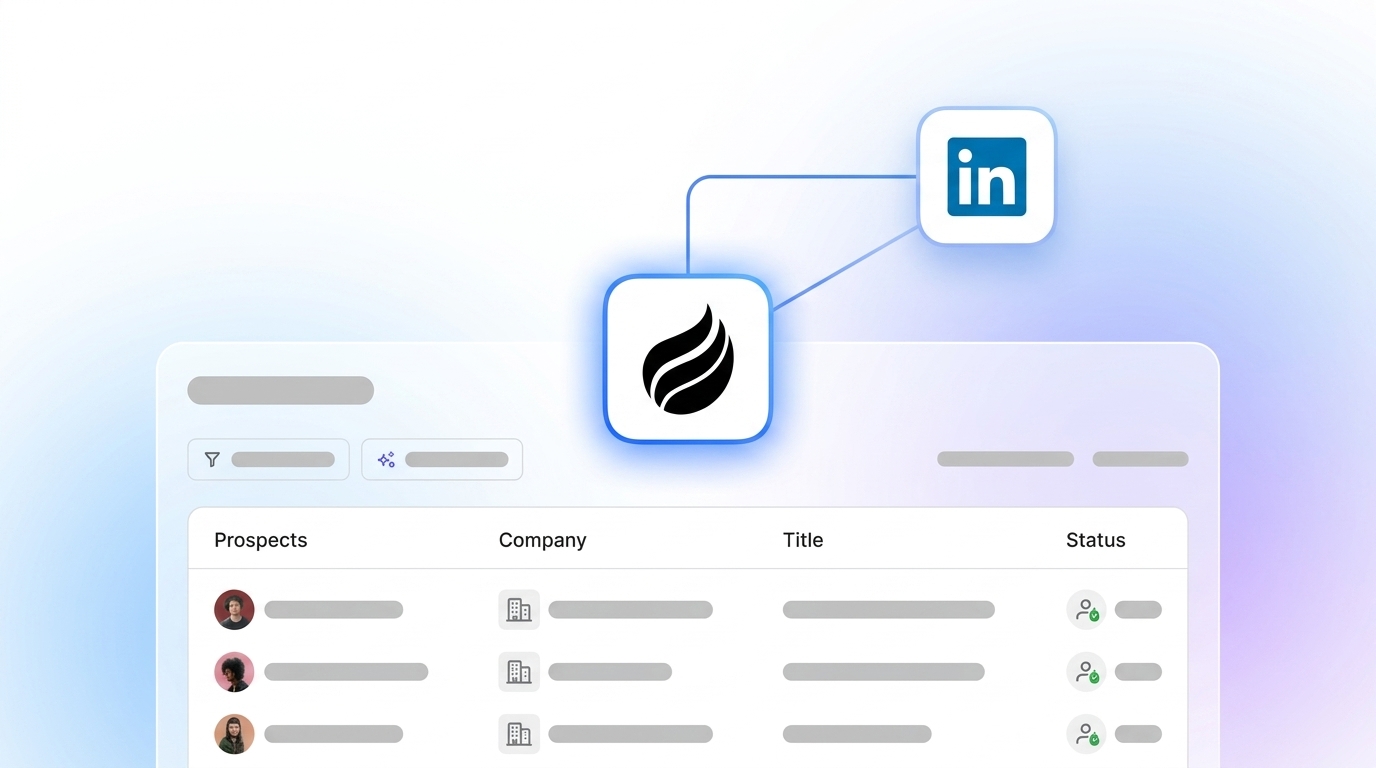
Coffee’s Lead Finder accepts natural-language queries directly inside the CRM. A user types “Find me VPs of Sales at SaaS companies with 50–200 employees.” The agent interprets the request, shows a preview of how it parsed the query and a sample of matching results, and then waits for confirmation before generating the full list.

Once confirmed, the list lives inside Coffee alongside every other record, with no CSV export, no re-import, and no duplicate records. From that list, the same agent can enroll contacts into a multi-step email Campaign without leaving the platform.
See Lead Finder in action — try a natural-language query in Coffee.
Lead Finder Example: “Find decision-makers at Series B startups in the United States”
A second query, “Find decision-makers at Series B startups in the United States”, demonstrates the same zero-cap delivery. The agent applies firmographic filters for funding stage and geography, previews the targeting logic, and builds the list on confirmation.

Because Coffee is SOC 2 Type 2 and GDPR compliant, the data does not feed public models and meets the compliance bar that free tools with opaque data sourcing cannot match. The resulting list is immediately actionable, so teams can enrich, track, and sequence from a single interface.
FAQ: Setup Time, Migration, and Team Fit
How long does it take to set up a free LinkedIn prospecting workflow in 2026?
A fully manual workflow that defines an ICP, applies LinkedIn People Search filters, and builds a tracking spreadsheet takes 30 to 60 minutes of initial setup. Daily maintenance runs 20 to 30 minutes for sending connection requests and managing follow-up messages. Browser-based tools like Dux-Soup require extension installation, while cloud platforms like Waalaxy (mentioned earlier) need only account setup.
Both approaches require additional time to configure sequences and confirm that campaign settings stay within safe daily limits. The setup time stays low, but the ongoing time cost becomes the real constraint, especially for solo founders who juggle prospecting with other responsibilities.
What migration effort is required when moving from free tools to a native CRM solution?
Migration effort depends on how much data has accumulated in the free tool and whether it was stored in a structured format. Most free tools allow a CSV export of contacts, which a team can import into a CRM in a single batch.
The larger effort involves data cleaning. Free-tier databases often contain stale records, missing fields, and duplicate entries that must be resolved before the new system can produce reliable pipeline data. Coffee’s agent handles enrichment automatically on import, filling in job titles, company data, and LinkedIn profiles from licensed data partners, which reduces the manual cleanup burden compared with importing raw CSVs into a passive CRM.
How do integration considerations affect small versus mid-market teams?
Small teams of one to twenty people feel workflow fragmentation most acutely. Free tools rarely integrate natively with CRMs, so every prospect requires a manual export-import cycle that breaks context and creates duplicate records.
Mid-market teams running Salesforce or HubSpot face a different problem. Free tools rarely support the field mappings, required fields, or forecasting logic that enterprise CRM configurations demand. Coffee operates as either a standalone CRM for small teams or a Companion App that layers on top of existing Salesforce or HubSpot instances, handling the data-in process without disrupting the existing system of record.
How should different team sizes assess fit between capped free tools and unlimited built-in prospecting?
Solo founders and early-stage teams validating a prospecting motion for the first time can extract real value from free tools when total monthly outreach volume stays under 100 contacts. The assessment shifts once a team moves from validation to execution.
At that point, the relevant comparison becomes the total cost of the free-tool stack, including time spent on CSV exports, data cleaning, and context switching, versus a single platform that handles prospecting, enrichment, sequencing, and CRM logging in one agent. For most small SDR teams, the break-even point arrives earlier than expected once time costs enter the calculation.
Conclusion: A Scalable Path Beyond Free LinkedIn Tools
Free LinkedIn prospecting tools serve a clear purpose by helping teams validate a workflow before committing budget. Beyond that stage, every free tier in this comparison imposes hard caps that typically limit users to between 20 and 80 usable prospects per month, introduces LinkedIn detection risk through browser-extension or cloud-based architectures, and requires manual CSV exports that fragment the prospecting workflow from the CRM.
The manual-only alternative avoids detection risk but caps throughput at the pace of human effort. Coffee’s Lead Finder is the only option in this comparison that removes the cap entirely. Prospect lists are built through natural-language queries, previewed before generation, and delivered directly inside the CRM, ready for enrichment, tracking, and automated outreach through Campaigns, with no separate subscription and no CSV in the workflow.
Get started with Coffee and build your first unlimited prospect list today.