6-Step Reddit-Approved Fix Checklist for Cleaner CRM Data
Audit open pipeline now. Export opportunities from the last 90 days, sample 20–30 records, and calculate the percentage missing a decision-maker contact, next steps, realistic close date, and activity log.
Implement stage-based validation rules. Require fields only at the stage where they matter, not universally. Block stage advancement until the relevant fields are populated with real values.
Eliminate universal required fields. When fields are required at every stage instead of specific points, reps enter placeholders like “Unknown” just to move forward. Those fields then add friction without improving routing, forecasting, or handoff decisions.
Set a recurring audit cadence. Run weekly duplicate scans, monthly completeness checks on revenue-critical fields, and a full audit before each planning cycle.
Replace manual entry with an autonomous agent. Validation rules and audits prevent and catch bad data. An agent removes the source of bad data by capturing email, calendar, and call data automatically and writing it back to your CRM.
What Reddit RevOps Pros Actually Do About Incomplete CRM Data
Threads on r/salesforce and r/revops tell a consistent story. The top-voted answers usually recommend three moves: tighten validation rules, run regular audits, and add an enrichment tool. Representative comments sound like this:
“We locked down stage advancement so reps can’t move a deal to Proposal without a primary contact role. Data quality improved overnight, but reps started putting in fake contacts to get past the gate.”
“We do a monthly audit in RevOps. It takes two full days and we’re back to the same mess six weeks later.”
“ZoomInfo helps with enrichment but it doesn’t log what actually happened on the call. That’s still on the rep.”
These comments describe real improvements. Stage-based validation, recurring audits, and enrichment tools all help. They just stop short of fixing the underlying problem.
Why Validation Rules and Manual Audits Hit a Ceiling
Stage-based validation follows the right instinct. A field should be required only when the business uses it to make a real decision or trigger a real workflow, and tying requirements to stage gates cuts friction. Validation rules, however, enforce completion rather than accuracy.
Validation rules and audits remain necessary. They still fall short on their own, even when well designed.
Even with strong controls in place, the fragmented nature of most RevOps tool stacks introduces a separate category of data quality problems.
The Hidden Cost of Fragmented RevOps Tools
The standard mid-market RevOps stack usually includes Salesforce or HubSpot as the system of record, ZoomInfo for enrichment, Salesloft or Outreach for sequencing, Gong or Fathom for call recording, and a spreadsheet for the pipeline review that nobody trusts. Each tool captures a slice of reality. None of them write that full reality back to the CRM automatically.
The forecast impact shows up quickly. A large share of open pipeline value often sits in deals with lapsed close dates, activity gaps, or incomplete fields. A Gartner survey of 303 sales leaders found that poor data quality ranked among the top barriers to analytics success, and 84% agreed that sales analytics had less influence on performance than leadership expected. The 500 hours of data work mentioned earlier translate into 62 full working days per rep spent on correction instead of revenue.
How an Agent-Driven CRM Actually Removes Manual Data Entry
The shift from passive CRM to active agent changes the architecture, not just the interface. Legacy CRMs such as Salesforce and HubSpot sit on relational databases built to store structured data that humans enter manually. They lack a native way to ingest an email thread, a call transcript, or a calendar event and convert it into structured field updates. That missing link is where data quality breaks down.
Transitioning CRM from a passive system of record to an active system of action enables automatic data capture from emails, calls, and documents instead of relying on manual rep input for updates like deal stages or follow-up activities. An autonomous agent ingests both structured data, such as firmographics and deal fields, and unstructured data, such as email text and call transcripts. It then writes the result back to the system of record without rep involvement.
Coffee deploys this agent as a Companion App on top of existing Salesforce or HubSpot installations. A simple authentication lets the Coffee Agent sync data, enrich it, and write valuable insights back to the primary CRM. Reps keep the system they know. The agent takes over the data entry they were never doing consistently.
Automated Contact Creation from Email and Calendar
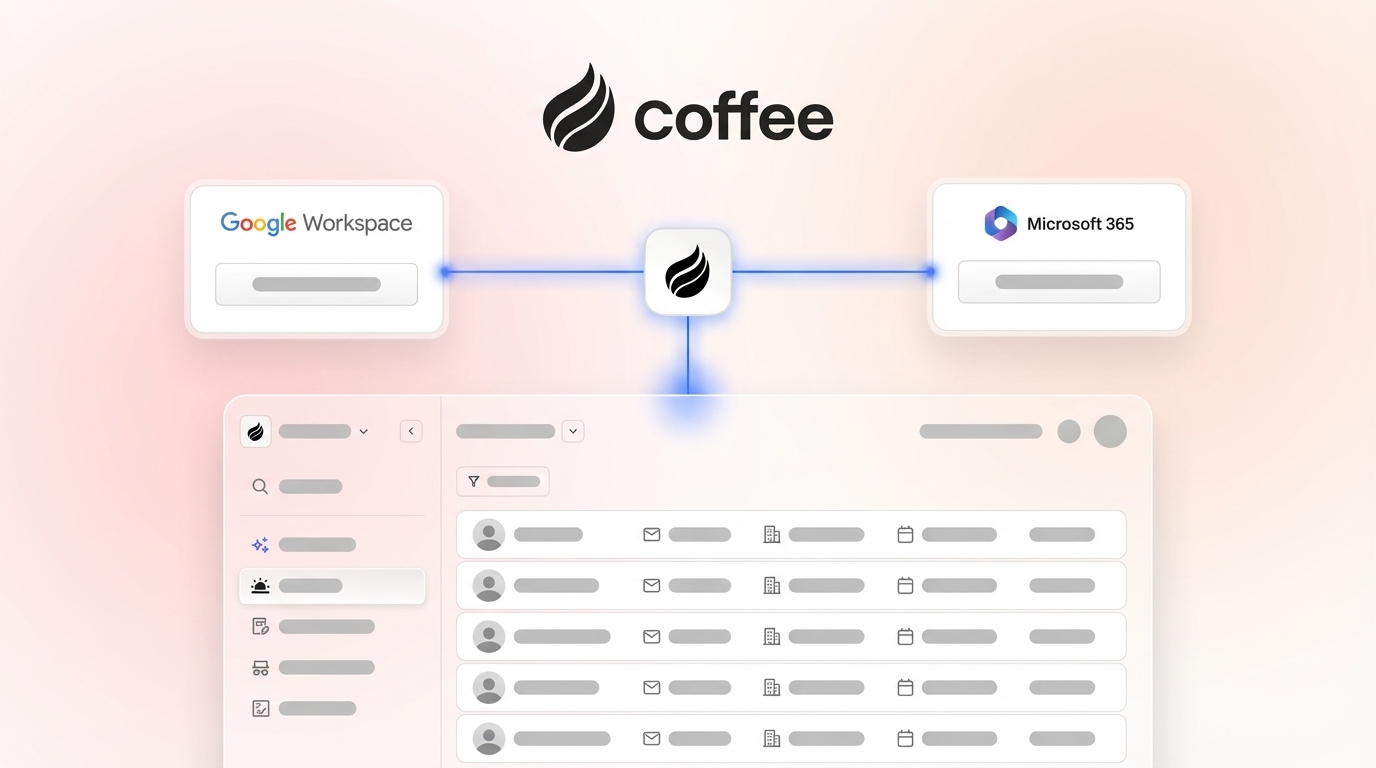
After connecting to Google Workspace or Microsoft 365, the Coffee Agent scans emails and calendars and populates the CRM with contacts and companies automatically. Every note and interaction links to the correct record without rep action. Automatic data capture from emails and calendar events eliminates manual entry, producing more complete CRM records with less effort. A scaling SaaS company that implemented calendar and email integration found that around 70% of buyer contacts engaged in the sales cycle were previously not added to CRM. The agent closed that gap automatically.
Build people lists automatically with Coffee AI CRM Agent
The Coffee Agent captures history in a built-in data warehouse, so the Pipeline Compare feature can visualize week-over-week changes automatically. It highlights progressed deals, stalled opportunities, and new additions. Pipeline reviews shift from interrogation sessions that ask why records were not updated to strategic discussions grounded in complete data. Teams using activity-based forecasting that automatically captures emails, calls, and meetings can see meaningful gains in forecast accuracy.
Create instant meeting follow-up emails with the Coffee AI CRM agent
2026 CRM Data-Quality Targets You Can Actually Reach
These targets stay realistic with agent automation. Validation rules and periodic audits alone rarely reach them.
15–25 percentage point improvement in forecast accuracy
Healthy CRM instances typically reach 80% or higher field completion, under 5% duplicate rate, and high accuracy verified against external sources. Effective CRM hygiene improves forecast accuracy by 20–30%, and AI-driven forecasting can improve forecast accuracy by 15–25 percentage points.
When to Stop Patching and Move to an Agent CRM
Validation rules, recurring audits, and enrichment tools still deserve a place in your stack. They cut the volume of bad data entering the system and catch issues before they corrupt reports. The ceiling appears when the underlying cause, manual data entry, stays the same. Manual CRM data entry is a system design failure, not a rep discipline problem. The CRM forces reps to stop selling and start typing at the exact moment they need to advance the deal.
The signal that it is time to move beyond patching shows up clearly. Audits surface the same gaps quarter after quarter, validation rules generate placeholder values instead of real data, and RevOps spends more time cleaning data than analyzing it. At that point, the fix is not another rule. The fix is removing the human from the data entry loop entirely.
Coffee’s Companion App deploys the agent on top of existing Salesforce or HubSpot instances with a simple authentication. No migration and no rip-and-replace. The agent begins capturing email, calendar, and call data immediately and writes enriched, structured records back to the CRM without rep involvement. Coffee is SOC 2 Type 2 and GDPR compliant, and data is never used to train public models.
What is incomplete CRM data and how does it affect forecasting?
Incomplete CRM data means records that miss one or more fields required for routing, forecasting, or handoff decisions, such as decision-maker contacts, close dates, deal amounts, activity logs, and next steps. When these fields stay blank or contain placeholders, the CRM produces forecasts that simply aggregate what the data shows instead of evaluating whether it is reliable. A pipeline review built on incomplete records will miss closed revenue, misallocate resources, and produce board reports that do not match reality. The problem compounds as data decays, because contacts change jobs, deals stall, and close dates pass without updates, so even complete records at entry become unreliable over time.
Does Coffee work with Salesforce and HubSpot, or does it replace them?
Coffee supports two deployment models. The Companion App sits on top of an existing Salesforce or HubSpot instance and acts as an autonomous agent that handles data capture, enrichment, and activity logging without migration or replacement. The agent authenticates with the existing CRM, reads emails, calendars, and call transcripts, and writes structured data back to the system of record automatically. For teams that want to move off legacy CRMs entirely, Coffee also offers a Standalone AI-first CRM where the agent powers the entire platform. Mid-market RevOps teams committed to Salesforce or HubSpot usually start with the Companion App.
How does Coffee handle data security and compliance?
Coffee is SOC 2 Type 2 certified and GDPR compliant. Data processed by the Coffee Agent does not train public AI models. The agent connects to Google Workspace or Microsoft 365 through standard authentication protocols, and the same security standards apply to the Salesforce and HubSpot integration. Teams in heavily regulated industries such as healthcare or finance that require multi-year security reviews or custom compliance frameworks may not find Coffee suitable, but mid-market sales and RevOps teams typically find that the security posture meets standard enterprise requirements.
How quickly will we see results after deploying the Coffee Agent?
The Coffee Agent begins capturing data immediately after authentication with Google Workspace or Microsoft 365. Contact creation, activity logging, and enrichment start on day one without manual configuration of individual fields. Pipeline Compare and forecast intelligence improve as the agent accumulates deal history in its built-in data warehouse. Teams usually see measurable gains in field completeness and rep time savings within the first few weeks. Deeper forecast accuracy improvements, which research places at 20–30 percentage points for activity-based capture versus manual logging, develop over the first quarter as the agent builds a complete activity history for open pipeline.
How does Coffee price the agent and platform?
Coffee uses seat-based pricing. You pay for the human seats on your team, and the agent’s work, including data capture, enrichment, activity logging, meeting management, and pipeline intelligence, is included without extra metering on AI usage or automated processes. You do not pay separately for the number of contacts enriched, calls transcribed, or workflows executed. This model lets the agent’s value scale with usage without cost scaling at the same rate. Pricing details and plan options appear on the Coffee pricing page.
Conclusion: From Patching CRM Data to Fixing It at the Source
The Reddit playbook for incomplete CRM data still holds up: implement stage-based validation, run recurring audits, automate email and calendar capture, and limit required fields to those tied to real decisions. These steps reduce bad data at the point of entry and catch decay before it corrupts forecasts. They form the right starting point for any RevOps team.
The limit of that playbook comes from its dependence on humans, who must run the audits, maintain the rules, and log the calls that enrichment tools do not capture. Manual entry remains the root cause of incomplete CRM data, and no combination of validation rules and quarterly cleanups removes it. An autonomous agent does.
Coffee’s agent captures every email, calendar event, and call transcript, structures that data, and writes it back to Salesforce or HubSpot without rep involvement. The result is a CRM that reflects reality instead of what reps chose to log, and forecasts that rely on complete data instead of defensible approximations.