Written by: Doug Camplejohn, CEO & Co-Founder, Coffee | Last updated: August 26, 2026
Key Takeaways for Fast Salesforce Setup
- Under-30-minute, no-code Salesforce integrations now define “easy” in 2026, and anything needing Apex or MuleSoft falls outside this bar.
- Manual processes still cost a typical 10-person sales team over 6,000 hours of lost selling time each year, so rapid automation matters.
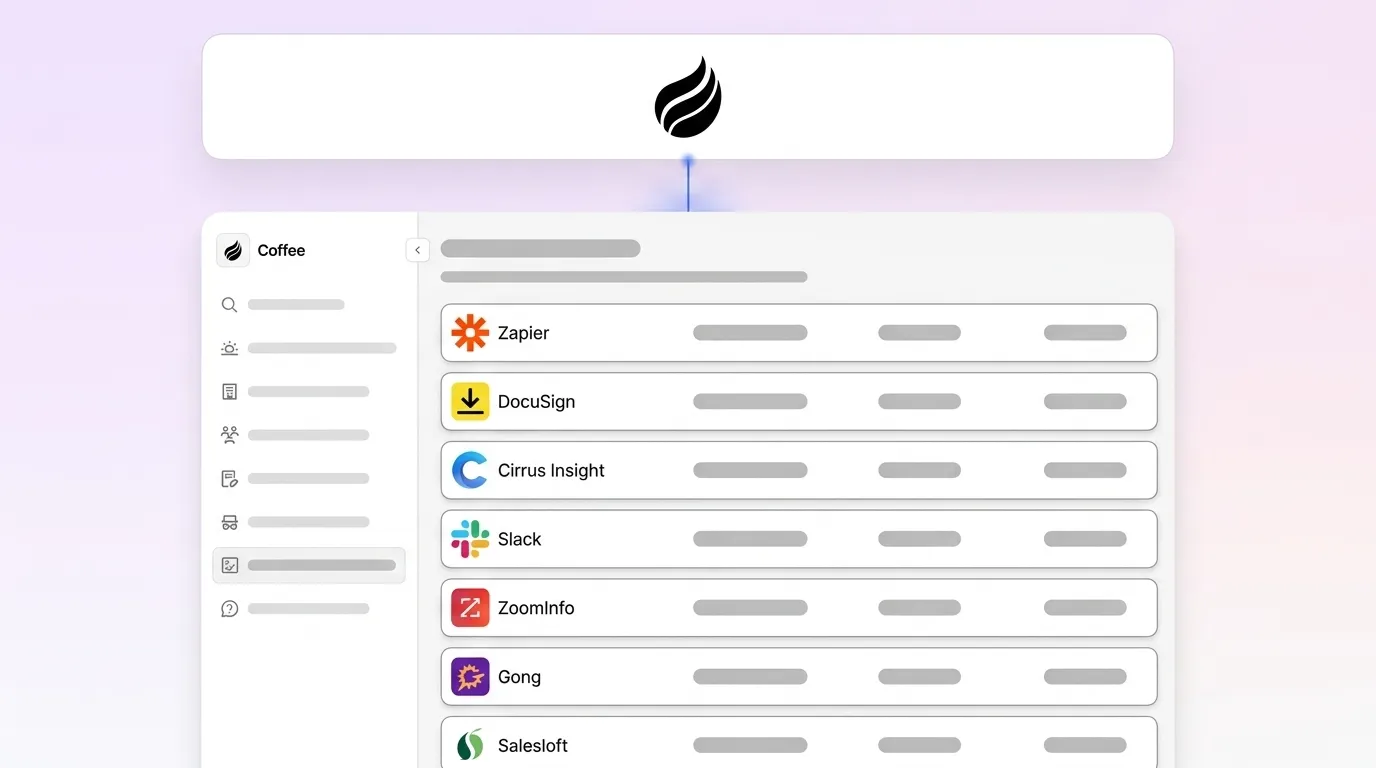
- The seven ranked apps range from 8 minutes (Zapier) to 28 minutes (Salesloft), yet each one adds several admin hours of monthly upkeep.
- Fragmented point solutions create duplicate records, broken field mappings, and hidden SaaS waste, and these issues compound as teams add tools.
- Coffee consolidates email logging, enrichment, meeting intelligence, sequencing, and more into a single autonomous agent; get started with Coffee to replace multiple subscriptions with one 10-minute OAuth install.
1. Zapier Salesforce Connector – 8 Minutes Setup, $29.99/mo
| Setup Time | Monthly Cost |
|---|---|
| ~8 minutes | From $29.99/mo |
Zapier connects Salesforce to hundreds of external apps through a point-and-click trigger-action interface. No-code Salesforce integration tools such as Zapier require zero programming knowledge and can be set up in hours for Salesforce admins and business analysts. For SMB and departmental use cases such as simple triggers and actions, Zapier is the lightweight automation tool of choice without heavy IT involvement.
That simplicity becomes a constraint as workflows grow more complex. The practical ceiling comes from its event-driven, one-step-at-a-time logic. Complex multi-object workflows need chained Zaps that increase subscription costs and break when field mappings drift. Ongoing maintenance is real, because every Salesforce schema change risks a broken Zap that silently stops logging data.
Setup steps:
- Create a Zapier account and select the Salesforce app.
- Authenticate with your Salesforce org via OAuth.
- Choose a trigger such as “New Lead in Salesforce” and an action app such as Slack or Gmail.
- Map fields using the point-and-click editor.
- Test the Zap with a live record and turn it on.
2. DocuSign for Salesforce – 12 Minutes to Connect
| Setup Time | Monthly Cost |
|---|---|
| ~12 minutes | Varies |
DocuSign for Salesforce includes the Salesforce connector add-on. The AppExchange package installs in minutes, yet the real project takes longer. AppExchange packages like DocuSign often require 2–4 weeks for full implementation. The 12-minute figure applies only to the initial OAuth connection and first template send.
A common Salesforce e-signature integration challenge is that signing occurs in one tool while the resulting data must be manually re-entered into Salesforce, creating extra work for small and mid-market teams. Envelope quotas are frequently capped, and bulk sends count toward these limits, which creates workflow constraints for high-volume teams.
Setup steps:
- Install the DocuSign AppExchange package from the Salesforce AppExchange listing.
- Authenticate DocuSign with your Salesforce org via the post-install configuration wizard.
- Map Salesforce Opportunity fields to DocuSign merge fields in the template editor.
- Assign DocuSign permission sets to relevant user profiles.
- Send a test envelope from an Opportunity record to confirm status sync.
3. Cirrus Insight Sidebar – 15 Minutes Setup, $35/user/mo
| Setup Time | Monthly Cost |
|---|---|
| ~15 minutes | From $35/user/mo |
Cirrus Insight embeds a Salesforce sidebar directly inside Gmail or Outlook, so reps can log emails, book meetings, and sync calendar events without leaving their inbox. Setup involves a browser extension install plus an OAuth handshake with Salesforce, which a single user can complete in under 15 minutes.
The maintenance burden accumulates over time. Every Gmail API policy change or Salesforce release can break the sidebar sync, requiring admin intervention to restore functionality. Even when the sync works correctly, teams running multiple activity-capture tools face a different issue. Overlapping activity capture tools can log the same meeting or email more than once, inflating activity counts, creating duplicates, and breaking automations that depend on last activity date or meeting volume. Coffee collapses email and calendar sync into a single authenticated agent that writes clean, deduplicated activity data back to Salesforce automatically, with no sidebar extension required.
Setup steps:
- Install the Cirrus Insight browser extension from the Chrome Web Store or Outlook Add-ins store.
- Sign in with your Google or Microsoft account.
- Connect to Salesforce via OAuth in the Cirrus Insight settings panel.
- Configure which Salesforce objects such as Contacts, Leads, and Opportunities appear in the sidebar.
- Send a test email and confirm the activity appears on the correct Salesforce record.
4. Slack Salesforce Integration – 18 Minutes Setup, $8/user/mo
| Setup Time | Monthly Cost |
|---|---|
| ~18 minutes | From $8/user/mo |
The native Slack for Salesforce integration surfaces CRM record previews, deal alerts, and approval notifications directly in Slack channels. Agentforce Sales agents operate directly within Sales Cloud and Slack to automate prospecting, qualifying leads, booking meetings, and generating quotes, saving teams up to 25 hours a week without requiring separate applications.
The base integration focuses on reading data. Writing data back to Salesforce from Slack requires additional Flow configuration or Agentforce setup. For teams already paying for Salesforce and Slack separately, the connector adds minimal incremental cost but still needs an admin to configure record alerts, channel routing, and notification rules. Those rules need revisiting whenever pipeline stages or team structures change.
Setup steps:
- Open the Salesforce AppExchange and install the Slack for Salesforce app.
- Authorize the Slack workspace from the Salesforce Setup menu.
- Map Salesforce record types to Slack channels using the configuration wizard.
- Set up deal alert criteria such as Opportunity stage changes in Salesforce Flow.
- Test by advancing a sandbox Opportunity stage and confirming the Slack notification fires.
5. ZoomInfo Salesforce Sync – 22 Minutes Setup, $125/user/mo
| Setup Time | Monthly Cost |
|---|---|
| ~22 minutes | From $125/user/mo |
ZoomInfo’s Salesforce sync enriches Contact and Account records with firmographic and contact data pulled from ZoomInfo’s database. The AppExchange connector authenticates quickly, while field mapping requires careful choices about which ZoomInfo attributes overwrite existing Salesforce fields to avoid data collisions.
A 2024 Gartner study found that poor data quality costs organizations an average of $12.9 million per year, with dirty data in Salesforce manifesting as duplicate leads and contacts that inflate pipeline metrics, missing required fields that break workflow triggers, inconsistent field formats, and stale records. ZoomInfo improves enrichment but adds a $125/user/mo line item and a separate login. Coffee’s built-in data enrichment, sourced via licensed data partners, augments records with job titles, funding data, and LinkedIn profiles inside the same agent that handles activity logging, which removes the need for a standalone enrichment subscription.

Setup steps:
- Install the ZoomInfo Salesforce integration from the AppExchange.
- Authenticate with ZoomInfo credentials in the post-install setup wizard.
- Configure field mapping rules to determine which Salesforce fields ZoomInfo data populates or overwrites.
- Set sync frequency such as real-time, daily, or on-demand in the ZoomInfo admin panel.
- Run an enrichment test on a sample of 10 Contact records and audit field accuracy.
6. Gong for Salesforce – 25 Minutes Setup, $99/user/mo
| Setup Time | Monthly Cost |
|---|---|
| ~25 minutes | From $99/user/mo |
Gong records, transcribes, and analyzes sales calls, then writes deal intelligence back to Salesforce Opportunity records. The Salesforce connector setup involves OAuth authentication, object mapping, and configuration of which Gong insights populate which Salesforce fields, which takes roughly 25 minutes for an admin familiar with both platforms.
Einstein Activity Capture does not store activities as standard Salesforce Task or Event records, which limits standard reporting, Flow and automation use cases, and logging to specific opportunities. That constraint also affects third-party conversation intelligence tools writing to non-standard objects. At $99/user/mo, Gong becomes one of the higher-cost line items in a mid-market stack. Coffee’s AI Meeting Bot joins calls via Zoom, Teams, or Meet, generates BANT, MEDDIC, or SPICED-structured summaries, and writes them directly to the correct Salesforce records. All of this sits inside the Coffee subscription.

Setup steps:
- Install the Gong for Salesforce package from the AppExchange.
- Connect Gong to Salesforce via OAuth in the Gong workspace settings.
- Map Gong deal intelligence fields such as next steps and risks to Salesforce Opportunity custom fields.
- Configure calendar integration with Google or Outlook so Gong auto-joins scheduled calls.
- Record a test call and verify the transcript and deal insights appear on the linked Opportunity.
7. Salesloft Salesforce Connector – 28 Minutes Setup, $75/user/mo
| Setup Time | Monthly Cost |
|---|---|
| ~28 minutes | From $75/user/mo |
Salesloft connects sequencing, dialing, and email cadences to Salesforce and logs activities against Leads, Contacts, and Opportunities. The connector setup requires OAuth authentication, field mapping for activity logging, and cadence-to-stage alignment, which makes it the most configuration-intensive setup on this list.
Zylo’s 2025 SaaS Management Index reports that the average enterprise runs 275 SaaS applications with 51% of licenses unused monthly, creating $21 million in annual shelfware waste. Salesloft at $75/user/mo becomes a significant recurring cost for a tool whose core job, sequencing outreach and logging it to Salesforce, Coffee’s Campaigns feature handles natively. Coffee runs multi-step, AI-generated email sequences from the rep’s own connected mailbox, uses stop-on-reply logic, and writes every activity back to Salesforce automatically, so no separate sequencing subscription is required.

Setup steps:
- Install the Salesloft AppExchange package and complete the post-install configuration wizard.
- Authenticate Salesloft with Salesforce via OAuth and assign permission sets to users.
- Map Salesloft activity types such as calls, emails, and meetings to Salesforce Task and Event records.
- Align Salesloft cadence stages to Salesforce Opportunity stages in the field mapping panel.
- Connect each rep’s Google or Microsoft mailbox to Salesloft for sequence sending.
- Run a test cadence on a sandbox Lead and confirm all activities log to the correct Salesforce record.
Get started with Coffee and consolidate sequencing, enrichment, and call intelligence into one agent that writes clean data to Salesforce automatically.
Setup Time vs. Ongoing Maintenance Comparison for 2026
| Tool | Setup Time | Monthly Cost (per user) | Estimated Monthly Maintenance (hrs/admin) |
|---|---|---|---|
| Zapier | ~8 min | From $29.99/mo (account) | 2–4 hrs (broken Zap monitoring, field-map updates) |
| DocuSign for Salesforce | ~12 min (OAuth); weeks for production (see above) | Varies | 1–3 hrs (template updates, envelope quota audits) |
| Cirrus Insight | ~15 min | From $35/user/mo | 2–3 hrs (duplicate activity cleanup, extension updates) |
| Slack Salesforce Integration | ~18 min | From $8/user/mo | 1–2 hrs (alert rule tuning, channel re-mapping) |
| ZoomInfo Salesforce Sync | ~22 min | From $125/user/mo | 2–4 hrs (field collision audits, ongoing data governance) |
| Gong for Salesforce | ~25 min | From $99/user/mo | 2–3 hrs (object mapping reviews, transcript QA) |
| Salesloft Connector | ~28 min | From $75/user/mo | 3–5 hrs (cadence-stage alignment, activity deduplication) |
| Coffee Companion App | ~10 min (single OAuth) | Seat-based; replaces above tools | 0 hrs (autonomous agent, no manual stitching) |
Data must be continuously governed as a dynamic asset, not treated as a one-time cleanup project. Every point solution above requires recurring admin hours to stay functional. 95% of organizations struggle with data integration challenges, most often due to mismatched API versions, inconsistent field mapping, and undocumented dependencies when connecting Salesforce to marketing automation, ERP systems, and enrichment tools. Coffee’s agent layer removes that maintenance surface entirely.
Decision Matrix: Matching Apps to Your Salesforce Stack
| Company Size & Pain Point | Best Point-Solution Fit | Consolidation Alternative |
|---|---|---|
| 1–20 employees; need basic workflow automation between Salesforce and other apps | Zapier | Coffee Standalone CRM (agent-native, no Salesforce license needed) |
| 10–50 employees; contracts slow deals by 2–3 days | DocuSign for Salesforce | Coffee Companion App (native document follow-up via AI-drafted emails) |
| 10–100 employees; reps not logging emails or meetings to Salesforce | Cirrus Insight | Coffee Companion App (auto-logs all email and calendar activity) |
| 20–200 employees; deal alerts buried in email | Slack Salesforce Integration | Coffee Companion App (real-time Slack notifications for website visitors and pipeline changes) |
| 20–200 employees; Salesforce records missing firmographic data | ZoomInfo Salesforce Sync | Coffee Companion App (built-in enrichment via licensed data partners) |
| 20–200 employees; no visibility into call quality or deal risk | Gong for Salesforce | Coffee Companion App (AI Meeting Bot with BANT/MEDDIC/SPICED summaries) |
| 20–200 employees; manual outreach sequencing and inconsistent follow-up | Salesloft Connector | Coffee Companion App (native Campaigns with stop-on-reply and AI-generated sequences) |
| Any size; running 3+ of the above tools with growing maintenance burden | – | Coffee Companion App (single agent replaces all six) |
Frequently Asked Questions
What is the easiest Salesforce sales app to integrate with no code in 2026?
Zapier is the fastest to authenticate, at roughly eight minutes to a working trigger-action workflow, which makes it the easiest entry point for non-technical RevOps managers. However, “easiest to start” and “easiest to maintain” measure different things. Zapier requires ongoing monitoring as Salesforce schema changes break field mappings silently. Coffee authenticates via a single OAuth connection in approximately ten minutes and then operates autonomously, requiring zero ongoing maintenance hours from an admin. For teams whose core problem is manual data entry rather than app-to-app event routing, Coffee delivers faster sustained time-to-value.
How long does it really take to set up a Salesforce integration in 2026?
Initial OAuth connections for AppExchange tools range from eight to twenty-eight minutes for the apps on this list. Full production readiness, which includes field mapping, user training, and data quality validation, takes longer. No-code workflow tools built by non-technical operations managers have a documented median deployment time of one to three days. More complex implementations involving multiple stakeholder groups, data migration, and custom automation typically take three to five months. The Salesforce 2026 Agentic Enterprise Index found that the average time to create and deploy a new agent fell to 1.9 days by April 2026, which shows how AI-assisted tooling has compressed the build clock, while decision, dependency, and adoption timelines remain controlled by human factors.
What replaces multiple Salesforce point solutions in 2026?
The 2026 Agentic Enterprise Index documents a clear shift as organizations nearly tripled the number of active AI agents while reducing agent creation times by 53%, moving away from fragmented point solutions toward native agent layers. Coffee’s Companion App for Salesforce is purpose-built for this consolidation. A single authenticated install deploys an agent that handles automatic contact and company creation, data enrichment, activity logging, AI meeting recording and summarization, pipeline change tracking, outreach sequencing via Campaigns, and website visitor identification. This replaces the functional scope of Cirrus Insight, ZoomInfo, Gong, Salesloft, and Zapier in one subscription. Coffee is SOC 2 Type 2 and GDPR compliant, and data is never used to train public models.

How does poor Salesforce data quality affect sales teams, and how is it prevented?
As noted in the ZoomInfo section, poor data quality carries a steep cost, and Gartner pegs it at $12.9 million annually, manifesting as duplicate leads, broken workflow triggers, and stale records that undermine AI features. Many sales teams deal with poor CRM data quality, and Databar estimates that sales reps spend roughly 546 hours per year dealing with inaccurate CRM data. The root cause is structural, because Salesforce is designed for managers to view pipeline status, not for reps, so reps rationally skip updates with no personal incentive to maintain field hygiene. Coffee’s agent removes this incentive problem by taking humans out of the data-entry loop. The agent scans emails, calendars, and call transcripts to populate and update records automatically, which keeps input accurate so pipeline reporting and forecasting stay reliable.
Is Coffee secure enough for a mid-market company’s Salesforce data?
Coffee is SOC 2 Type 2 and GDPR compliant. Data ingested by the Coffee agent, including emails, calendar events, and call transcripts, is not used to train public AI models. The Companion App connects to Salesforce via standard OAuth, the same authentication mechanism used by every AppExchange tool on this list. For mid-market companies in the 10–200 employee range that are not in heavily regulated industries such as healthcare or finance requiring multi-year security reviews, Coffee’s compliance posture is sufficient for production deployment. An AI solutions company generating tens of millions in revenue moved its entire sales operation off spreadsheets onto Coffee, citing automatic contact creation from Google Workspace and the Pipeline Compare feature as the two capabilities that made the transition immediate and irreversible.
Stop Adding Tools and Consolidate with Coffee
Every app on this list solves one problem and creates another, such as a new subscription, a new field-mapping dependency, a new source of duplicate records, and a new admin task on the quarterly data hygiene checklist. The SaaS point-solution era is ending because of data silos that lack operational context, while horizontal platforms with contextual richness and vast proprietary data moats are poised to dominate the next decade.
The Coffee Companion App for Salesforce installs in approximately ten minutes via a single OAuth connection. From that moment, the Coffee agent handles automatic contact and company creation from Google Workspace or Microsoft 365, data enrichment with job titles and LinkedIn profiles, activity logging for every email and meeting, AI Meeting Bot recording and BANT, MEDDIC, or SPICED-structured summaries, Pipeline Compare for week-over-week deal tracking, native Campaigns for multi-step outreach sequences, and website visitor identification with Suggested Leads. That is the functional scope of six of the seven apps on this list, delivered by one agent with zero ongoing maintenance hours.
According to Salesforce’s 2026 Agentic Enterprise Index, organizations that moved to agent-led workflows reduced average agent creation time by 53% and saw agents expand from two skills to six cross-system skills over 14 months. The direction of the market is unambiguous. Deloitte forecasts that the global agentic AI market could reach US$45 billion in 2030, contingent on proper orchestration. Heads of Sales and RevOps now face a timing decision about consolidation rather than a question of whether consolidation will happen.
Get started with Coffee and replace your fragmented Salesforce sales app stack with a single autonomous agent that delivers good data in and good data out, starting today.