Written by: Doug Camplejohn, CEO & Co-Founder, Coffee | Last updated: August 19, 2026
Key Takeaways
- Coffee saves sales reps 8–12 hours per week by capturing emails, calls, and meetings without manual entry.
- Legacy CRMs force reps to spend 25–30% of their week on data entry, costing teams of 10 reps roughly 100 lost selling hours weekly.
- Three evaluation criteria matter most: hours saved per rep, depth of unstructured-data capture, and total cost of ownership.
- Coffee outperforms competitors by using an autonomous agent architecture that eliminates manual CRM updates entirely.
- Teams ready to reclaim those hours can get started with Coffee today.
The 5–12 Hours Reps Lose Every Week
Sales reps lose a meaningful share of their week to CRM admin instead of selling. Reps dedicate roughly 28–30% of their workweek to actual selling, with CRM data entry among the largest categories of non-selling work. A Forrester Activity Study tracking 3,031 reps found CRM data entry and pipeline updates consume 17% of the average rep’s week, roughly 6.8 hours. Separate analysis puts the figure higher: sales representatives lose 10 to 11 hours per week to manual CRM data entry, equal to 25–30% of a full workweek.
For a team of 10 reps, that 25% admin burden translates to roughly 100 lost selling hours per week, the equivalent of 2.5 full-time sellers doing nothing but data entry. The root cause is architectural. Legacy CRMs were designed for management reporting, not seller productivity. They require human input after every call, email, and meeting. 75% of respondents say staff fabricates CRM data to tell the story they want decision makers to hear. Bad data in, bad forecasts out.
Three Criteria That Actually Matter
Solving the time-loss problem requires a different kind of CRM, not more effort from reps. The right evaluation framework helps teams choose platforms that remove manual entry instead of adding more tasks. Three criteria separate time-saving CRMs from time-sink CRMs.
- Hours saved per rep per week: This metric shows whether the CRM serves the rep or the rep serves the CRM. Anything under 4 hours saved weekly is noise.
- Depth of unstructured-data capture: Legacy relational databases store structured fields only. Email text, call transcripts, and meeting notes are where deals actually live. A CRM that cannot ingest and structure unstructured data leaves the most valuable context unused.
- Total cost of ownership (TCO): Seat cost is only one line item. Teams also pay for enrichment tools, recording software, and sequencing platforms. Once those are included, the real price of a “cheap” CRM becomes clear.
Hours Saved: Side-by-Side Comparison
The table below compares estimated weekly hours saved per rep. Coffee’s figures reflect its autonomous agent architecture. Competitor figures reflect aggregated AI-assisted CRM benchmarks from Outreach’s 2026 Agent Productivity Impact Report and the Revenue Velocity Lab (N=938 reps), and published product capabilities for each platform.
| CRM | Architecture | Est. Hours Saved / Rep / Week | Primary Mechanism |
|---|---|---|---|
| Coffee | Autonomous agent | 8–12 hrs | Full auto-capture: email, calendar, calls, enrichment, follow-ups |
| Day.ai | AI-assisted, unstructured focus | 5–18 hrs | Productivity and meeting capture, limited structured-data automation |
| Close | Passive DB + built-in calling | 8–12 hrs | Auto-logging of calls made within Close, manual entry elsewhere |
| HubSpot | Passive DB + AI add-ons | 7.5 hrs | AI email assist and partial auto-logging, reps still update fields manually |
| Salesforce | Passive DB + Einstein AI | 3.5 hrs/day (~17.5 hrs/week) | AI suggestions, manual entry remains the default for most fields |
See Coffee’s pricing and calculate your team’s time savings
How Each CRM Handles Data, Meetings, and Stack Bloat
Data Capture Architecture
Legacy CRMs rely on a relational database model built before large language models existed. When a field is updated, historical context disappears. Salesforce carries decades of that architecture. HubSpot bolted a CRM onto a marketing platform, so it was never designed as a unified intelligence system. Neither product ingests unstructured data such as email threads, call transcripts, and meeting notes without expensive middleware or manual copy-paste.
Coffee’s agent connects to Google Workspace or Microsoft 365 and quickly begins scanning emails and calendars to auto-create contacts, companies, and activity logs. It stores everything in a built-in data warehouse, which preserves historical context instead of overwriting it. An AI-native CRM that automatically captures emails, meetings, and calls can produce a 60–80% reduction in data-entry time.

Meeting-to-CRM Workflow
In a passive CRM, a rep finishes a call and then spends 10–15 minutes logging notes, updating fields, and drafting a follow-up. Preparing a complete account brief before a call can drop from 45–60 minutes to 15 minutes with an AI-native CRM, recovering substantial time weekly for reps with multiple meetings. Coffee’s agent joins calls through its AI meeting bot, transcribes in real time, generates summaries and next steps after the call, and drafts follow-up emails in Gmail for one-click review. The rep focuses on selling while the agent handles the admin work.

Pipeline Intelligence
Salesforce and HubSpot pipeline reviews depend on reps logging accurate data. When they have not, and as noted earlier, three-quarters of reps admit to fabricating data, the forecast becomes fiction. Coffee’s Pipeline Compare feature automatically visualizes week-over-week changes. It highlights progressed deals, stalled opportunities, and new additions without any CSV export. Because the agent ensures clean data enters the system, the intelligence that comes out stays reliable.

Stack Consolidation
A typical Salesforce or HubSpot user also pays for ZoomInfo for enrichment, Gong or Fathom for recording, Outreach or Salesloft for sequencing, and a separate prospecting database. Coffee’s agent performs all of those functions natively. It provides enrichment via licensed data partners, an AI meeting bot, Campaigns for multi-step email sequences, Lead Finder for prospecting, and Visitor Identification for anonymous web traffic. Teams manage fewer subscriptions and one agent, which lowers TCO.
What Reps Say in 2026
Reps in forums, Slack communities, and sales subreddits in 2026 describe similar frustrations with legacy CRMs. Common patterns include:
- “I spend more time updating Salesforce than I do talking to prospects.”
- “HubSpot is a great marketing tool. As a CRM for a small sales team, it’s a chore I resent.”
- “We have a ‘shadow CRM’ in Notion because the real CRM is always out of date.”
- “My manager asks why the pipeline is wrong. I was on calls all day and did not have 90 minutes to log everything.”
These complaints align with the data. 71% of sales reps spend five or more hours a week on manual CRM data entry. The rep who treats the CRM as a chore is the norm, not the exception, under passive-database architectures.
Choosing the Right Coffee Deployment for Your Team
Coffee offers two deployment models. Matching the right one to team size and existing stack reduces implementation risk.
Coffee Standalone CRM — Best for 1–20 reps with no entrenched CRM:
- Ideal for founders and early sales hires who have outgrown spreadsheets or Notion and need a proper CRM without heavy overhead.
- Because the agent is the system of record from day one, there is no migration of complex workflows from a previous CRM.
- Setup is straightforward. Connect Google Workspace or Microsoft 365, and the agent begins populating records from email and calendar history immediately.
- Smaller organizations see faster productivity gains from CRM automation because they can implement changes quickly and have fewer legacy processes to untangle.
Coffee Companion App — Best for teams already on Salesforce or HubSpot:
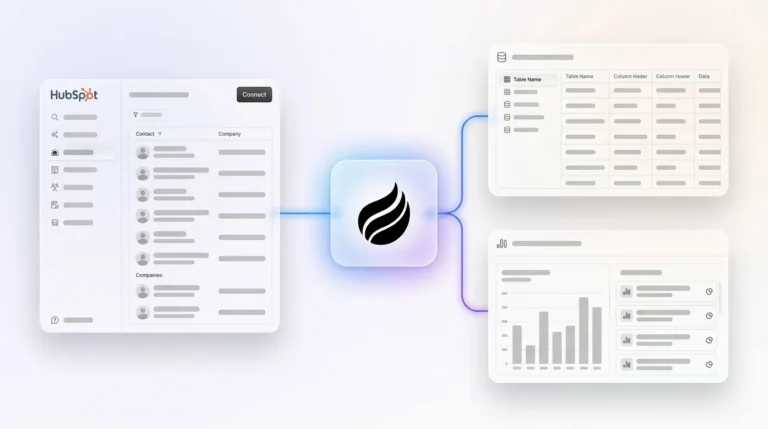
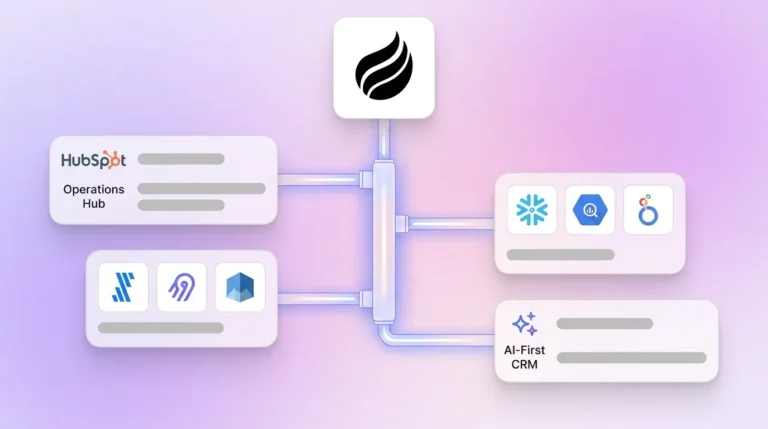
- Deploys as an intelligent layer on top of an existing instance through simple authentication.
- The agent handles data entry, enrichment, and meeting capture, then writes clean data back to Salesforce or HubSpot fields, including required fields, quotas, and forecasting structures that newer AI CRMs cannot handle.
- Improves adoption and data quality without forcing a platform migration.
- Replaces fragmented point solutions such as ZoomInfo, Gong, and Salesloft with one agent subscription.
Choose your Coffee deployment model
One-Page Checklist for Selecting Coffee
Use the criteria below to identify the right path for your team and stack.
- Team size 1–20, no existing CRM or using spreadsheets/Notion: Choose Coffee Standalone.
- Team size 1–20, committed to HubSpot or Salesforce: Choose Coffee Companion.
- Reps logging more than 1 hour per day in the CRM manually: Any Coffee deployment typically recovers that time within the first week.
- Pipeline reviews require CSV exports or manual prep: Coffee’s Pipeline Compare removes both steps.
- Paying separately for enrichment, recording, and sequencing tools: Coffee consolidates all three, so calculate TCO before renewing those contracts.
- Data quality is poor and forecasts are unreliable: The agent-first architecture improves inputs, and accurate output follows.
Conclusion: Why Agent-First CRMs Win Back Selling Time
Legacy CRMs act as passive databases that require reps to serve them. For roughly 25 years, the model has stayed the same. A human logs every call, updates every field, and exports every report. Teams using AI-powered CRM automation cut admin time by 60–80%, but only agent-led systems, not AI-assisted passive databases, remove the manual entry requirement entirely. Coffee’s autonomous agent flips the model so the agent does the work, the rep does the selling, and 8–12 hours per week return to the pipeline.
Start reclaiming your team’s selling hours
Frequently Asked Questions
How long does it take to implement Coffee?
For the Standalone CRM, implementation requires connecting Google Workspace or Microsoft 365. The Coffee agent begins scanning emails and calendars to auto-populate contacts, companies, and activity logs immediately after authentication. Most teams have a working CRM within the same day. The Companion App for Salesforce or HubSpot also deploys through a simple authentication step. After that, the agent begins writing enriched data back to existing fields. Teams under 20 reps avoid lengthy configuration projects, data model redesigns, and outside consultants.
How difficult is data migration when switching from Salesforce or HubSpot?
Teams moving to Coffee Standalone can import existing records in standard formats. Many small teams find that Coffee’s agent repopulates contact and company records automatically from email and calendar history, which reduces the urgency of a full migration. Teams that prefer to keep Salesforce or HubSpot as the system of record use Coffee Companion instead. This approach removes migration entirely because the agent layers on top of the existing instance and enriches it without replacing it.
What security certifications does Coffee hold?
Coffee is SOC 2 Type 2 certified and GDPR compliant. Data ingested by the agent is not used to train public AI models. For teams in heavily regulated industries such as healthcare or finance that require multi-year security reviews or custom compliance frameworks, Coffee is not the recommended fit at this stage.
Can Coffee handle required Salesforce fields, quotas, and forecasting structures?
Yes. This capability is a meaningful differentiator versus newer AI CRM alternatives like Day.ai or Clarify, which lack deep understanding of Salesforce’s required-field logic, quota structures, and forecasting hierarchies. Coffee’s Companion App was built with these integration complexities in mind. The agent writes data back to Salesforce in a way that respects required fields and existing workflow rules. Adoption improves without breaking reporting or forecasting processes.
Does Coffee replace tools like ZoomInfo, Gong, and Outreach?
For most teams under 20 reps, it does. Coffee’s agent includes built-in data enrichment via licensed data partners, which can replace ZoomInfo or Apollo. It offers an AI meeting bot that records and transcribes calls, which can replace Gong or Fathom. The Campaigns feature runs multi-step email sequences from the rep’s own mailbox, which can replace Outreach or Salesloft. It also includes Lead Finder for prospecting and Visitor Identification for anonymous web traffic. Teams currently paying for several of these tools separately often find that Coffee’s seat-based pricing reduces total stack cost while consolidating the workflow into one agent.