Written by: Doug Camplejohn, CEO & Co-Founder, Coffee | Last updated: August 6, 2026
Key Takeaways
- Custom fields track renewal dates, compliance IDs, and deal-specific attributes that default CRM schemas miss.
- Legacy platforms like HubSpot, Pipedrive, and Zoho rely on heavy manual data entry, which drives low fill rates and unreliable pipeline data.
- Coffee’s agent-led automation creates and enriches custom fields from email, calendar, and call transcripts, so most data entry disappears.
- Teams using Coffee recover hundreds of hours per quarter that would otherwise disappear into CRM admin work.
- See Coffee in action and let your contact data maintain itself with custom fields that stay current on every plan.
Why Custom Fields Matter in Contact Management Software
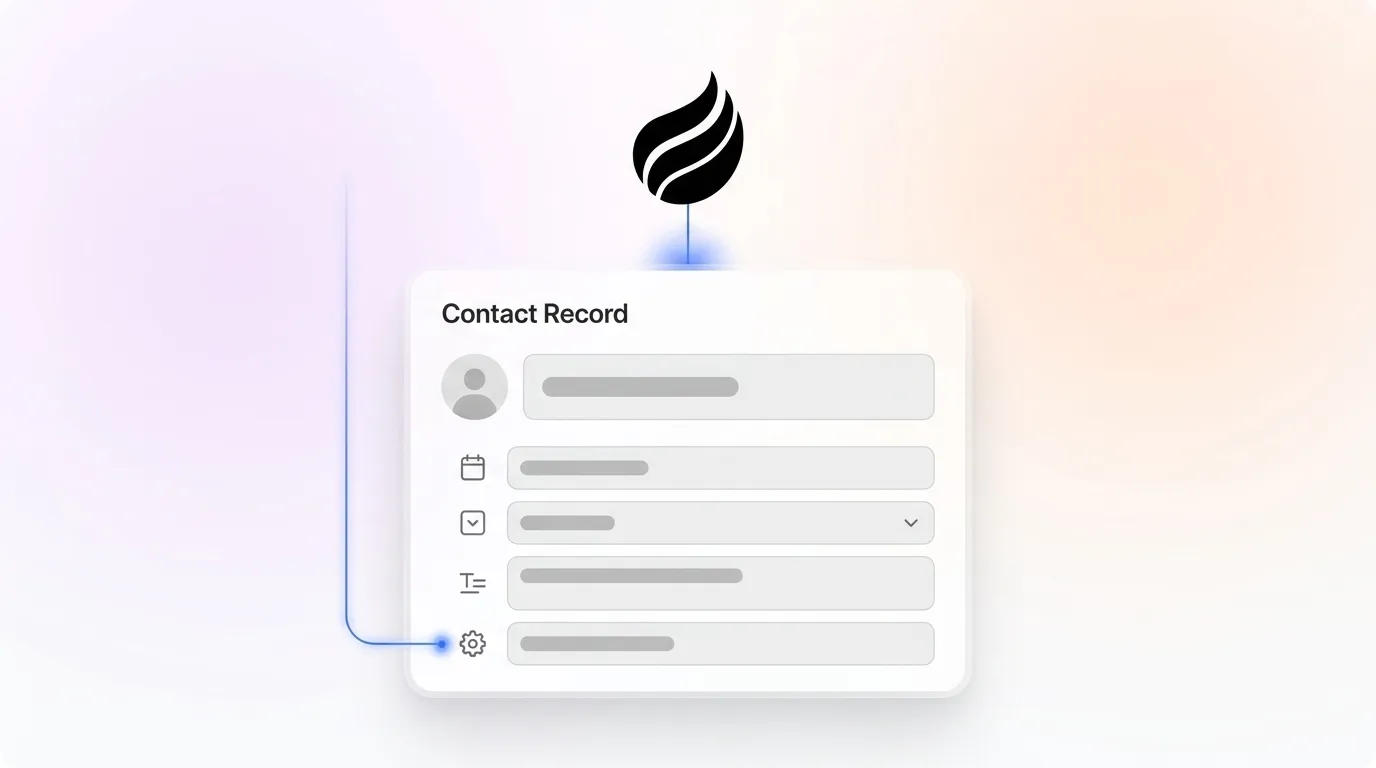
Custom fields are user-defined data attributes added to contact, company, deal, or activity records beyond a platform’s default schema. A SaaS team might add a “Contract Renewal Date” field to trigger automated outreach. A professional-services firm might add a “Compliance ID” field to satisfy audit requirements. A recruiting firm might add “Preferred Location” to segment candidates.
Without these fields, teams fall back to free-text notes. Notes cannot be filtered, reported on, or used in workflows. B2B contact data decays at 22–30% per year, and 37% of sales reps fabricate entries to satisfy required CRM fields. The CRM may look full, yet forecasts stay unreliable. Structured custom fields, especially when auto-populated, create the foundation for trustworthy pipeline data.
Custom Field Types Sales Teams Use Every Day
These field types cover most non-standard sales data, as documented in Gangly’s 2026 CRM best-practices benchmark:
- Text, such as champion name, compliance ID, or account ID, with regex or character limits to enforce format.
- Number / Currency, such as MRR, ARR potential, deal size, or employee count, validated with minimum and maximum bounds.
- Date, such as contract renewal date, close date, or last meaningful touch, often paired with workflow triggers.
- Dropdown (single-select), such as lead source, ICP fit, or deal stage loss reason, which stays reportable and filterable.
- Multi-select, such as buying signals, pain themes, or competitors evaluated, ideally capped at 10 values.
- Checkbox / Boolean, such as NDA signed, security review required, or procurement involved.
- Relationship / Lookup, which links one record to another instead of storing a related name as free text.
- Formula, which computes values such as days since last activity or weighted pipeline score.
These field types form the building blocks. The next step is evaluating how well each platform supports creating, populating, and maintaining them at scale.
How to Evaluate CRM Software with Custom Fields
Seven criteria show whether a platform’s custom-field implementation actually supports a growing sales team:
- Data quality, meaning fields stay populated with consistent, structured values instead of free-text noise.
- Automation depth, meaning the platform can auto-create and enrich fields from email, calendar, and call transcripts instead of relying on manual entry.
- Setup effort, meaning the time and skill required for initial field configuration.
- User adoption, meaning reps fill fields reliably instead of letting fill rates collapse below 30%.
- Integration complexity, meaning how many extra tools are required to connect enrichment, sequencing, and recording.
- Reporting visibility, meaning custom fields appear in native reports and pipeline views without exports.
- Long-term scalability, meaning field caps and performance as the team and schema grow.
See how Coffee’s automation compares to manual CRM workflows.
HubSpot, Pipedrive, Zoho CRM, and Coffee: Custom Fields Compared
| Criteria | HubSpot | Pipedrive | Zoho CRM | Coffee |
|---|---|---|---|---|
| Custom field types supported | Various field types | Text, number, date, dropdown, multi-select, phone, monetary | Text, number, date, dropdown, checkbox, multi-select, formula | All standard types, auto-created from email, calendar, and call transcripts |
| Free-tier custom field limit | 10 fields on free plan | No free tier, trial only | Limited custom fields on free plan | Seat-based pricing, no field-count cap |
| Paid-tier field limit | Up to 1,000 on paid plans | Varies by tier, no published hard cap | Varies by edition, enterprise tiers allow extensive fields | No published hard cap, governed by agent-led field lifecycle |
| Automated field population from email/calendar/calls | Basic enrichment on free tier (up to 1,000 contacts), advanced automation behind paid hubs | Manual entry, third-party integrations required for enrichment | Basic task automation, no native call-transcript enrichment | Agent scans email, calendar, and calls to auto-create and enrich fields natively |
| Median rep admin time (weekly) | Several hours per week for legacy CRM users | Under 2 hours per week with automated extraction (Gangly 2026 benchmark) | ||
| Native reporting on custom fields | Yes on paid tiers, restricted on free | Yes on paid tiers | Restricted on free plan | Yes, Pipeline Compare surfaces field-level changes week over week |
| Companion App for existing CRM | No | No | No | Yes, deploys as an agent layer on top of HubSpot or Salesforce |
Setup and Onboarding Effort for Custom Fields
HubSpot and Pipedrive both offer guided setup wizards, yet configuring custom fields still requires an admin to define each field’s type, label, validation rules, and visibility settings manually. TatvaCRM’s 2026 guidance recommends SMBs start with only 3–5 custom fields per module and expand based on real demand. Launching with 50 fields on day one usually creates a data graveyard that teams never populate.
A new AE joining a CRM with 80+ opaque custom fields takes 30–45 days longer to reach productive output, according to Gangly’s 2026 benchmark. Zoho’s free tier has limited support for custom fields, so teams often upgrade before tracking extensive non-standard data. Coffee connects to Google Workspace or Microsoft 365 and begins auto-creating contacts, companies, and activity records immediately. Initial configuration time shrinks to authentication instead of field-by-field schema design.

Data Capture and Maintenance with Agent-Led Automation
Sales reps spend an average of 17% of their day on data entry, which leaves only 28% of their time for active selling. In legacy CRM workflows, every custom field becomes a new manual obligation. Reps must open the record, locate the field, and enter a value after every call, email, and meeting.
Coffee’s agent removes that burden by scanning emails and meeting invites to auto-create records, log activity, and enrich fields with job titles, funding data, and LinkedIn profiles. Post-call, the agent joins Zoom, Teams, or Meet sessions, transcribes the conversation, generates summaries, and writes structured data, including BANT, MEDDIC, or SPICED qualification fields, back to the correct record without rep intervention.

Automated extraction of custom-field data can cut admin time dramatically. For a 10-person team, that shift recovers roughly 360 hours of selling time per quarter.

Recover 360 hours of selling time per quarter with Coffee’s automated field capture.
Rep Usability and Manager Visibility into Custom Fields
Custom fields reach high adoption when enrichment services or API integrations populate them automatically. Heavy manual entry usually drives adoption down. Low adoption creates a “garbage in, garbage out” cycle. Managers cannot trust pipeline reports, so they schedule interrogation-style review calls, which consume more rep time and further reduce selling capacity.
Coffee’s Pipeline Compare feature visualizes week-over-week changes such as progressed deals, stalled opportunities, and new additions without CSV exports or manual status updates. The agent captures history in a built-in data warehouse, so field-level changes stay preserved instead of overwritten. Managers gain a reliable audit trail and a clear view of how custom fields change over time.
Customization Limits and Long-Term Scalability
Large numbers of custom fields on a single CRM object often degrade fill rate and rep adoption. Salesforce imposes limits on the number of custom fields per object depending on the edition, while HubSpot paid plans support up to 1,000 custom properties. Both platforms need dedicated admin governance to prevent field sprawl.
CRM audits show that reducing custom fields on key objects can improve fill rates. Fewer, well-governed fields usually outperform large, ungoverned schemas. Coffee’s agent-led approach enforces this discipline by design. Fields originate from real interaction data instead of speculative schema planning.
Best-Fit Platforms by Company Size and Process Maturity
Platform fit depends on team size and how much manual overhead the team can tolerate:
- 1–10 employees: Coffee’s Standalone AI-first CRM fits best. Founders and early hires avoid data-entry overhead, since the agent handles contact creation, enrichment, and activity logging from day one. HubSpot’s free tier works for very early-stage teams but requires manual field entry and hides most automation behind paid hubs.
- 11–25 employees: Teams with a defined sales process benefit from Coffee’s Standalone CRM or its Companion App if they already use HubSpot. Pipedrive suits teams that want a visual pipeline and accept manual field entry. Zoho CRM remains cost-effective but demands more configuration effort.
- 26–75 employees: Coffee’s Companion App deploys as an agent layer on top of existing Salesforce or HubSpot instances, enriching custom fields automatically without a platform migration. HubSpot Sales Hub Professional or Enterprise supports this segment natively but requires RevOps resources to maintain field governance and automation workflows.
Operational Discipline and Long-Term Field Governance
Teams that maintain clear field governance reduce field-related escalations, and a structured Custom Field Lifecycle can keep field management under four hours per quarter. Legacy platforms place this governance burden entirely on admins. Coffee’s agent-led architecture reduces that burden by sourcing field values from ground-truth interaction data instead of rep memory. Placeholder entries such as “TBD” or “N/A” appear less often and corrupt downstream reporting less frequently.
Change management also matters. Normalized CRM fields with consistent picklist values enable reliable workflow automation, accurate lead scoring, and effective AI agent performance, while non-normalized fields cause misrouting, inconsistent scoring, and incorrect AI outputs. Platforms that rely on manual entry cannot guarantee normalization at scale.
Decision-Framework Checklist for Choosing a Platform
Start by identifying your primary constraint, then match it to the platform best suited to address it:
- If manual data entry is the primary pain point → Coffee (Standalone or Companion App).
- If you already use HubSpot or Salesforce and want to keep the system of record → Coffee Companion App.
- If budget is the primary constraint and the team has fewer than 2 users → HubSpot free tier with limited automation.
- If a visual pipeline with manual field entry is acceptable → Pipedrive.
- If cost-effective customization with moderate setup effort is the priority → Zoho CRM paid tier.
- If field fill rates are low on the current platform → Agent-led automation is required, so evaluate Coffee.
- If the team has a high number of custom fields on any object → Audit and consolidate fields before adding automation.
Use this checklist to evaluate Coffee against your current CRM.
Frequently Asked Questions
How long does implementation take for contact management software with custom fields?
Implementation timelines vary by platform and team size. HubSpot and Pipedrive typically require one to two weeks for initial field configuration, workflow setup, and data import for teams of 10–25 people, assuming a dedicated admin. Zoho CRM can take two to four weeks because of its broader configuration surface. Coffee’s Standalone CRM connects to Google Workspace or Microsoft 365 in minutes. The agent begins auto-creating contacts and logging activity immediately, so time-to-value is measured in hours instead of weeks. Coffee’s Companion App for HubSpot or Salesforce uses a simple authentication step and begins enriching existing records without a migration.
What is the migration effort when switching CRMs?
Migrating between CRMs involves three phases: exporting existing records, mapping fields to the new schema, and validating data integrity after import. Field mapping usually takes the most time, especially when the source system contains free-text fields that must convert to structured types in the destination. Teams moving to Coffee’s Standalone CRM can import contacts via CSV and let the agent enrich and normalize records automatically, which reduces manual cleanup. Teams adopting Coffee’s Companion App avoid migration entirely, since the agent writes enriched data back to the existing Salesforce or HubSpot instance.
What are the free-tier custom-field limits in 2026?
HubSpot’s free tier supports up to 10 custom properties per object. Zoho CRM’s free plan has limited custom fields. Salesforce’s starter offering limits custom fields per object and restricts automation. Pipedrive does not offer a permanent free tier. Coffee uses seat-based pricing with no published field-count cap, and the agent’s labor, including automated field creation and enrichment, is included in every seat.
How do leading platforms handle security and compliance for automated custom fields?
HubSpot and Salesforce are SOC 2 Type 2 certified and support GDPR compliance controls, including data deletion and consent tracking. Zoho CRM holds ISO 27001 certification and offers GDPR data-processing agreements. Coffee is SOC 2 Type 2 and GDPR compliant, and data ingested by the agent, including email content and call transcripts used to populate custom fields, does not train public AI models. For teams in regulated industries such as healthcare or financial services that require multi-year security reviews, enterprise-tier Salesforce or HubSpot usually fits best.
Conclusion: Picking Contact Management Software That Keeps Custom Fields Accurate
HubSpot, Pipedrive, and Zoho CRM all support structured custom fields and serve distinct segments well. HubSpot fits teams that want a broad marketing-and-sales platform and can invest in admin resources. Pipedrive fits teams that prioritize a visual pipeline with straightforward field configuration. Zoho CRM fits cost-conscious teams willing to invest setup time for broad customization depth.
All three share the same limitation: a manual-entry tax. Reps spend several hours per week on CRM admin, and field fill rates often collapse without constant governance. Customization depth in these platforms only creates value when reps actually enter data.
Coffee removes that tax. As an agent-powered contact management software with custom fields, it auto-creates records, enriches them from email, calendar, and call transcripts, and writes structured data back to the system of record, whether that system is Coffee’s Standalone CRM or an existing HubSpot or Salesforce instance. Teams gain clean, current, and actionable pipeline data without turning reps into data-entry clerks.
Compare Coffee’s agent-led CRM to your current setup and see how much admin time you can retire.