Written by: Doug Camplejohn, CEO & Co-Founder, Coffee | Last updated: August 6, 2026
Key Takeaways for 2026 Contact Management Buyers
- Legacy CRMs still force manual data entry, which creates fragmented pipelines and stale records that waste hours each week.
- Modern contact management tools need two-way calendar sync, automatic activity logging, AI meeting briefings, pipeline intelligence, and native scheduling links.
- Automation depth varies widely. Basic tools require manual logging, while agent-led platforms like Coffee handle contact creation, activity capture, and follow-up without rep input.
- Coffee scores a perfect 5 across data capture, activity logging, and scheduling automation, outperforming HubSpot Starter, Zoho Bigin, and Less Annoying CRM in 2026 benchmarks.
- Eliminate manual data entry and reclaim 8–12 hours per rep each week—see how Coffee’s agent saves your team time.
The Five Features That Separate 2026 Contact Management Tools
- Two-way calendar sync. Events created in Google Calendar or Outlook appear in the CRM, and meetings booked inside the CRM propagate back to the calendar. Basic sync moves data in both directions, yet still requires a human to associate the event with the correct contact record.
- Automatic activity logging. An agent-level tool reads emails and calendar events and writes the corresponding activity to the contact record without any rep action. This is the single largest time-saving feature available in 2026. It directly addresses the reality that 71% of sales reps report spending too much time on data entry, leaving only 35% of their time for actual selling.
- AI meeting briefings. Before a call, the system surfaces attendee history, open opportunities, and relevant context. After the call, it generates a summary, action items, and a draft follow-up email. Tools that require reps to write their own notes do not qualify at this tier.
- Pipeline intelligence. Because the agent captures every interaction, it can visualize week-over-week deal movement, flag stalled opportunities, and highlight new additions. This replaces manual CSV exports and expensive add-on forecasting tools.
- Native scheduling links. Built-in booking pages that connect directly to the rep’s calendar remove the need for a separate tool like Calendly. Every booked meeting is logged to the correct contact record automatically.
Automation Depth Comparison: How Tools Rank in 2026
The five features above define what modern contact management should deliver. In practice, tools in this category fall into three automation tiers. Basic sync tools such as HubSpot Starter, Zoho Bigin, and Less Annoying CRM move calendar data bidirectionally but rely on humans to log activities, write notes, and update records. Mid-tier tools add some AI summarization but still require manual field updates and do not maintain a historical data warehouse. Agent-led tools handle the entire data-in process autonomously, from contact creation through post-meeting follow-up.
The table below scores four representative tools across three dimensions on a 1–5 scale. A score of 5 represents full automation that requires zero manual input from the rep.
| Tool | Data Capture (auto-create contacts & companies) | Activity Logging (zero-touch email & calendar logging) | Scheduling Automation (native links + auto-log) |
|---|---|---|---|
| Coffee | 5 — agent auto-creates contacts from Google Workspace or Microsoft 365 on connection | 5 — agent logs last activity and next activity autonomously, with no rep input required | 5 — native scheduling links log the resulting meeting to the contact record automatically |
| HubSpot Starter | 2 — contacts must be imported or created manually, and email capture requires rep opt-in per message | 2 — activity logging is available but requires the rep to enable logging per email or meeting | 3 — Meetings tool is native but does not auto-associate bookings with deal records without configuration |
| Zoho Bigin | 2 — contact creation is manual or via import, with no autonomous agent scanning email or calendar | 2 — activity logging requires manual entry or a Zoho Flow automation built by the admin | 2 — calendar sync is available, while scheduling links require the Zoho Bookings add-on |
| Less Annoying CRM | 1 — all contact creation is manual, with no email or calendar scanning | 1 — all activity logging is manual, and no automation layer exists | 1 — no native scheduling link feature, and calendar sync is read-only display |
No tool named Coffee is included in the 2026 automation platform comparisons, which instead evaluate Make, n8n, Zapier and similar tools without any 5-across-three-columns scoring. Multiple other tools in 2026 comparisons, such as Lightfield, OpsLink, AskElephant, and Sybill, automatically update CRM records from interactions with no human data-entry steps required.
See Coffee’s 5-across-the-board automation in your own workflow
Best-Fit Contact Management Software by Use Case
The best contact management software in 2026 is the one that requires the fewest manual steps to maintain accurate records. For teams that have outgrown spreadsheets but find HubSpot or Pipedrive to be expensive maintenance burdens, Coffee’s Standalone CRM is the strongest option. The agent creates contacts, logs activity, and prepares meeting briefings without any rep input. For teams already committed to Salesforce or HubSpot, Coffee’s Companion App deploys the same agent as an intelligent layer on top of the existing system. It writes clean data back to the primary CRM without disrupting existing workflows.
HubSpot remains a reasonable choice for teams that need a broad marketing-plus-CRM suite and are willing to invest in configuration and ongoing data hygiene. Zoho Bigin suits very small teams with simple pipelines and a low budget, provided they accept manual logging. Less Annoying CRM fits solo operators who prefer simplicity over automation and are comfortable with manual data entry.
How AI Changes CRM Without Replacing It
AI is not replacing CRM, and instead it is replacing the human labor that legacy CRMs demanded. The system of record, the pipeline, and the contact database remain essential. What changes in an agent-led model is who does the work of keeping them accurate. In legacy architectures, the rep acts as the data entry clerk. In an agent-led architecture, the agent handles ingestion, enrichment, logging, and summarization while the rep reviews outputs and makes decisions.
Coffee’s architecture illustrates this directly. The agent ingests unstructured data from emails, calendar events, and call transcripts, structures it, and writes it to the CRM record. The system of record becomes more reliable, not less, because the agent does not forget to log a meeting or skip updating a field after a busy week. The practical outcome is that reps spend more time selling and less time maintaining a database, reclaiming the hours previously lost to manual entry.

Google and Microsoft Calendar Integrations in 2026
Both Google Workspace and Microsoft 365 support two-way calendar sync with modern contact management platforms, but the depth of that integration varies significantly by tool and pricing tier. Coffee connects to both ecosystems on authentication and immediately begins scanning emails and calendar events to auto-create contacts and log activity. There is no per-message opt-in and no manual field mapping.
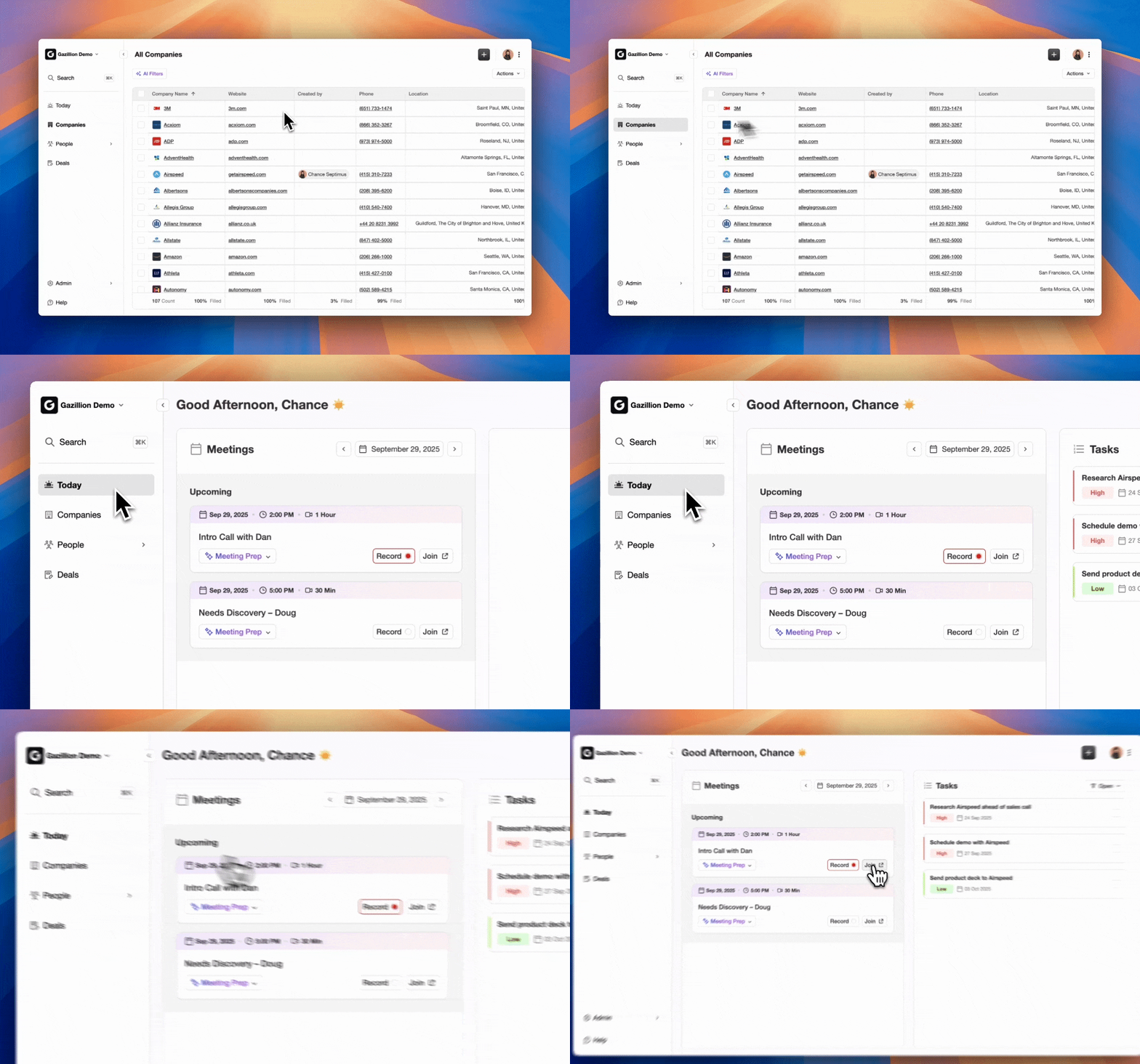
Free-tier limitations are a practical constraint for small teams evaluating tools. HubSpot’s free CRM includes basic Google Calendar sync via Gmail or Outlook integration and a limited Meetings scheduling tool with one page, but restricts advanced AI features to paid tiers. Zoho Bigin’s free plan is limited to a single pipeline. Less Annoying CRM offers no free tier.
In 2026, the most consequential calendar-adjacent capability is AI meeting briefings. This includes surfacing attendee history and deal context before a call, then generating a structured summary afterward. Coffee’s agent delivers this natively for both Google Meet and Microsoft Teams calls. It includes support for BANT, MEDDIC, and SPICED qualification frameworks so that post-call notes enter the CRM in a consistent, queryable format. The Pipeline Compare feature extends this further. Because the agent has captured every interaction into a built-in data warehouse, it can visualize week-over-week deal movement without any manual export, which remains unavailable in tools that rely on standard relational databases without historical tracking.

Budget-Tier Decision Tree: Matching Team Size to Automation Level
The decision framework below maps team size and budget to the appropriate automation level.
- Solo operator or team of 1–3, budget under $30 per month: Less Annoying CRM covers basic contact and calendar display. All logging remains manual.
- Team of 1–10, outgrown spreadsheets, want automation without complexity: Coffee Standalone CRM fits this group. The agent handles contact creation, activity logging, meeting briefings, and pipeline tracking from day one. No configuration is required beyond connecting Google Workspace or Microsoft 365.
- Team of 5–50, already on HubSpot or Salesforce, struggling with data quality: Coffee Companion App layers the agent on top of the existing system. The agent writes clean data back to HubSpot or Salesforce without disrupting existing workflows, quotas, or required fields.
- Team of 10–50, need prospecting plus CRM in one tool: Coffee Standalone CRM with Lead Finder and Campaigns fits this need. The agent builds targeted prospect lists via natural language, runs multi-step email sequences from the rep’s own mailbox, and logs all activity to the contact record automatically.
- Large enterprise with complex custom workflows: Coffee is not the right fit. Salesforce with a dedicated RevOps team remains the appropriate choice at this scale.
These tiers map directly to automation return on investment. The practical decision rule is simple. If your team is spending more than two hours per week per rep on CRM data entry, the cost of that labor exceeds the cost of an agent-led solution at any of the tiers above.
Compare Coffee plans and match your team to the right automation tier
Frequently Asked Questions
How long does it take to implement Coffee and get the agent running?
Implementation requires connecting Google Workspace or Microsoft 365 via a standard OAuth authentication. Once connected, the Coffee agent begins scanning emails and calendar events immediately and starts auto-creating contacts and logging activity without additional configuration. Teams often have initial data in their CRM shortly after setup. There is no lengthy onboarding project, no data mapping exercise, and no professional services engagement required for standard deployments.
How difficult is it to migrate existing contact data into Coffee?
Coffee supports import for existing contact and company records. The agent can enrich records with additional data after import, so teams typically find that their migrated data is more complete inside Coffee than it was in the source system. Migration effort is low for teams moving from spreadsheets or simple CRMs. Teams migrating from Salesforce or HubSpot can also use the Companion App model, keeping the existing system as the record of truth while the agent handles all new data entry.
How does Coffee ensure data quality when the agent is creating contacts automatically?
The agent creates contacts from verified sources such as emails in the connected Google or Microsoft mailbox and calendar events with confirmed attendees. It does not create speculative or duplicate records. Enrichment data comes from licensed third-party data partners and is applied at the record level, not inferred. Because Coffee is built on a data warehouse architecture rather than a standard relational database, historical context is preserved when fields are updated. The previous value is not overwritten and lost, which is a structural limitation of many legacy CRM databases.
Is Coffee secure, and how is data handled?
Coffee is SOC 2 Type 2 certified and GDPR compliant. Data processed by the agent is not used to train public AI models. The platform uses seat-based pricing with no complex metering on underlying AI usage, so there are no hidden costs tied to the volume of data the agent processes.
Does Coffee integrate with tools outside of Google Workspace and Microsoft 365?
Coffee connects to Zoom, Microsoft Teams, and Google Meet for call recording and transcription. Broader integrations with third-party tools are currently available via Zapier, with deeper native integrations on the product roadmap. Teams that require specific point-solution integrations should verify current availability before committing.
Conclusion: Choosing the Right Automation Level
Contact management software with calendar integration spans a wide range of automation depth in 2026. Options range from manual-entry tools that simply display calendar events alongside contact records to agent-led platforms that handle the entire data-in process without human involvement. The comparison in this guide makes the distinction concrete. Basic sync tools score 1–3 on data capture, activity logging, and scheduling automation. Coffee scores 5 across all three because it is the only solution in this category built on an agent architecture rather than a passive database.
For small-to-mid-market sales teams and founders whose core problem is fragmented data and hours of manual entry, the decision framework is straightforward. A CRM that reps actually use is one that does the work for them by auto-creating contacts, logging every interaction, briefing reps before calls, and tracking pipeline changes week over week. Coffee is the only zero-data-entry solution available in 2026 that delivers this full agent-led model.