Written by: Doug Camplejohn, CEO & Co-Founder, Coffee | Last updated: August 10, 2026
Key Takeaways for RevOps and Sales Leaders
- Clearbit enriches known HubSpot records with firmographic data but does not identify anonymous website visitors.
- Warmly identifies real-time visitors and triggers alerts, yet lacks background enrichment and native outreach sequencing.
- Stacking Clearbit and Warmly creates dual contracts, per-credit costs, and integration overhead that many teams want to avoid.
- A unified agent that combines enrichment, visitor identification, Suggested Leads, and Campaigns in one seat-based subscription reduces tool sprawl and alert fatigue.
- Teams ready to replace the Clearbit + Warmly stack can consolidate to a single agent connected directly to HubSpot.
Five Criteria to Compare Clearbit, Warmly, and Coffee
RevOps and Heads of Sales make better choices when they align on a simple evaluation framework first. This comparison uses five criteria that directly affect pipeline quality and team workload.
- Identification accuracy: Whether the tool resolves visitors to a named person or only to a company, and what realistic match rates look like against independent 2026 benchmarks instead of vendor-claimed maxima.
- Total cost of ownership: All-in spend including per-credit fees, HubSpot sync charges, seat costs for every role that needs access, and the compounding cost of data decay.
- Integration friction: Depth of native HubSpot or Salesforce sync, API rate limits, and whether additional middleware is required to make the tool operational.
- Automation depth: The range from background enrichment of known records, to real-time visitor alerts, to full agent orchestration that moves a visitor from pixel hit to enrolled outreach sequence without human intervention.
- Scalability: How pricing, data quality, and operational overhead change as team size, traffic volume, and contact database size grow.
How Each Tool Approaches Identification and Enrichment
Clearbit enriches known records with 100+ firmographic attributes but does not identify anonymous visitors. Warmly identifies person-level visitors against a large contact graph and focuses on real-time engagement. Coffee provides person-level identification plus Suggested Leads that match your buyer persona and feed directly into Campaigns.

The table below compares these tools on quantifiable criteria that matter for pipeline quality and cost.
Side-by-Side Comparison
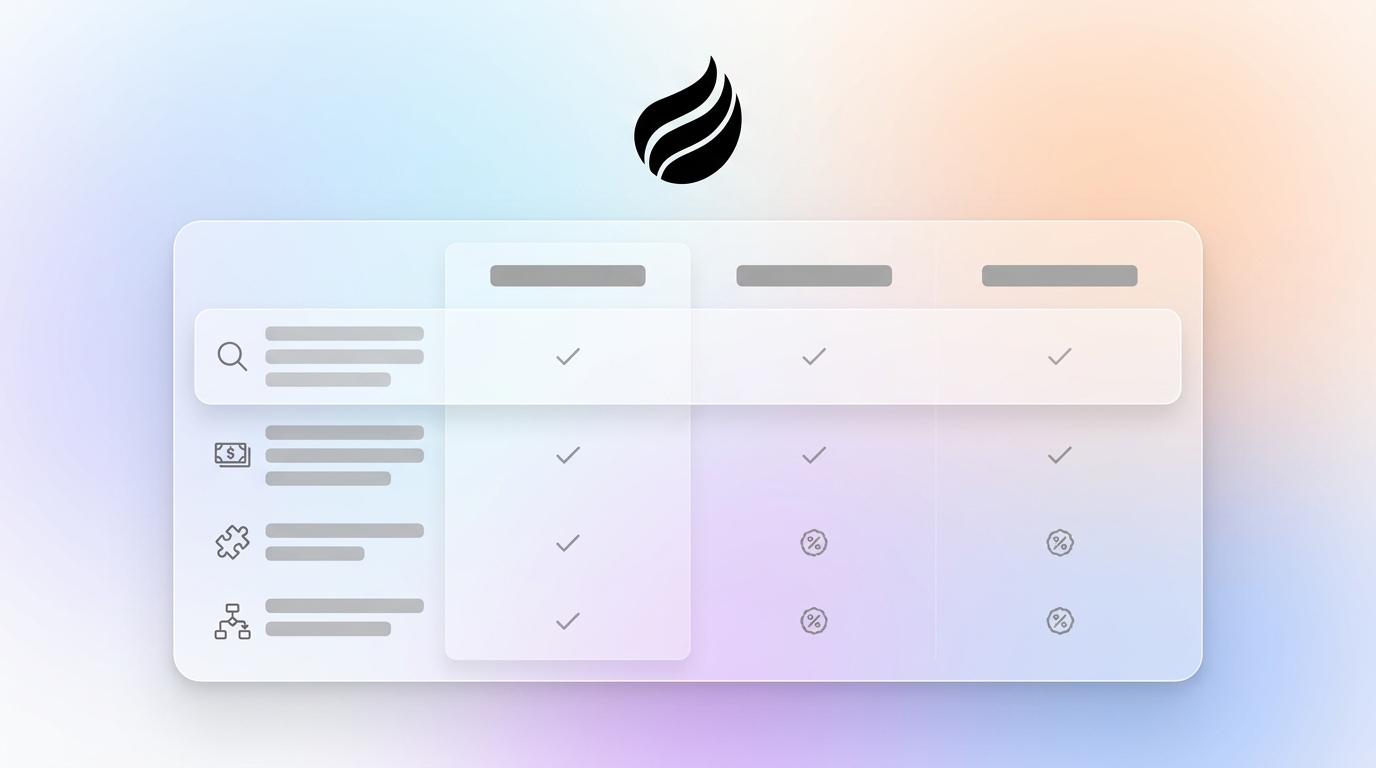
| Criterion | Clearbit | Warmly | Coffee |
|---|---|---|---|
| Identification rate (2026 benchmark) | Not applicable, enriches known records only | 15–30% person-level on B2B traffic, while independent benchmarks place best-in-class person-level at 5–20% | Benchmarked against the same 5–20% person-level range, with persona-matched lead suggestions beyond raw identification |
| TCO model | HubSpot Breeze Intelligence credits at $0.010 each, expiring monthly with no rollover, plus enterprise contracts with median cost of about $33,500 per year | Per-seat subscription plus usage tiers, and stacking with Clearbit adds a second contract and integration overhead | Seat-based subscription where enrichment, visitor ID, Lead Finder, and Campaigns are included, with no separate credit pools |
| Integration effort | Native HubSpot sync with over 100 verified attributes, while API rate limits can constrain enterprise-scale throughput | Auto-syncs to HubSpot or Salesforce, yet requires a separate enrichment source for background record quality | Single pixel plus CRM authentication, with the agent writing enrichment and visitor data back to HubSpot natively |
| Automation depth | Background enrichment of known records, with no anonymous visitor identification or real-time outreach triggering | Real-time alerts, AI chat, rep routing, and email sequences, but no enrichment of background CRM records | End-to-end agent orchestration from pixel to identification to Suggested Leads to Campaigns, plus background enrichment and meeting intelligence in one seat |
Identification Accuracy in 2026
Realistic identification benchmarks matter because vendor-quoted rates often include low-confidence matches, ISP-only results, and unknown company IDs. A 2026 MarketBetter controlled traffic study of 12 visitor identification platforms found real US match rates of 20–40% for company-level tools and 5–15% for person-level tools after filtering for actionable named matches.
Industry benchmarks set reasonable targets for a US-leaning B2B SaaS site at both company-level and person-level identification. However, two structural limitations constrain even best-in-class tools, regardless of vendor claims. First, mobile B2B traffic identification tends to be lower than desktop because mobile carrier IPs often do not resolve to a single employer. Second, EU person-level identification is effectively 0% under GDPR without affirmative opt-in, though company-level identification remains possible at roughly 40–55% on EU-headquartered traffic. Both limitations mean that raw identification rates must be interpreted through the lens of your traffic mix.
About 96–98% of B2B website visitors leave without identifying themselves through forms, chat, or signup. That gap is the core problem both Warmly and Coffee’s visitor identification features address. Clearbit focuses on enriching records that are already known and does not attempt to solve anonymous visitor identification.
Total Cost of Ownership Reality Check
Stacking Clearbit and Warmly introduces compounding cost structures that are rarely visible in initial vendor conversations. HubSpot Breeze Intelligence credits, which power Clearbit-style enrichment inside HubSpot, are priced at $0.010 each, expire monthly with no rollover, and must be purchased in addition to base HubSpot seats. At scale, ZoomInfo contracts carry a median annual cost of $33,500 per Vendr third-party contract data.
Hidden costs compound further because credits burn on failed lookups, duplicate records, and re-reveals, while phone number and mobile data carry separate charges. Business data decays steadily, so teams must budget for ongoing re-enrichment even after the initial purchase. Adding Warmly’s per-seat subscription on top creates a second contract with its own renewal cycle and integration maintenance overhead.
Many organizations now aim to consolidate their tech stacks from multiple disconnected applications down to fewer integrated platforms. This shift reduces cognitive load for reps and supports cleaner data flow. A seat-based agent that includes enrichment, visitor identification, prospecting, and outreach sequencing in one subscription removes per-credit exposure and dual-contract overhead entirely.
See seat-based pricing that replaces the Clearbit + Warmly stack with one subscription.
Integration Friction and Setup Effort
Clearbit performs real-time enrichment inside HubSpot natively, adding over 100 verified attributes to contact and company records, while API rate limits can constrain enterprise-scale throughput. Warmly auto-syncs identified visitors to HubSpot or Salesforce, yet it does not enrich background CRM records, so teams still need a separate enrichment source to maintain record quality on contacts that never visit the site.
Integration allows systems to exchange data, while orchestration enables systems to coordinate actions in real time using shared customer context. Each additional integration point in a multi-tool stack becomes a potential data quality failure. Platforms that consolidate enrichment, buying signals, and workflow automation reduce the number of handoffs where data can degrade.
Automation Depth and Frontline Usability
Background enrichment operates as an asynchronous process that updates records behind the scenes while users continue working. This approach improves record completeness for known contacts but does not detect anonymous live visitors or trigger immediate outreach. Warmly closes that gap for live visitors, and its full pipeline of identification, enrichment, context assembly, scoring, and engagement runs in under three seconds end to end per visitor.
The operational risk in a two-tool stack is alert fatigue. Real-time notifications from Warmly surface intent signals that require a rep to decide on next steps, look up context in HubSpot, and initiate outreach in a separate sequencing tool. Studies show that B2B sales reps spend only 28–30% of their time actively selling, and a large share of the remaining time goes to CRM updates, data entry, and navigation across multiple tools. Adding another alert layer without closing the action loop increases that burden.
Full agent orchestration, where a single system moves from pixel hit to Suggested Leads to enrolled outreach sequence without rep intervention, removes the gap between signal and action that both Clearbit and Warmly leave open independently.

Manager Visibility and Long-Term Scalability
B2B leaders frequently cite data quality issues as a blocker for accurate routing or assignment, and many CRM systems suffer from significant accuracy problems as contact data decays. When enrichment and visitor data live in separate tools, pipeline reporting requires reconciling two data models, which becomes a growing maintenance burden as the team scales.
Seat-based pricing for enrichment tools becomes expensive when multiple roles, such as RevOps, SDR managers, reps, finance, and leadership, all require access, because most platforms do not offer discounted viewer or role-based seats. A unified agent priced per human seat, with the agent’s labor included, scales predictably as headcount grows and builds on the earlier point about ongoing data maintenance without adding new per-credit or per-seat charges for each function.
Scenario-Based Best-Fit Guidance
Early-stage teams (under 20 employees): Budget and operational bandwidth stay tight at this stage. Stacking two tools with separate contracts, credit pools, and integration maintenance creates disproportionate overhead. A single agent that handles enrichment, visitor identification, and outreach sequencing in one seat fits these constraints.
Growing mid-market organizations (20–200 employees) on HubSpot: These teams generate enough traffic to benefit from real-time visitor identification and enough pipeline volume to require reliable background enrichment. The Clearbit + Warmly stack is technically viable but introduces the TCO and integration friction described above. A unified agent removes tool sprawl while meeting the same identification benchmarks.
Established HubSpot shops with dedicated RevOps: Teams with existing Clearbit contracts embedded in HubSpot workflows face real migration effort. The key evaluation point is whether the ongoing per-credit cost and the gap between enrichment and outreach automation justify maintaining the stack, or whether consolidation onto an agent that closes the loop natively creates more long-term value.
Map Coffee to your HubSpot setup and see how the unified agent fits your current workflows.
Decision Checklist
Use the following criteria to connect your constraints to the right approach.
- If your primary need is enriching known CRM records with firmographic data and you have no anonymous traffic problem to solve, Clearbit alone is sufficient.
- If your primary need is surfacing real-time visitor intent and you already run a separate enrichment source and sequencing tool, Warmly adds value as a signal layer.
- If you need both enrichment and visitor identification and want to move from anonymous traffic to automated outreach without stacking tools or managing per-credit budgets, a unified agent is the appropriate fit.
- If your HubSpot data quality is degrading and reps spend significant time on manual entry, the enrichment problem sits upstream of the visitor identification problem, so solve data quality first.
- If EU traffic represents a meaningful share of your audience, confirm that any person-level identification vendor has a compliant opt-in mechanism before purchasing, because the GDPR constraints discussed earlier eliminate person-level identification without affirmative consent.
Frequently Asked Questions
How long does it take to implement Coffee alongside an existing HubSpot instance?
Setup requires a single authentication to connect Coffee to your HubSpot instance and a tracking pixel placed in the head tag of your website. Coffee verifies pixel installation automatically and begins identifying visitors immediately. The agent starts scanning emails and calendars to auto-create contacts and log activities as soon as Google Workspace or Microsoft 365 is connected. Most teams become operational within a single business day, without engineering resources or a formal implementation project.
What does migrating from a Clearbit plus Warmly stack to Coffee involve?
Migration involves three steps. First, disconnect the Clearbit enrichment workflow from HubSpot. Second, remove the Warmly pixel and replace it with Coffee’s tracking script. Third, authenticate Coffee as the enrichment and outreach layer. Existing HubSpot records remain intact, and Coffee enriches and updates them going forward. Active Warmly sequences need to be recreated as Coffee Campaigns, which the agent can generate from a plain-English description. Teams with complex Clearbit workflow automations should audit those workflows before migration to ensure equivalent logic is rebuilt inside Coffee or HubSpot’s native workflow engine.
How does Coffee’s identification accuracy compare to the 2026 benchmarks?
Coffee’s visitor identification benchmarks against the same independent ranges that apply to all person-level tools: 5–20% person-level identification on US B2B traffic, with company-level identification in the 30–65% range depending on traffic source and company size. The differentiator is not identification rate alone, but what happens after identification. Where Warmly surfaces a raw people list and Clearbit does not identify visitors at all, Coffee’s Suggested Leads feature uses your buyer persona to recommend the two or three specific contacts inside a visiting company most worth reaching out to and surfaces their LinkedIn profiles for immediate outbound. The action layer is where Coffee closes the gap that raw identification rates leave open.

Is Coffee SOC 2 compliant, and how is visitor data handled?
Coffee is SOC 2 Type 2 and GDPR compliant. Data ingested by the agent, including emails, calendar events, call transcripts, and visitor identification data, is not used to train public models. For EU traffic, Coffee’s visitor identification operates within the same GDPR constraints that apply to all person-level identification tools: person-level identification requires affirmative opt-in, while company-level identification remains available on EU-headquartered traffic. Teams with significant EU audience exposure should implement a compliant consent mechanism before activating person-level identification features for that traffic segment.
Does Coffee scale as the sales team and traffic volume grow?
Coffee’s seat-based pricing model means the agent’s labor, including enrichment lookups, visitor identification, campaign sends, meeting summaries, and pipeline tracking, scales with usage without additional per-credit charges. Adding a new rep means adding one seat, and the agent handles that rep’s data entry, enrichment, and outreach automation at no incremental cost beyond the seat price. For teams generating high traffic volumes, Coffee’s pixel and identification infrastructure process visitors continuously without per-visit fees. The Pipeline Compare feature and built-in data warehouse ensure that as deal volume grows, pipeline visibility scales with it rather than requiring additional reporting tools.
Conclusion: When a Unified Agent Replaces a Two-Tool Stack
Clearbit and Warmly each solve a real problem. Clearbit keeps known HubSpot records accurate with verified firmographic and technographic data. Warmly surfaces real-time intent from anonymous visitors and triggers immediate engagement. The gap is that neither tool closes the full loop. Clearbit never sees anonymous traffic, and Warmly does not enrich background records or run outreach sequences natively. Stacking them introduces two contracts, two credit models, two integration maintenance burdens, and the alert fatigue that comes from surfacing signals a rep cannot act on without switching to additional tools.
Coffee’s agent delivers enrichment, visitor identification, Suggested Leads matched to your buyer persona, and automated outreach Campaigns inside one seat-based subscription connected directly to HubSpot or Salesforce. The agent handles the data entry, the identification, and the outreach so reps spend their time selling rather than reconciling systems.
Replace your current stack with a single agent that closes the loop from anonymous traffic to automated outreach.