Written by: Doug Camplejohn, CEO & Co-Founder, Coffee | Last updated: August 20, 2026
Key Takeaways for Small Sales Teams
- Clarify CRM uses a credit-based model that can trigger overage charges and AI throttling for small sales teams.
- Seat-based pricing from Coffee delivers predictable monthly costs without surprise overages or usage limits.
- Unlimited AI assistance keeps regular meetings and deal updates running without mid-month disruptions.
- Automated data entry and enrichment save reps hours each week by removing manual CRM work.
- Small sales teams ready for predictable, unlimited AI should explore Coffee’s seat-based pricing.
How Small Teams Should Judge CRM Pricing Models
Three factors determine whether a CRM pricing model works for teams under 20 reps:
- Predictable cost: The monthly bill must be forecastable from headcount alone, with no surprise overages.
- Unlimited AI assistance: AI features must remain available throughout the billing cycle without throttling or pausing.
- Minimal manual data entry: The system must automate contact creation, activity logging, and enrichment so reps spend time selling, not typing.
Clarify uses a credit-based model that meters AI work. Coffee uses seat-based pricing where the agent’s labor is unlimited and included. Each model behaves differently against these three criteria.
Clarify CRM Tiers and Credit Costs for Small Teams
The table below reflects Clarify’s published pricing as of mid-2026. Notice how credits jump 5× from Free to Starter while the overage rate stays fixed at $50 per 5,000 credits. A single overage block can double a small team’s monthly cost once AI usage passes the base allowance.
| Plan | Base Price | Monthly AI Credits | Overage Rate |
|---|---|---|---|
| Free | $0/month | 1,000 credits | AI pauses, on-demand disabled by default |
| Starter | $50/month | 5,000 credits | $50 per additional 5,000-credit block |
| Growth | Custom pricing | Custom | Custom |
Clarify’s credit costs per action are as follows:
- Meeting summary or meeting prep: 30 credits each
Credit-burn model for a 5-rep team on the Starter plan: Assume each rep takes 8 recorded meetings per month, or 40 total. At 30 credits per meeting summary, that is 1,200 credits on summaries alone. Other AI actions consume additional credits and can push total usage over the Starter plan’s 5,000-credit monthly allowance. That triggers one overage block at $50, bringing the monthly bill to $100 for a team that started expecting to pay $50. Note that a team taking 40 recorded meetings per month spends roughly 1,200 credits on meeting summaries alone, which already exceeds the Free tier’s 1,000-credit ceiling before any other AI actions run.
See how Coffee removes credit math with flat seat pricing.
Head-to-Head Cost: Clarify Credits vs. Coffee Seats
This credit-burn dynamic, where moderate usage triggers overage charges, highlights the structural gap between Clarify’s consumption-based model and Coffee’s seat-based alternative.
Coffee’s pricing model charges per human seat. The agent’s labor, including data entry, enrichment, meeting summaries, and pipeline tracking, is unlimited and included. There are no credit blocks, no overage rates, and no mid-month throttling.
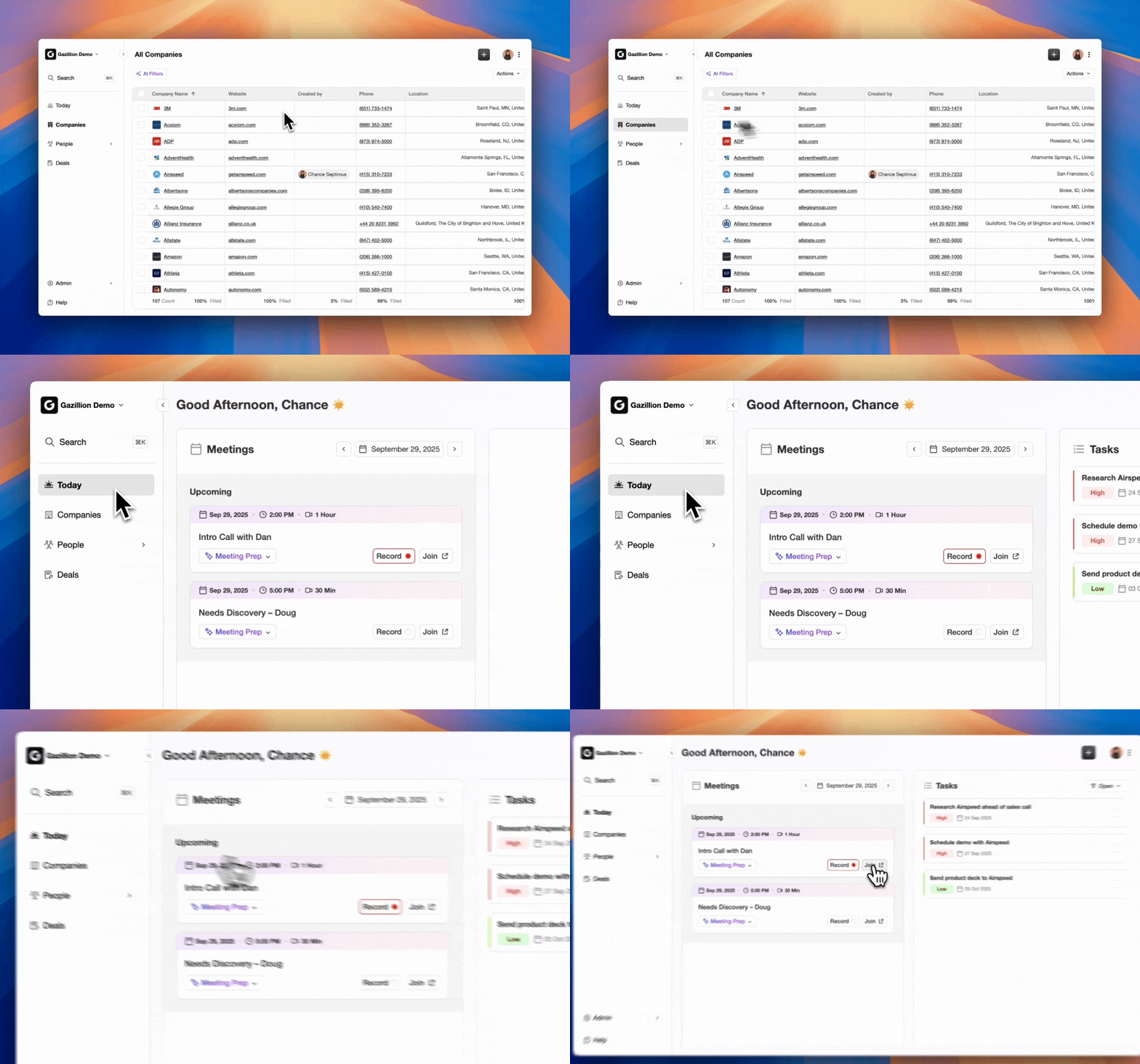
The table below compares estimated monthly cost of ownership for Clarify Starter, using the 5-rep overage scenario above, against Coffee’s seat-based plan. The key difference is that Clarify’s bill can double from its base price under moderate AI usage, while Coffee’s bill stays flat for the same headcount regardless of activity volume.
| Scenario | Clarify Starter (est. with overages) | Coffee Seat-Based |
|---|---|---|
| 5-rep team, moderate AI use | $100+/month (base $50 + 1 overage block) | Flat per-seat rate, no overages |
| 10-rep team, moderate AI use | $50 base + multiple overage blocks likely | Flat per-seat rate, scales linearly with headcount |
Because Coffee does not publish a per-seat dollar figure in the background research available, a direct dollar-to-dollar comparison is not possible here. See Coffee’s current seat rates and calculate your predictable monthly cost. The structural difference is clear: Clarify’s bill varies with AI consumption, and Coffee’s bill varies only with headcount.
Unlimited AI Access: Throttled Credits vs. Always-On Agent
On-demand credits on Clarify are disabled by default, meaning AI features pause entirely when monthly credits are exhausted unless a user manually enables on-demand spending in Settings → Workspace → Billing. A rep who hits the credit ceiling mid-month loses access to meeting summaries, deal intelligence, and field-update suggestions for the rest of the billing period, or the team absorbs an unplanned overage charge.
Coffee’s agent operates without a credit meter. Meeting briefings, automated summaries, pipeline tracking, and data enrichment run continuously throughout the month regardless of usage volume. Seat-based pricing makes the bill predictable and easy to budget because spend can be forecasted directly from headcount, while usage-based pricing introduces variability that complicates ownership cost estimates.

Manual Data Entry: Clarify’s Credit Limits vs. Coffee’s Automation
Clarify’s background enrichment and meeting recording draw no credits, but the AI actions that make that raw data useful, such as summaries, deal intelligence, and field suggestions, do consume credits. When credits run out, reps are left with recordings and raw transcripts but no automated synthesis, which pushes manual work back onto the team.
Coffee’s agent automatically creates and enriches contacts from Google Workspace or Microsoft 365 emails and calendars, logs last and next activity autonomously, generates post-call summaries and follow-up drafts, and tracks pipeline changes week-over-week, all without a credit ceiling. Manual note-taking and CRM entry for a typical sales meeting requires 10–15 minutes of note writing plus 5 minutes of CRM entry, totaling roughly 3–4 hours per person per week at 12 meetings weekly. Automating that process at scale, without throttling, widens the productivity gap between the two models.

Real-World Outcomes: Clarify Free Limits vs. Coffee Consolidation
Profile 1 — Outgrew the Free tier in 60 days: A 5-rep team signs up for Clarify’s Free plan expecting it to cover their needs. The Free tier provides 1,000 AI credits per month and pauses AI when credits are exhausted. With the 1,200-credit meeting load described earlier, the team hits the ceiling before the month ends. They either upgrade to Starter at $50 per month or lose AI functionality for the remainder of the cycle, a disruption that was not visible in the original pricing evaluation.
Profile 2 — Consolidated four tools into Coffee: A revenue-generating company building custom AI solutions was managing sales in spreadsheets and rejected Salesforce and HubSpot for requiring too much manual work. After deploying Coffee, automatic contact creation from Google Workspace kept the CRM clean without human effort, the Pipeline Compare feature automated weekly reviews, and the team eliminated separate subscriptions for enrichment, recording, and pipeline tracking. The agent consolidated the stack into a single seat-based cost.

Hidden Cost Drivers Beyond the CRM Invoice
For CRM systems, hidden costs including implementation, training, and integrations typically add 40 to 70 percent on top of the base subscription price during the first year. For small teams evaluating Clarify, the credit model introduces additional hidden-cost vectors beyond implementation:
- Shadow spreadsheets: When credits throttle AI mid-month, reps revert to manual tracking in Notion or Google Sheets, creating a parallel system that undermines CRM data quality.
- Unpredictable budget cycles: Usage-based pricing ties price more directly to delivered value but makes revenue harder to forecast for buyers because it varies with actual usage.
- Enrichment limits: Clarify’s Starter plan includes 5,000 credits per month, and enrichments do not consume credits, yet teams that hit credit ceilings lose the AI features that make enrichment data actionable.
- Governance overhead: Gartner research discussed in September 2025 noted SaaS price increases of 9-25% and hidden generative-AI costs, but did not report a 30% cost uplift from undisclosed AI functionality, and the bulk of GenAI cost sits in inference and usage-based consumption that scales fast and unpredictably.
Guided Decision Framework for Clarify vs. Coffee
Use the criteria below to route the evaluation. Clarify’s column clusters around low-volume, variable-cost scenarios, while Coffee’s column aligns with teams that need high AI usage without throttling or budget surprises:
| Criteria | Points to Clarify | Points to Coffee |
|---|---|---|
| Team size | Solo or very low AI usage | 5–20 reps with active AI use |
| Budget predictability | Comfortable with variable monthly bills | Requires fixed, forecastable cost |
| AI usage volume | Minimal meetings and deal updates | Regular meeting summaries, deal intelligence, enrichment |
| Manual data entry tolerance | Willing to manage credit limits manually | Wants full automation without throttling |
| Stack consolidation | Already has separate enrichment and recording tools | Wants CRM, enrichment, recording, and outreach in one agent |
For teams of 5–20 reps running regular sales cycles, the credit model introduces cost variability and AI throttling that disrupt both budgeting and rep productivity. The seat-based model removes both risks.
Compare your team’s profile against Coffee’s seat-based model.
Frequently Asked Questions
How much does Clarify cost for 5 reps?
Clarify’s Free plan is $0 per month with 1,000 AI credits. The Starter plan is $50 per month with 5,000 credits. For a 5-rep team running a moderate volume of meetings, deal updates, and field suggestions, the Starter plan’s 5,000 credits can be exhausted within a single billing cycle, triggering overage blocks at $50 per additional 5,000 credits. As the cost comparison shows, moderate AI use can push a 5-rep team’s Starter bill to $100 or more, which doubles the base rate. The Growth tier carries custom pricing with no public list rate.
What are Clarify’s hidden costs?
Clarify’s most significant hidden cost is credit overage. Because on-demand credits are disabled by default, teams that do not proactively enable and cap overage spending will have AI features pause mid-month, which forces either manual workarounds or an unplanned upgrade. As noted in the pricing breakdown, Starter includes 5,000 credits monthly, with enrichments running credit-free. Teams should monitor their credit usage closely to avoid disruptions.
What is the best CRM for small sales teams in 2026?
The best CRM for a small sales team in 2026 depends on three factors: pricing predictability, AI automation depth, and stack consolidation. For teams of 5–20 reps that want unlimited AI assistance, automated data entry, and a single platform covering enrichment, meeting intelligence, pipeline tracking, and outreach, Coffee’s seat-based agent model is designed specifically for this profile. Teams that need only a lightweight contact database with minimal AI usage may find Clarify’s Free or Starter tier sufficient, provided they monitor credit consumption closely.
How do usage-based and seat-based CRM pricing models compare for small teams?
Seat-based pricing charges a fixed rate per user, which makes the monthly bill directly forecastable from headcount. Usage-based pricing charges for AI consumption, such as credits, events, or API calls, so the bill scales with actual activity. For small sales teams, the practical difference is budget stability. A seat-based model produces the same invoice every month regardless of how many meetings are summarized or how many deals are updated. A usage-based model can produce a higher invoice in active months and a lower one in slow months, but the real concern is the downside risk of throttled AI during a high-activity period. When credits run out under a usage-based model, AI features pause, reps lose productivity, and shadow systems emerge. Seat-based models remove that failure mode entirely.
Conclusion: Why Coffee Fits Small Teams Needing Unlimited AI
Clarify CRM’s credit-based pricing creates two compounding risks for small sales teams: unpredictable monthly costs that scale with AI usage, and mid-cycle throttling that cuts off the features reps depend on most. The Free tier’s 1,000-credit ceiling can be exhausted by meeting summaries alone for teams holding regular recorded meetings per month. The Starter plan’s 5,000 credits can be reached under moderate use by a 5-rep team, which triggers overage blocks that increase the expected invoice.
Coffee’s seat-based model removes both risks. The agent handles data entry, enrichment, meeting summaries, pipeline tracking, and outreach natively, with no credit meter running in the background. The monthly bill is a function of headcount, not AI consumption. For sales leaders who need a CRM that works as hard at the end of the month as it does at the beginning, that distinction drives the decision.
Start your Coffee trial for unlimited AI agent labor at a fixed monthly cost.