Written by: Doug Camplejohn, CEO & Co-Founder, Coffee | Last updated: August 11, 2026
Key Takeaways for 2026 Enrichment Decisions
Automated lead enrichment continuously appends, verifies, and refreshes CRM data to offset the 22.5% annual B2B contact decay rate that erodes pipeline accuracy.
Native two-way CRM sync, scheduled re-enrichment, confidence scoring, and duplicate handling are the five criteria that separate tools that sustain accuracy from those that add integration tax.
Fragmented stacks incur hidden costs, including integration labor, context switching, and extended ramp time, that can push fully loaded TCO 45% higher than a single native platform.
Agentic layers like Coffee consolidate enrichment, sequencing, visitor identification, and meeting intelligence into one system, cutting direct tool spend by 60–75% while eliminating middleware fees.
Fragmented stacks amplify this drag. A mid-market SDR team running a typical stack pays heavily for tool licenses before integration labor, context-switching losses, and ramp-time extension even enter the picture.
Five Criteria That Keep Enrichment Data Accurate
Given that roughly a quarter of your CRM data decays each year, enrichment tools must do more than fill missing fields once. They need to slow decay, surface changes quickly, and avoid creating new cleanup work. The five criteria below highlight which tools actually offset decay and which ones simply add more data and integration overhead.
Waterfall vs. agentic enrichment. Single-source tools return contact data for 40–60% of a B2B list, while waterfall configurations that query multiple providers can push match rates above 80% and significantly reduce bounce rates. Agentic enrichment goes further by autonomously deciding when and what to re-enrich based on live signals.
Duplicate and merge rules with field-level confidence scores. A high confidence threshold works best for auto-merging duplicate records, while lower-confidence matches should route to a human review queue with full audit logs. A healthy CRM duplicate rate sits below 5%.
The table below applies these five criteria to six leading enrichment tools, so you can see which platforms sustain accuracy and which ones rely on workarounds.
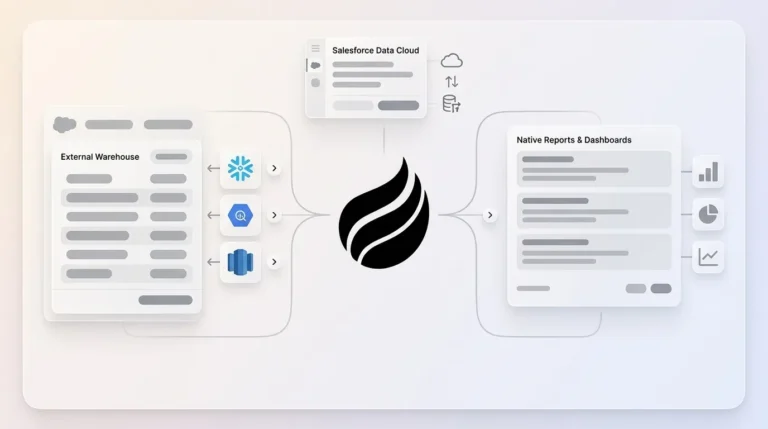
Point solutions solve one problem at a time, while an agentic layer solves the system problem. Data enters clean, stays clean, and triggers action without human intervention. Coffee’s agent performs the jobs of enrichment, sequencing, visitor identification, meeting intelligence, and pipeline tracking inside a single system connected to Salesforce or HubSpot.
Build people lists automatically with Coffee AI CRM Agent
Coffee Agent Stack Consolidation
Automated meeting prep with Coffee AI CRM Agent
A typical mid-market RevOps team replaces the following with Coffee’s agent layer:
Enrichment database (ZoomInfo or Apollo) removed through Coffee’s built-in Lead Finder and data enrichment
Sales engagement platform (Outreach or Salesloft) removed through Coffee’s native Campaigns with stop-on-reply sequencing
Visitor identification tool (Warmly or RB2B) removed through Coffee’s pixel-based Visitor ID with Suggested Leads
Meeting intelligence tool (Gong or Fathom) removed through Coffee’s AI Meeting Bot, automated summaries, and MEDDIC or BANT-structured notes
Pipeline reporting add-on removed through Coffee’s Pipeline Compare feature
As shown in the TCO analysis above, consolidating five to six separate tools into Coffee’s agent layer delivers the 60–75% cost reduction while also eliminating integration tax and context-switching losses. Coffee’s seat-based pricing includes the agent’s unlimited labor, with no per-enrichment credit metering and no middleware fees.
Early-stage teams (1–20 reps): Coffee’s Standalone CRM replaces spreadsheets and manual HubSpot entry with an agent that auto-creates contacts from Google Workspace or Microsoft 365, enriches records, and logs every activity without human input.
Growing sales organizations (20–100 reps): Clay or Apollo provide waterfall enrichment and scheduled refresh at reasonable per-seat costs, but they require separate sequencing and visitor-ID tools, which reintroduces integration tax as headcount scales.
Established mid-market Salesforce or HubSpot teams: Coffee’s Companion App deploys the agent as an intelligent layer on top of the existing system of record, handling enrichment, re-enrichment, meeting intelligence, and outreach sequencing without a CRM migration.
How long does it take to implement an automated lead enrichment tool?
Implementation timelines vary by tool architecture and by how much governance you define up front. Point solutions like Apollo or Lusha can connect to a CRM in hours via OAuth, but field mapping, deduplication rules, and enrichment governance policies typically require one to three weeks of RevOps configuration to operate safely at scale. An agentic layer like Coffee’s Companion App authenticates to Salesforce or HubSpot in minutes and begins enriching records immediately with no custom code. Full governance setup, including overwrite rules, protected fields, and review queues, works best when completed within the first two weeks.
How difficult is it to migrate from a fragmented enrichment stack to a consolidated platform?
Migration complexity depends on how deeply individual tools sit inside existing workflows. The primary risks involve broken field mappings, duplicate records created during the transition, and sequencing gaps if outreach tools are swapped mid-campaign. Coffee’s Companion App avoids a full migration by sitting on top of the existing Salesforce or HubSpot instance rather than replacing it. Teams can retire point solutions incrementally, starting with visitor identification or meeting intelligence, while the agent takes over each function and reduces cutover risk.
What data security certifications should I require from an enrichment tool?
At minimum, require SOC 2 Type 2 certification, GDPR compliance, and a clear data processing agreement that prohibits the vendor from using your CRM data to train public models. For teams in regulated industries, also verify CCPA compliance and whether the vendor undergoes annual third-party penetration testing. Coffee is SOC 2 Type 2 and GDPR compliant, and does not use customer data to train public models.
How do I measure accuracy lift after deploying an enrichment tool?
Start with a baseline before deployment by auditing three fields with high decay rates, including email validity, job title currency, and phone reachability, across a random sample of 500 records. After 90 days of enrichment, re-audit the same sample and calculate the percentage of records with valid, current data in each field. Secondary metrics include email bounce rate with a target below 1%, duplicate rate by object with a target below 2%, and enrichment match rate with a target above 80%. For revenue impact, track cost per held meeting before and after, since that metric directly links enrichment spend to pipeline outcomes.
Does Coffee’s agent work if we stay on Salesforce or HubSpot?
Yes. Coffee’s Companion App is designed specifically for teams committed to Salesforce or HubSpot. A simple authentication allows the Coffee Agent to sync data bidirectionally, enrich and re-enrich records, log meeting intelligence, run outreach sequences, and surface pipeline changes, all while writing back to the existing system of record. Teams keep their CRM investment while the agent removes the point solutions layered around it.
Conclusion: Choose Accuracy Without Extra Overhead
CRM data accuracy in 2026 functions as a continuous operational discipline rather than a one-time enrichment project. The five criteria that matter most include waterfall or agentic enrichment depth, native two-way CRM sync, scheduled and trigger-based re-enrichment, auditable duplicate handling with confidence scoring, and fully loaded total cost of ownership. No single point solution scores well on all five without adding integration tax and RevOps overhead.
Coffee’s agent layer addresses all five criteria inside a single system, whether deployed as a standalone CRM or as a companion to Salesforce and HubSpot. It replaces enrichment databases, sequencing tools, visitor identification, and meeting intelligence with one agent running on seat-based pricing, with no credit metering, no middleware, and no swivel-chair tax.