Written by: Doug Camplejohn, CEO & Co-Founder, Coffee | Last updated: July 21, 2026
Key Takeaways for Mailchimp-First Teams
- Mailchimp users need a CRM that delivers pipeline visibility without manual data entry or duplicate systems.
- Three integration tiers exist in 2026: native two-way sync, Zapier/API middleware, and agent-automated zero-entry solutions.
- Tier 1 native sync options like Copper, Zoho, and Capsule offer bidirectional contact and campaign data but still require human configuration and maintenance.
- Tier 3 agent automation, such as Coffee, eliminates data-entry labor by ingesting Mailchimp data and enriching CRM records without middleware.
- Teams ready to remove admin overhead can start automating their CRM with Coffee’s agent to keep Mailchimp as the marketing source of truth while gaining accurate pipeline intelligence.
Comparison Table: CRM Options Ranked for Mailchimp Users
Pricing reflects published 2026 per-user/month figures billed annually unless noted. Migration effort is rated Low, Medium, or High based on documented implementation complexity.
| CRM | Mailchimp Integration Tier & Sync Direction | 2026 Starting Price (per user/month, annual) | Migration Effort (5–30 seats) |
|---|---|---|---|
| Coffee | Tier 3, agent-automated zero-entry, ingests Mailchimp data, enriches records, logs activities autonomously | See Coffee’s pricing page | Low, agent auto-creates contacts from Google Workspace or Microsoft 365 on connection |
| HubSpot Sales Hub | Tier 1/2, native sync is one-way only, two-way requires Outfunnel or Zapier | $15 Starter, $90 Professional | Medium, onboarding fees of $4,500–$12,000 for Professional/Enterprise |
| Pipedrive | Tier 2, Zapier/API, no native Mailchimp two-way sync | $14 Essential, $29 Advanced | Low-Medium, fast adoption for sales-focused teams |
| Copper CRM | Tier 1, native Mailchimp integration syncing contacts, campaigns, and engagement data | $23 Basic, $59 Professional (annual) | Low for Google Workspace teams, auto-captures Gmail contacts and calendar events |
| Zoho CRM | Tier 1, native bidirectional contact sync with Mailchimp | Free (3 users), $14 Standard | Low-Medium, implementations typically $5k–$40k for small/mid teams |
| Capsule CRM | Tier 1, native Mailchimp integration for contact and campaign syncing | Free (2 users), $18 Starter | Low, lightweight setup suitable for small teams |
| Freshsales | Tier 2, Zapier/API for Mailchimp, native email tools built in | $9 Growth (annual) | Low, free plan available for up to 3 users |
| Close CRM | Tier 2, Zapier/API, strong built-in calling and sequencing | $99/month for 3 seats (minimum) | Medium, mandatory 3-seat minimum increases entry cost |
How HubSpot Handles Mailchimp Sync
HubSpot is the most common CRM evaluated by Mailchimp users, but its native Mailchimp integration has a clear limitation. HubSpot’s native connector only syncs new contacts added to HubSpot one-way and does not sync contacts or updates from Mailchimp back to HubSpot. Teams that need true bidirectional sync must add Outfunnel or build Zapier workflows, which introduces separate configuration, cost, and ongoing maintenance.
Setup: The native HubSpot-Mailchimp connector supports one-way sync by default. To capture engagement data, teams add marketplace apps. Outfunnel records Mailchimp opens, clicks, and unsubscribes in HubSpot.
Data capture: Zapier supports workflows for contact creation, field updates, and engagement events when marketplace apps are not enough.
Usability: HubSpot’s Professional plan provides advanced automation such as workflows, lead scoring, and deal triggers. The Starter plan at $15 per user each month offers only basic automation.
Reporting: HubSpot’s reporting connects email engagement directly to contact records and closed deals for revenue attribution. This capability improves on Mailchimp-only analytics.
Maintenance burden: A 12-person marketing agency using HubSpot and three other systems spent about 18 hours per week on manual reporting and list-pulling before automation. Even after full automation, the integration required active configuration across five platforms. Licensing fees represent only 30–40% of total CRM expenditure, with the remaining 60–70% coming from implementation, customization, data migration, training, administration, integrations, and add-ons.
CRMs That Keep Mailchimp as the Source of Truth
While HubSpot often relies on middleware for full sync, several CRMs connect more directly to Mailchimp and preserve it as the marketing system of record. These tools differ in how much work they shift to automation versus your team.
Pipedrive
Setup: Pipedrive connects to Mailchimp through Zapier. There is no native two-way sync, so each trigger such as new contact, field update, or campaign engagement needs a separate Zap.
Data capture: Engagement data from Mailchimp does not appear in Pipedrive contact timelines without middleware configuration.
Usability: For a sales-focused small team, Pipedrive often provides good value through fast adoption. Its pipeline interface feels familiar to teams moving from spreadsheets.
Reporting: Pipedrive’s reporting centers on deals. Campaign attribution from Mailchimp requires manual cross-referencing unless Zapier automations write engagement fields back to contact records.
Maintenance: Zapier connections for advanced automation add about $49–$69 each month beyond base CRM licensing. Each Zap also needs monitoring for failures.
Copper CRM
Setup: Copper provides native Mailchimp integration that syncs contacts, campaigns, and engagement data. It is the official Google-recommended CRM in the Google Workspace Marketplace and appears directly in Gmail through a sidebar.
Data capture: Copper automatically captures contacts, email threads, and calendar events from Google Workspace, which removes most manual data entry. Mailchimp engagement data flows into contact records through the native connector.
Usability: Copper is designed for Google Workspace teams. Teams on Microsoft 365 will see less native alignment.
Reporting and maintenance: Workflow rules trigger actions based on deal events such as assigning tasks, sending follow-up emails, or updating field values when a deal moves to a new stage. Pricing starts at $23 per user each month for the Basic plan, and the comparison table above lists the full tier breakdown.
Zoho CRM
Setup: Zoho CRM connects directly to Mailchimp with bidirectional contact syncing that adds new CRM leads to Mailchimp audiences and returns email engagement data to CRM records.
Data capture and usability: Zoho CRM works well as a budget option for teams already using the Zoho suite. The free plan supports up to three users, and the Standard plan is $14 per user each month.
Maintenance: Zoho’s broad feature set introduces configuration complexity. Teams outside the Zoho ecosystem may find integration maintenance time-consuming as the stack expands.
Other CRM Choices for Mailchimp Users in 2026
Capsule CRM
Capsule CRM integrates with Mailchimp for contact and campaign syncing. Its free plan supports up to two users and 250 contacts, which suits very small teams. The Starter plan is $18 per user each month billed annually. Capsule is a lightweight option with limited automation depth, so it fits teams that need basic contact management alongside Mailchimp but not deep pipeline intelligence.
Freshsales
Freshsales connects to Mailchimp through Zapier. Its Growth plan at $9 per user each month includes contact scoring, email sequences, and phone features, which makes it one of the most affordable paid options. A free plan supports up to three users. Mailchimp engagement data does not appear in Freshsales timelines without middleware, which limits campaign attribution visibility.
Close CRM
Close focuses on high-velocity inside sales teams and includes strong built-in calling and sequencing. Close requires a third-party automation tool such as Zapier for Mailchimp integration. The Startup plan starts at $99 each month for a mandatory minimum of three seats, which raises the entry cost for small teams. Close fits teams where outbound calling is the primary motion and Mailchimp supports secondary nurture.
See how Coffee’s agent removes CRM data entry across your entire stack.
Automation Level: Passive Databases vs. Agent-Led Solutions
The CRMs above differ in price and features, but most share one trait: they act as passive databases that store whatever humans type in. About 45% of CRM buyers rank automation capabilities as their top feature requirement, yet many tools still rely on manual updates. Sales reps spend about 30% of an average workweek selling and 70% on non-selling work such as manual data entry, meetings, and planning. A passive CRM usually increases that admin load instead of reducing it.
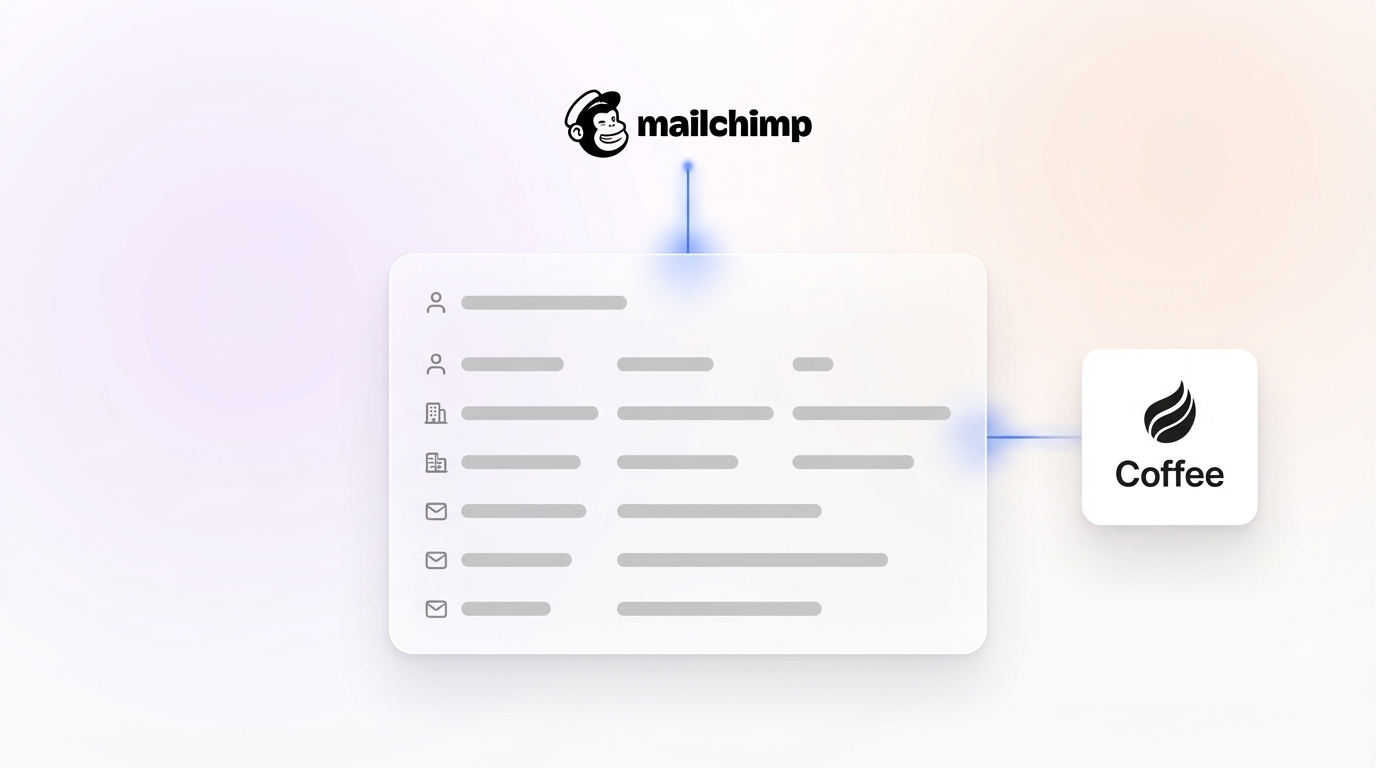
Agent-led solutions change this pattern. Coffee’s agent connects to Google Workspace or Microsoft 365 and quickly begins auto-creating contacts and companies from emails and calendar events. It enriches records with job titles, funding data, and LinkedIn profiles, and it logs last and next activity automatically. When Mailchimp campaign engagement data is available, the agent ingests it and writes structured insights back to contact records, without a human configuring a Zap or copying a field.

The contrast with passive databases is structural. About 32% of sales reps spend more than one hour daily on manual data entry in their CRM. Coffee’s agent removes that labor by treating data entry as an agent task instead of a human task. Mailchimp remains the marketing source of truth, Coffee maintains the sales source of truth, and the two stay synchronized without manual intervention.

Roughly one-third of marketing teams run at least one agentic AI system in 2026, up from around 14% in late 2025. Teams that delay agent-led automation widen the gap between themselves and competitors that already removed the data-entry bottleneck.
Best-Fit Use-Case Matrix by Company Size and Tech Stack
| Company Size & Stack | Best-Fit CRM | Rationale |
|---|---|---|
| 1–10 seats, Google Workspace, Mailchimp as primary channel | Coffee (Standalone) or Copper | Coffee’s agent auto-creates contacts from Gmail and Calendar with zero setup. Copper offers native Google Workspace and Mailchimp sync at lower automation depth. |
| 1–10 seats, Microsoft 365, budget-constrained | Coffee (Standalone) or Zoho CRM | Coffee connects to Microsoft 365 natively. Zoho Standard at $14 per user each month is a strong budget option with native Mailchimp sync. |
| 10–30 seats, existing HubSpot or Salesforce, Mailchimp for campaigns | Coffee (Companion App) on top of HubSpot or Salesforce | Coffee’s agent layer handles data-in without replacing the existing system of record. It removes manual sync labor while preserving the current pipeline structure. |
| 10–30 seats, no existing CRM, high-velocity inside sales | Close or Freshsales | Close’s built-in calling and sequencing suits outbound-heavy teams. Freshsales Growth at $9 per user each month fits budget-constrained teams with lighter automation needs. |
| 5–15 seats, migrating from spreadsheets, Mailchimp as source of truth | Coffee (Standalone) or Capsule | Coffee’s agent removes much of the migration burden by auto-populating records. Capsule’s native Mailchimp sync offers a low-friction entry point for teams not yet ready for agent automation. |
Operational Considerations and Risks for Every Option
Data hygiene: B2B contact data decays at 22–30% annually because of job changes, company acquisitions, and email updates. A 50,000-contact CRM loses accurate data on 11,000–17,000 records every year without active hygiene. When that CRM syncs with Mailchimp, dirty records spread in both directions. Broken records from a CRM are a primary recurring source of cleaned contacts in Mailchimp because the CRM often remains the source of truth for contact data.
Migration risk: CRM migration failure rates are commonly reported between 55% and 70%. Failures usually stem from people-related issues such as weak user adoption and limited training rather than data quality, with data migrations succeeding about 90% of the time. Workflow reconstruction can consume a large share of migration effort but often receives little planning.
Hidden costs: Integration costs often include middleware platforms, custom API integrations, and ongoing maintenance. Teams that focus only on sticker price routinely underestimate total cost of ownership.
Scalability: APIs change and platforms push updates without warning, so a sync that worked in Q1 can start dropping records by Q3. Tier 2 Zapier or API integrations need active monitoring. Tier 3 agent-automated solutions self-maintain because the agent manages the sync logic.
Incomplete automation: Many sales leaders report that tech silos limit AI and CRM effectiveness when tools do not integrate fully. A CRM that syncs contacts but not engagement data, or engagement data but not deal stages, creates partial visibility that can be worse than no integration because it builds false confidence in incomplete data.
Decision Framework: Matching CRM Options to Your Constraints
This checklist helps narrow your CRM options before you request demos or trials.
- Mailchimp as your long-term marketing platform: If Mailchimp remains central, prioritize Tier 1 native sync options such as Copper, Zoho, and Capsule or Tier 3 agent automation like Coffee instead of Tier 2 Zapier-dependent tools.
- Existing HubSpot or Salesforce: Adding Coffee as a Companion App preserves your current system of record and removes the data-entry labor that harms data quality.
- Google Workspace stack: Copper’s native Gmail integration and Mailchimp connector make it a low-friction Tier 1 choice. Coffee also connects natively to Google Workspace.
- Migrating from spreadsheets: For small teams moving from spreadsheets, migration involves export, upload, mapping, and reconnecting integrations including Mailchimp. Coffee’s agent further reduces work by auto-populating records from email and calendar history.
- True budget over three years: Licensing is only 30–40% of true CRM cost, so factor in the implementation, middleware, and training expenses discussed earlier before comparing sticker prices.
- Admin capacity: Tier 2 integrations require ongoing Zap monitoring, field mapping audits, and sync validation. Tier 3 agent automation removes that overhead.
- Need for campaign attribution: Only Tier 1 and Tier 3 options surface Mailchimp engagement data inside CRM contact records without manual configuration for each campaign.
Frequently Asked Questions
How long does it take to implement a Mailchimp-CRM sync in 2026?
Implementation time depends on the integration tier and team size. For small teams migrating from spreadsheets, the full process of export, upload, field mapping, and reconnecting Mailchimp can finish quickly when setups are simple. Mid-market teams with 50,000–250,000 records and existing automation workflows should plan 8–12 weeks, with the data cleanup phase often taking the longest regardless of record volume. Tier 2 Zapier-based integrations add configuration time because each trigger action needs a separate Zap. Tier 3 agent-automated solutions such as Coffee shorten setup because the agent auto-creates contacts and starts logging activity after connecting to Google Workspace or Microsoft 365, with no field mapping or Zap configuration required for core sync.
How much migration effort is involved in moving from spreadsheets to a new CRM while keeping Mailchimp?
Migration effort is often underestimated because teams focus on data movement and overlook workflow reconstruction. Raw record movement is usually the easiest step, while rebuilding automations, field mappings, and integration logic consumes most of the work. For teams migrating from spreadsheets, the lack of existing CRM automations simplifies the process. The non-negotiable pre-migration step is data cleanup, and contact lists typically degrade at the 22–30% annual decay rate mentioned earlier. When you keep Mailchimp as the marketing source of truth, reconnect Mailchimp after the primary data import and after reconnecting core tools such as email providers so that marketing data enrichment occurs in the right order. Coffee’s agent further reduces migration effort by auto-populating contact and company records from email and calendar history, which removes the need to import and map historical interaction data manually.
What security and compliance requirements apply to CRM-Mailchimp integrations?
GDPR requires that personal data stored in a CRM remain accurate, relevant, and not retained longer than necessary. This rule applies to any contact data synced between a CRM and Mailchimp, so both systems must reflect the same consent and suppression states. Access controls should restrict record creation, editing, and deletion to authorized team members, and records without a legal retention basis should be purged regularly. For teams evaluating CRM vendors, SOC 2 Type 2 certification is the baseline security standard for cloud-based CRMs that handle contact data. Coffee is SOC 2 Type 2 and GDPR compliant, and data processed by the Coffee agent does not train public models. When you evaluate any CRM-Mailchimp integration, confirm that unsubscribe events in Mailchimp flow back to the CRM in real time because failure to sync suppression states is a common compliance gap in Tier 2 Zapier-based integrations.
How do you evaluate CRM fit for a 5–30 seat team in 2026?
Five criteria matter most for this team size. First, integration quality with your existing stack, especially whether Mailchimp engagement data flows into CRM contact records natively or needs middleware. Second, automation depth, meaning whether the CRM reduces data-entry labor or simply provides a structured place for manual entry. Third, total cost of ownership over three years, not sticker price per seat, because licensing usually represents only 30–40% of total CRM spend. Fourth, migration effort from your current system, including data cleanup and workflow reconstruction. Fifth, adoption likelihood, since a CRM that sales reps view as a chore will collect bad data and undermine the integration. Agent-led CRMs such as Coffee address adoption structurally by removing the data-entry requirement, so reps use the system to get insights instead of entering records.
Conclusion: Choosing the Right CRM Path
Teams already using Mailchimp have three realistic paths in 2026. Tier 1 native sync options such as Copper, Zoho, and Capsule provide bidirectional contact and campaign data flow with manageable setup effort. Tier 2 Zapier or API options such as Pipedrive, Freshsales, and Close offer strong pipeline tools but require ongoing middleware maintenance that increases cost and failure risk over time. Tier 3 agent-automated solutions remove the maintenance burden by replacing human data-entry labor with an autonomous agent that ingests, enriches, and writes back data without configuration overhead.
The decision depends on how much administrative capacity your team will dedicate to keeping two systems synchronized. For teams that want Mailchimp to remain the marketing source of truth while gaining accurate pipeline data without extra admin work, the agent-led path scales without adding headcount or middleware complexity.
Let Coffee’s agent manage your CRM sync, data entry, and pipeline intelligence automatically.