Written by: Doug Camplejohn, CEO & Co-Founder, Coffee | Last updated: August 6, 2026
Key Takeaways
- Standalone enrichment tools create recurring maintenance and integration overhead that grows with team size.
- Agent-native enrichment inside the CRM removes manual data entry and keeps records continuously updated.
- Coffee’s companion app respects Salesforce and HubSpot native objects, required fields, and forecasting logic from day one.
- Teams under 20 reps can replace multiple point solutions with Coffee’s standalone CRM on a single seat-based plan.
- Eliminate your standalone enrichment subscription and consolidate your stack with Coffee.
Evaluation Criteria for Contact Enrichment Tools in 2026
These criteria reflect real costs and risks that appear during deployment, not just during vendor evaluation.
- Data quality and match rates by ICP: The percentage of target contacts that return accurate, current firmographic and contact data. Match rates vary by geography, company size, and industry vertical.
- Total cost of ownership: The full cost of a solution, including subscription fees, implementation time, ongoing CRM maintenance hours, and the cost of data decay between enrichment cycles.
- Integration depth with Salesforce and HubSpot: Whether the tool writes enriched data back to the correct fields, respects required fields and validation rules, and supports forecasting and quota objects, not just basic contact sync.
- Automation of data capture: The degree to which the tool removes manual entry. A tool that surfaces data but requires a rep to copy it into the CRM is assisted, not automated.
- Regional and GDPR compliance: Whether the vendor maintains documented lawful bases for processing, supports data subject access requests, and restricts data to permissible geographies.
- Long-term scalability: Performance and cost trajectory as the sales team grows from 5 to 50 to 200 reps, including seat-based pricing predictability and administrative overhead at scale.
The following table applies these criteria across eight leading enrichment solutions and compares data quality, integration depth, and total cost of ownership.
2026 Comparison Table: Leading Contact Enrichment Tools
| Tool | Data Quality & Match Rate | Integration Depth | Total Cost of Ownership |
|---|---|---|---|
| Apollo | Strong for SMB and mid-market US contacts, thinner internationally | Native Salesforce and HubSpot sync, field mapping requires manual configuration | Low entry price, CRM maintenance hours and deduplication work add hidden cost |
| ZoomInfo | Broad US enterprise coverage, intent data layer available | Deep Salesforce integration, HubSpot connector available, complex setup | High subscription cost, annual contracts, significant admin overhead |
| Clay | Aggregates multiple sources, quality depends on underlying providers | Exports to CRM via webhook or Zapier, no native write-back agent | Usage-based credits add unpredictability, requires RevOps build time |
| Cognism | Strong EMEA and GDPR-compliant coverage, US coverage improving | Salesforce and HubSpot connectors, phone-verified data available | Mid-to-high subscription, compliance posture reduces legal risk cost |
| Lusha | Good for individual contact lookup, weaker for bulk enrichment | Browser extension and CRM sync, limited field-level control | Low per-seat cost, scales poorly for large teams, manual workflow persists |
| Clearbit | Strong firmographic enrichment, acquired by HubSpot, tighter HubSpot integration | Deep HubSpot native integration, Salesforce via API, limited standalone use | Pricing restructured post-acquisition, HubSpot-centric value proposition |
| Seamless.AI | Real-time search model, accuracy varies, US-focused | CRM push available, field mapping manual, no agent-level write-back | Subscription plus credits, rep adoption required for data to enter CRM |
| Coffee (Agent) | Enrichment via licensed data partners, on par for most ICP use cases, built into the agent | Native Salesforce and HubSpot companion, respects required fields, quotas, and forecasting objects | Seat-based pricing, enrichment, capture, sequencing, and pipeline intelligence included, no separate tool subscriptions |
See how Coffee's pricing compares to the tools in this table for your team size.
Category-by-Category Analysis of Enrichment Approaches
The comparison table shows what each tool offers on paper. This section explains how those capabilities translate into real setup effort, daily workflows, and long-term admin costs across six key dimensions.
1. Setup Effort
Standalone tools like ZoomInfo and Cognism require dedicated implementation time for field mapping, CRM object configuration, deduplication rule setup, and user provisioning. Clay needs RevOps engineering to build enrichment workflows before any data reaches the CRM. Coffee's agent activates through a simple authentication to Google Workspace or Microsoft 365 and connects to Salesforce or HubSpot through a companion app that understands native objects, required fields, and validation logic from day one.
2. Data Capture and Maintenance
Standalone enrichment tools share a structural limitation: they surface data, and then a human or a custom integration must move that data into the CRM. Coffee's agent captures contacts and companies automatically by scanning emails and calendars, logs activity without rep input, and enriches records with job titles, funding data, and LinkedIn profiles through licensed data partners. This approach removes the data entry step entirely instead of simply speeding it up.
3. Usability for Reps
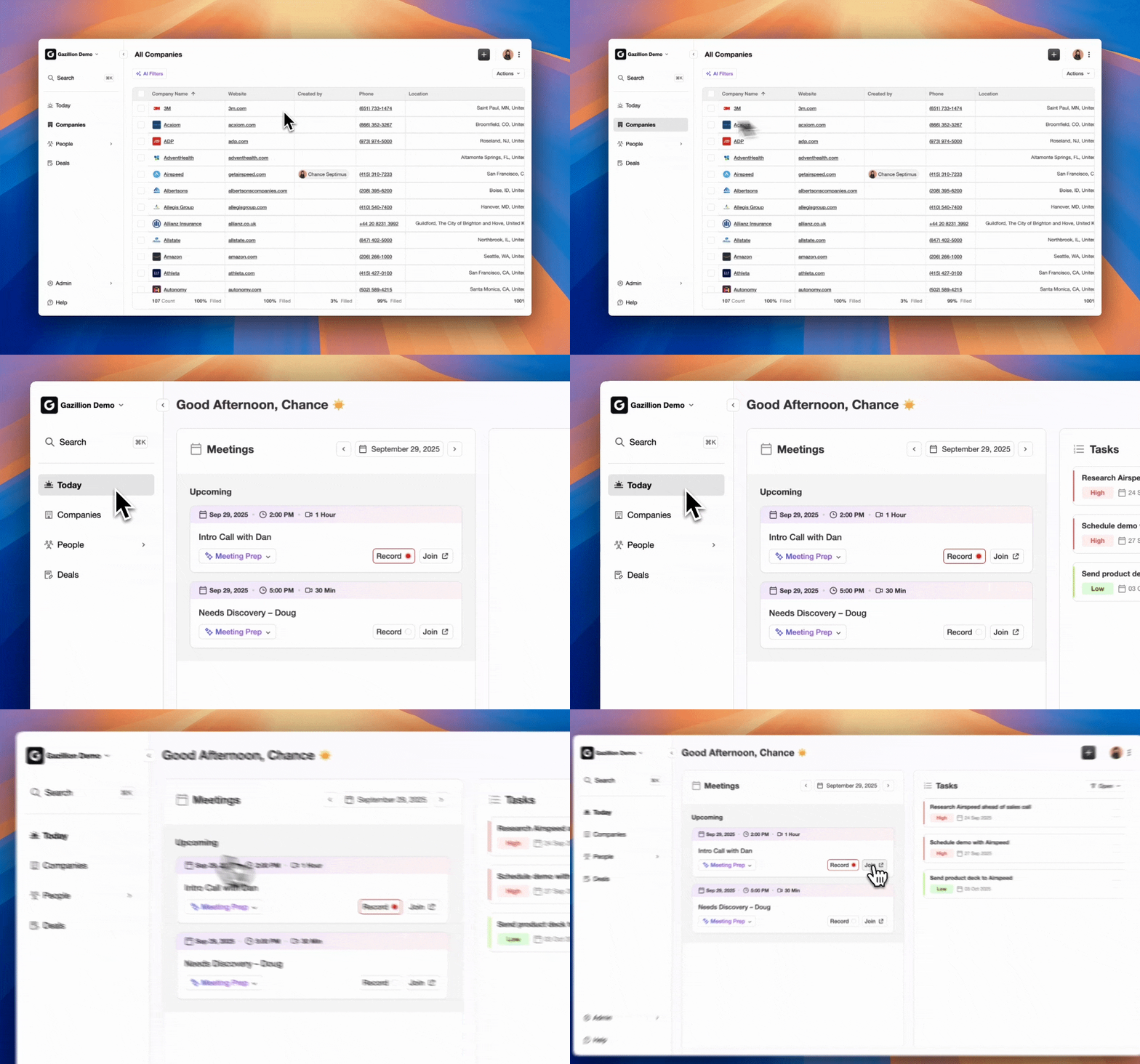
Sales reps using Apollo, Lusha, or Seamless.AI work in a browser extension or a separate interface, then manually transfer or confirm data into the CRM. Coffee operates as a co-pilot inside the rep's existing workflow. It prepares meeting briefings, joins calls, generates post-call summaries, and drafts follow-up emails, then writes everything back to the CRM automatically. Reps interact with the agent instead of administering a database.

4. Manager Visibility
Pipeline visibility in standalone enrichment setups depends on the quality of rep data entry. When reps skip logging, managers see an incomplete picture. Coffee's agent captures every interaction from email and calendar, so the pipeline reflects ground truth. The Pipeline Compare feature surfaces week-over-week deal changes automatically and replaces manual CSV exports and interrogation-style pipeline reviews.

5. Integration Complexity
ZoomInfo and Clearbit offer deep Salesforce integrations, but deep in this context means extensive configuration requirements. Quota objects, forecasting categories, required fields, and custom validation rules must be mapped manually. Coffee's companion app is built with an explicit understanding of Salesforce and HubSpot complexity, including forecasting, required fields, and quota structures, which newer agent-style CRMs like Clarify and Day.ai have not yet matched.
6. Ongoing Administrative Burden
Standalone tools require recurring maintenance such as refreshing enrichment on decayed records, managing duplicate contacts from imperfect sync, updating field mappings after CRM schema changes, and renewing contracts for each point solution. Coffee consolidates enrichment, prospecting, meeting intelligence, sequencing, and pipeline tracking into one agent on one seat-based contract, which reduces the administrative surface area for RevOps.
Best-Fit Use Cases by Company Size and Tech Stack
Early-stage teams (1–20 employees): Teams that have outgrown spreadsheets but find Salesforce or HubSpot expensive and maintenance-heavy fit well with Coffee's standalone CRM. A separate enrichment subscription adds cost and complexity that feel disproportionate at this stage. Coffee's agent handles enrichment, meeting notes, and outreach natively from a single seat-based plan.
Growing sales organizations (20–200 employees): At this scale, data quality problems compound. Reps are too busy to maintain CRM hygiene, and RevOps lacks bandwidth to manage multiple point solutions. Apollo or ZoomInfo may cover prospecting needs, but they do not solve the data entry problem. Coffee's companion app addresses both by enriching records and capturing activity automatically inside the existing CRM.
Teams committed to Salesforce or HubSpot: These teams need enrichment that respects the CRM's native structure. ZoomInfo and Cognism offer the deepest standalone integrations, but both require ongoing configuration work. Coffee's companion app is purpose-built for this scenario and writes enriched data back to Salesforce or HubSpot without disrupting existing workflows, forecasting models, or required field logic.
Find the right Coffee plan for your team size and CRM setup.
Operational Considerations as Headcount Grows
Scaling a standalone enrichment tool from 10 to 50 reps introduces compounding administrative work. Each new rep requires provisioning, training on the enrichment interface, and enforcement of data entry discipline, but even strong onboarding does not solve the core issue. Data hygiene degrades as more reps create duplicate records or skip enrichment steps under time pressure, so the administrative burden grows faster than headcount.
Coffee's agent-native model scales differently. The agent handles capture and enrichment automatically, so adding a rep seat does not add a proportional administrative burden. The agent's behavior stays consistent regardless of rep discipline. Change management focuses on onboarding reps to the agent's meeting and follow-up features instead of training them on a separate tool and a manual data entry workflow.
Performance at scale also depends on the underlying data architecture. Legacy CRMs built on relational databases lose historical context when fields are updated. Coffee's agent runs on a data warehouse that retains history and enables accurate week-over-week pipeline comparisons and trend analysis that relational CRM architectures struggle to produce without expensive add-ons.
Risks and Limitations of Current Options
Hidden maintenance work: Every standalone enrichment tool creates a recurring maintenance obligation. Enriched data decays as job titles change, companies are acquired, and contacts leave roles. Without an agent that continuously re-enriches records from live signals like email and calendar activity, the CRM drifts back to stale data between enrichment cycles.
Incomplete automation: As noted in the category analysis, tools marketed as automated often automate only the lookup step. The structural limitation remains that enriched data must still be transferred into the correct CRM fields and associated with the correct account and opportunity.
Integration gaps: The integration gaps described earlier, where tools sync contacts but ignore opportunity objects, forecasting categories, or required field validation, create downstream data integrity problems that undermine forecast accuracy.
Overbuying for current needs: ZoomInfo and Cognism are enterprise-grade tools with enterprise-grade price points. Teams under 50 reps frequently pay for coverage, intent data layers, and compliance infrastructure they do not use. The total cost of ownership for these tools at SMB scale often feels disproportionate to the data quality improvement they deliver.
Decision Framework for Choosing an Enrichment Model
The following criteria map directly to the options evaluated in this article.
- Primary CRM is Salesforce or HubSpot, and data entry is the core problem: Coffee's companion app addresses both enrichment and capture natively inside the existing system.
- No CRM yet, team under 20 reps: Coffee's standalone CRM removes the need for separate enrichment, meeting intelligence, and sequencing tools.
- EMEA-heavy ICP with strict GDPR requirements: Cognism's phone-verified, GDPR-documented data set is the strongest standalone option for this geography.
- Enterprise US coverage with intent data as the priority: ZoomInfo remains the most comprehensive standalone database for large US enterprise accounts, at a corresponding cost.
- RevOps team with capacity to build custom enrichment workflows: Clay offers flexible multi-source aggregation but requires engineering investment to operationalize.
- Team wants to consolidate stack and reduce per-tool subscriptions: Coffee's agent replaces multiple point tools in one seat-based plan and simplifies vendor management.
Frequently Asked Questions
How long does implementation typically take for each option?
Standalone tools like Apollo and Lusha can be provisioned in hours for basic use, but meaningful CRM integration with field mapping, deduplication rules, and validation logic typically takes one to three weeks of RevOps configuration time. ZoomInfo and Cognism enterprise deployments often extend to four to eight weeks when Salesforce integration is involved. Clay requires custom workflow builds that vary widely by complexity. Coffee's companion app connects to Salesforce or HubSpot through a standard authentication flow and begins capturing and enriching data immediately, with no custom field mapping required for standard objects. The standalone CRM activates after connecting Google Workspace or Microsoft 365.
What is the migration effort when switching enrichment approaches?
Migrating from a standalone enrichment tool to an agent-native approach involves three workstreams: exporting existing enriched data, deduplicating records in the destination CRM, and decommissioning the old tool's integration. The data export is straightforward for most tools. Deduplication is the highest-effort step and scales with the size of the existing contact database. Coffee's agent handles ongoing deduplication and enrichment after migration, but the initial cleanup of a legacy database is a one-time project that teams should scope before switching. Teams migrating from a full CRM to Coffee's standalone product should plan for a structured data import and a brief parallel-run period to validate record accuracy.
How do data quality and match rates compare in 2026 tests?
Match rates vary significantly by ICP geography and company size. US mid-market contacts are well-covered by Apollo, ZoomInfo, and Seamless.AI. EMEA contacts are more reliably covered by Cognism, which maintains phone-verified records and documented GDPR compliance. SMB contacts globally tend to have lower match rates across all providers because smaller companies have less publicly indexed firmographic data. Coffee's enrichment comes from licensed data partners and focuses on the most common ICP profiles for teams under 200 employees. For highly specialized or international ICPs, teams should validate match rates against their specific target list before committing to any single provider.
Which solutions best support GDPR compliance and regional data regulations?
Cognism is the most explicitly GDPR-focused standalone tool and maintains documented lawful bases for processing with a phone-verified, consent-managed data set for EMEA contacts. ZoomInfo has expanded its compliance infrastructure but has faced regulatory scrutiny in European markets. Apollo and Lusha are primarily US-focused and carry higher compliance risk for EMEA campaigns. Coffee is SOC 2 Type 2 certified and GDPR compliant. Data processed by the agent is not used to train public models, and the platform supports data subject access requests. Teams with significant EMEA pipeline should evaluate both the vendor's compliance documentation and their specific data processing agreements before deployment.
How do these tools scale as sales teams grow beyond 50 reps?
Standalone tools scale in subscription cost linearly with seats, while administrative burden often scales faster because each additional rep introduces new data entry variability, duplicate creation risk, and training overhead. ZoomInfo and Cognism are designed for enterprise scale and handle large seat counts well, though at significant cost. Apollo's pricing becomes less competitive at higher seat counts relative to its enterprise alternatives. Coffee's seat-based model includes the agent's integrated capabilities at every seat, so the per-seat value increases as the team grows and the agent absorbs more administrative work. The data warehouse architecture also means historical pipeline data accumulates and improves forecast accuracy over time instead of degrading as it often does in relational CRM systems.
Conclusion: Choosing Data That Works, Not Just Data That Exists
The core trade-off in 2026 sits between a model that only surfaces data and a model that also acts on it. Standalone tools like ZoomInfo, Apollo, Cognism, and Clay provide valuable data coverage, but they do not remove the manual work of moving that data into the CRM, maintaining it over time, or connecting it to meeting intelligence, sequencing, and pipeline visibility. Each additional tool adds a subscription, an integration, and an administrative obligation.
Coffee's agent replaces that stack by handling enrichment, data capture, meeting intelligence, outreach sequencing, and pipeline tracking natively, either as a standalone CRM for teams under 20 reps or as a companion app inside Salesforce or HubSpot for growing organizations. The result is accurate CRM data without manual entry and pipeline intelligence without spreadsheets.
See Coffee's pricing and start consolidating your sales stack today.