Written by: Doug Camplejohn, CEO & Co-Founder, Coffee | Last updated: July 30, 2026
Why Coffee Stands Out for Small Sales Teams
- Cloud contact management platforms in 2026 fall into two groups: passive databases that rely on manual entry and autonomous systems that capture and enrich data automatically.
- Small sales teams with 2–15 reps should focus on automation depth, hours saved per rep, pricing under $25 per user each month, and native email or calendar integration.
- Coffee’s autonomous agent removes 8–12 hours of manual data entry per rep each week and outperforms HubSpot, Pipedrive, Zoho, and Salesforce Starter on automation at a similar price.
- Teams already using Salesforce or HubSpot can add Coffee as a Companion App that enriches records and writes data back without a disruptive migration.
- Eliminate manual data entry today, deploy your autonomous agent and let it handle your pipeline.
How This Comparison Evaluates Coffee vs Legacy CRMs
This guide evaluates seven platforms: Coffee, HubSpot, Pipedrive, Zoho CRM, Salesforce Starter, Day.ai, and Clarify. Each platform is assessed against seven criteria that matter most for teams of 2–15 reps:
- Data-entry automation depth
- Hours saved per rep per week
- Pricing at or under $25 per user per month
- Email and calendar integration depth
- Pipeline intelligence without spreadsheets
- Mobile access
- Microsoft 365 and Google Workspace fit
See how Coffee performs on these criteria and remove manual data entry from your team’s workflow today.
Side-by-Side Pricing and Time-Savings Snapshot
| Tool | Hours Saved / Week (per rep) | Price per User / Month |
|---|---|---|
| Coffee | See time-savings analysis | Seat-based; agent labor included — see pricing |
| HubSpot Sales Hub Starter | Minimal, reps still spend 60% of their week on non-selling tasks on legacy platforms | $20/user/month (annual) |
| Pipedrive Essential | Low, only 2 of 10 email integration features on its standard plan | $14/user/month (annual) |
| Zoho CRM Standard | Low, 3 of 10 email integration features at the standard tier | $14/user/month (annual) |
| Salesforce Starter | Low at Starter tier, advanced automation requires a significant upgrade | $25/user/month |
| Day.ai | Moderate for note-taking workflows, limited pipeline automation | Varies, no published sub-$25 tier with full automation |
| Clarify | Moderate for new setups, integration gaps reduce savings for existing stacks | Varies, early-stage pricing |
The table above gives a quick view of pricing and time impact. The next sections unpack how each platform handles setup, data capture, usability, and long-term fit.
Category-by-Category Analysis of Coffee vs Alternatives
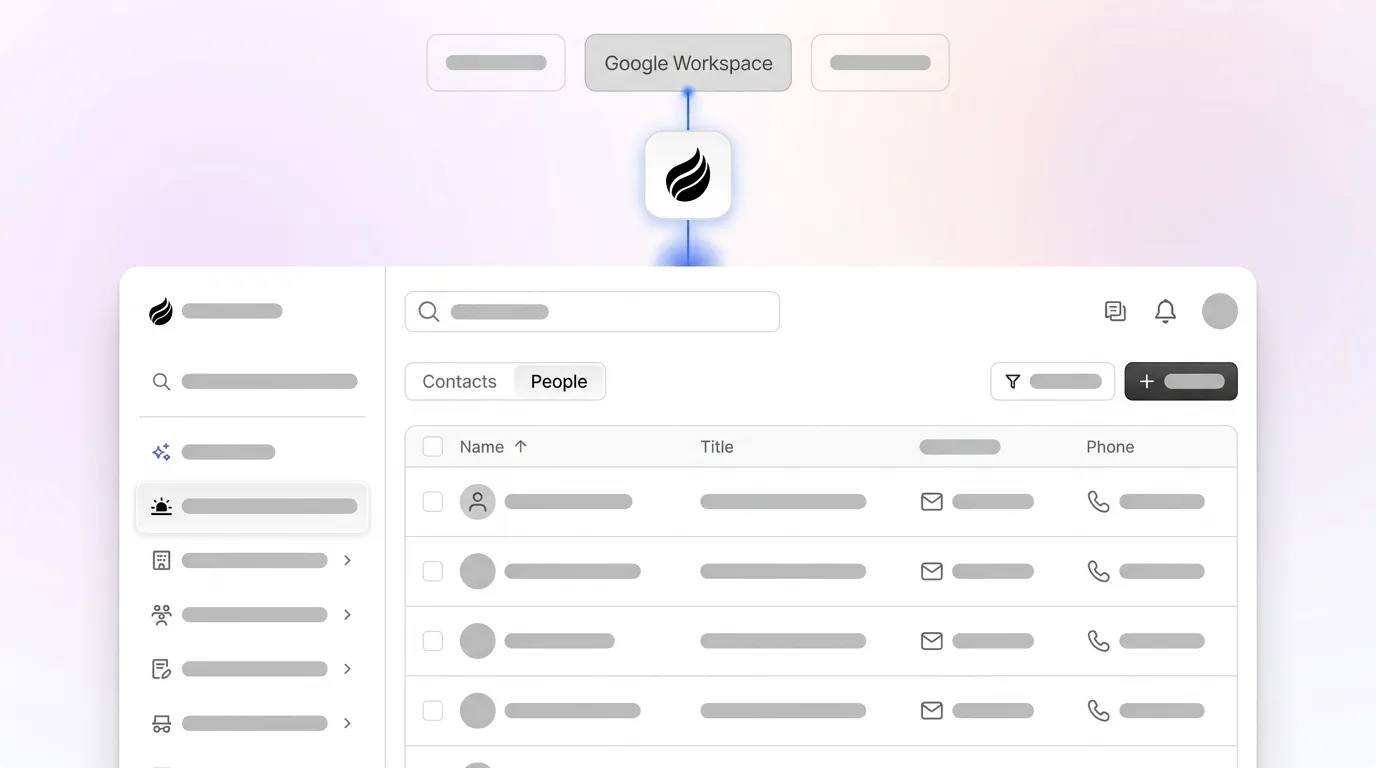
Setup effort. Coffee connects to Google Workspace or Microsoft 365 with a single authentication and immediately scans emails and calendars to auto-create contacts and companies. HubSpot and Salesforce require field mapping, workflow configuration, and often paid onboarding. Salesforce’s Pro Suite starts at $100 USD/User/Month (billed annually) before teams reach the automation depth that Coffee delivers at its base tier.
Data capture. Traditional CRM systems act as passive filing cabinets whose usefulness depends entirely on manual data entry by sales reps. Coffee’s autonomous agent ingests emails, calendar events, and call transcripts, then maps them to the correct records without rep involvement. Email and calendar automation can remove 60–70% of manual data entry for activity tracking. Coffee targets the full burden. The Coffee Stripe integration, launched in January 2026, automatically imports customers and companies, enriches them, and adds paid invoices to deals as Closed Won, a capability missing from every other tool in this comparison at the same price point.

Usability. 71% of sales reps report spending too much time on data entry, ranking it among their top job frustrations. Coffee removes that friction entirely. Pipedrive’s visual pipeline feels intuitive but still forces reps to drag deals and log activities manually. HubSpot’s interface is powerful yet increasingly complex for small teams that do not need its full marketing suite.

Manager visibility. A Validity 2025 study found that 76% of organizations say less than half of their CRM data is accurate, and companies lose an average of 16 sales deals per quarter from poor CRM data quality caused by manual entry methods. Coffee’s Pipeline Compare feature visualizes week-over-week changes automatically and replaces manual CSV exports. Coffee’s AI search on deals, released in January 2026, answers natural-language questions such as “Which deals are stuck in negotiation?” or “What’s closing this month?”. Salesforce and HubSpot reserve similar capabilities for expensive add-ons.

Integration complexity. Coffee integrates natively with Google Workspace and Microsoft 365 and connects to other tools through Zapier, with deeper integrations on the roadmap. Day.ai and Clarify lack the integration depth required for teams already running Salesforce or HubSpot with quotas, forecasting, and required fields. Coffee’s Companion App model deploys the agent as an intelligent layer on top of existing Salesforce or HubSpot instances. This approach preserves the system of record and removes the data-entry burden.
Long-term flexibility. Top-performing sales organizations are 1.7x more likely to use AI agents than underperformers, per Salesforce’s 2026 State of Sales report. Coffee’s dual-model strategy, Standalone CRM or Companion App, keeps teams flexible as their stack evolves and avoids lock-in to a single deployment path.
Best-Fit CRM Choices for Teams That Want No Data Entry
Early-stage teams (1–5 reps, no existing CRM). Coffee’s Standalone CRM fits directly. The agent auto-creates contacts from Gmail or Outlook from day one. The Intelligence layer, introduced in February 2026, lets teams define ICP, product specifics, and competitors for tailored AI suggestions. This approach removes the configuration overhead that makes HubSpot and Pipedrive feel like chores at this stage.

Growing sales organizations (6–15 reps, outgrowing spreadsheets). A team of 5 SDRs spends 25–30 hours per week combined on manual CRM data entry, totaling 1,200–1,440 hours annually, which equals 62–75% of one additional full-time SDR’s annual hours. Coffee recovers that capacity without extra headcount. Its Campaigns feature runs AI-generated multi-step email sequences natively and can replace separate Outreach or Salesloft subscriptions.
Teams already committed to Salesforce or HubSpot. Coffee’s Companion App authenticates against the existing instance and writes enriched data, call summaries, and pipeline changes back to the primary CRM. More than half of sales leaders cite disconnected systems as a drag on AI initiatives, and 74% of sales professionals prioritize data cleansing and integration. The Companion App addresses both issues without a rip-and-replace migration.
Choose your deployment model — Standalone CRM or Companion App based on your current stack.
Operational Risks Small Teams Should Plan For
Every platform carries implementation risk, and small teams feel these risks quickly. The following factors matter most when evaluating this category:
- Change management. Reps accustomed to spreadsheets or Notion need a clear reason to adopt any new tool. Coffee’s value proposition that the agent does the work, not the rep, reduces adoption friction because reps gain time rather than lose it. This time savings becomes even more valuable when teams confront the next common risk, data quality at migration.
- Data hygiene at migration. Importing a dirty contact list into any CRM produces dirty output. Coffee’s enrichment agent augments records with job titles, funding data, and LinkedIn profiles on import, which reduces the manual cleanup burden that can undermine adoption. After migration, teams still need to watch for automation gaps in their chosen platform.
- Incomplete automation in legacy tools. HubSpot and Pipedrive advertise automation but gate meaningful AI features behind mid-tier plans. HubSpot’s deeper AI capabilities require the Professional plan, so teams that buy based on advertised automation may still pay for manual work. These gaps often appear alongside integration limitations.
- Integration gaps. Coffee currently connects to third-party tools via Zapier. Teams with complex native integration requirements should confirm compatibility before committing. This review helps avoid overbuying features that do not match real needs.
- Overbuying. Salesforce Starter at $25 per user each month delivers core contact management but reserves advanced automation for higher tiers that exceed the $25 ceiling. Teams that buy Starter expecting Einstein-level intelligence will feel disappointed. A clear view of scale expectations helps avoid this trap.
- Scalability. Coffee is designed for companies up to mid-market scale. Large enterprises with custom workflows and multi-year security review requirements fall outside its current ICP. Those organizations often require heavier platforms and longer deployment cycles.
Decision Framework for Picking the Right Tool
Match your situation to the recommendation below and choose a platform that fits your current stage:
- No existing CRM, 1–10 reps, Google Workspace or Microsoft 365. Coffee Standalone CRM. The agent handles all data entry from day one, and pricing stays competitive with HubSpot Starter and Pipedrive Essential.
- Existing Salesforce or HubSpot, low adoption, dirty data. Coffee Companion App. The agent enriches and writes back to the existing system of record without migration.
- Budget under $15 per user each month, basic pipeline only, no automation requirement. Pipedrive Essential or Zoho CRM Standard. Expect manual data entry to remain a burden.
- Google Workspace-native, email-first workflow. Coffee or Copper (Basic at $23 per user each month). Coffee adds autonomous capture. Copper embeds CRM in Gmail but lacks automatic contact enrichment from email signatures and relationship strength scoring.
- Teams prioritizing AI-driven pipeline forecasting. Coffee. AI CRM platforms use Natural Language Processing to analyze call transcripts and email text, flagging hesitation, pricing objections, and competitor mentions in real time. Coffee delivers this capability natively at its base tier.
Frequently Asked Questions
How long does it take to implement Coffee?
Coffee connects to Google Workspace or Microsoft 365 through a single authentication step. The agent begins scanning emails and calendars immediately and starts auto-creating contacts and logging activities within minutes of connection. Small teams avoid field-mapping configuration and paid onboarding. Most teams become operational on the same day they sign up.
Is AI replacing contact management entirely?
AI is not replacing contact management, it is replacing the manual labor inside it. The work of tracking contacts, logging interactions, and forecasting pipeline remains essential. What changes in 2026 is who performs that work. Autonomous agents now handle data capture, enrichment, and activity logging, while sales reps focus on conversations and strategy. The 2026 Salesforce State of Sales report found that 54% of sales teams have already deployed AI agents across the sales cycle, and as noted earlier, top performers show significantly higher AI agent adoption rates. Contact management as a category remains, but it becomes agent-operated.
Does Microsoft 365 replace a CRM?
Microsoft 365 provides email, calendar, and document collaboration but does not replace a CRM. It lacks pipeline tracking, deal stage management, contact enrichment, forecasting, and sales sequence functionality. Microsoft Dynamics 365 is a separate, paid CRM product. For small sales teams, Microsoft 365 serves as the workspace that a CRM integrates with, not a substitute for one. Coffee connects to Microsoft 365 natively and uses Outlook and Teams data as the raw input for its autonomous agent.
How accurate is Coffee’s enrichment data compared to ZoomInfo or Apollo?
Coffee’s enrichment agent provides data on par with standalone prospecting databases for most small-team use cases. It pulls job titles, funding information, and LinkedIn profiles through licensed data partners. Coffee includes enrichment in the seat price, which removes the need for a separate ZoomInfo or Apollo subscription. Teams with highly specialized data requirements, such as direct-dial phone numbers at enterprise scale, may still benefit from a dedicated data provider. Most early-stage and growing teams find Coffee’s built-in enrichment sufficient.
What security certifications does Coffee hold?
Coffee is SOC 2 Type 2 and GDPR compliant. Customer data is not used to train public AI models. Teams in heavily regulated industries such as healthcare or finance that require multi-year security reviews or HIPAA compliance fall outside the recommended use case. For the majority of US-based B2B sales teams, the existing compliance posture meets standard enterprise procurement requirements.
Conclusion: Put an Agent in Charge of Data Entry
32% of sales reps spend 5 or more hours per week on manual CRM entry, and the 28–30% selling-time ceiling mentioned earlier still constrains most legacy stacks. HubSpot, Pipedrive, and Zoho remain viable for teams that accept manual data entry as a permanent cost. Teams that reject that cost find Coffee as the only platform in this comparison that deploys an autonomous agent to remove it entirely, whether as a Standalone CRM or as a Companion App on top of an existing Salesforce or HubSpot instance.
The decision matrix stays simple. If your team has no CRM, Coffee Standalone removes both the setup burden and the data-entry burden at the same time. If your team already runs Salesforce or HubSpot with low adoption and dirty data, Coffee Companion fixes the input problem without a migration. Every other tool in this guide requires reps to serve the software. Coffee’s agent serves the reps.
Put your agent to work on your pipeline today.