Written by: Doug Camplejohn, CEO & Co-Founder, Coffee | Last updated: August 8, 2026
Key Takeaways for Choosing an Enrichment Tool
- Waterfall enrichment chains multiple data providers sequentially to maximize coverage and accuracy, outperforming single-source databases that return only 70–80% verified emails.
- Most enrichment tools require manual RevOps effort for field mapping, refresh scheduling, and CRM hygiene, which creates ongoing operational overhead.
- Coffee’s autonomous agent performs continuous waterfall enrichment, writes verified data directly into Salesforce or HubSpot, and removes human data-entry tasks.
- Coffee is SOC 2 Type 2 and GDPR compliant, so teams can enrich US and EU contacts in one workflow without separate tools or compliance processes.
- Eliminate manual contact enrichment for good with Coffee’s autonomous agent.
CRM Sync Without Manual Work
The central friction point in B2B contact enrichment is not finding data. The real challenge is getting verified data into a CRM without creating a second job for RevOps. Every tool in this category claims CRM integration, yet the quality and effort required for that integration vary significantly.
ZoomInfo’s CRM auto-refresh automatically updates contact and company records in Salesforce, HubSpot, and Microsoft Dynamics as data changes, which is the strongest passive refresh capability among legacy databases. However, ZoomInfo’s rigid contract terms and minimum annual commitment of around $15,000 create exit challenges. G2 reviewers also note difficulty modifying agreements, which becomes a structural problem for growing teams whose data needs shift quarterly.
Apollo.io offers scheduled CRM enrichment that automatically updates contact and company records in Salesforce, HubSpot, and Pipedrive on a set schedule. Apollo’s pricing is more accessible at roughly $49 to $119 per user per month with a freemium model. Scheduled enrichment, however, is not continuous, so records still decay between cycles.
Clay provides native CRM sync that connects directly to HubSpot, Salesforce, and Pipedrive, but requires a dedicated RevOps person to build and maintain workflows due to setup complexity. Clay’s entry pricing starts at $167/month after a free 500-action tier. For teams without a dedicated RevOps engineer, Clay’s power comes with an operational cost that can offset its coverage advantages.
Breeze Intelligence delivers native automatic CRM enrichment inside HubSpot only, with every enriched record automatically updated every 30 days and no data transfer required, but cannot be used with Salesforce, Pipedrive, or other CRMs. Teams committed to HubSpot may find this sufficient. Teams running Salesforce or a dual-CRM environment cannot use it.
Cognism offers native CRM integrations that connect directly with Salesforce, HubSpot, Outreach, and Salesloft for enriched data transfer, plus API enrichment for auto-enriching inbound leads without manual effort. Cognism uses custom quote-based pricing, typically starting at $15,000–$25,000 per year with platform fees plus per-user licensing, which positions it for established mid-market teams with EMEA outbound requirements.
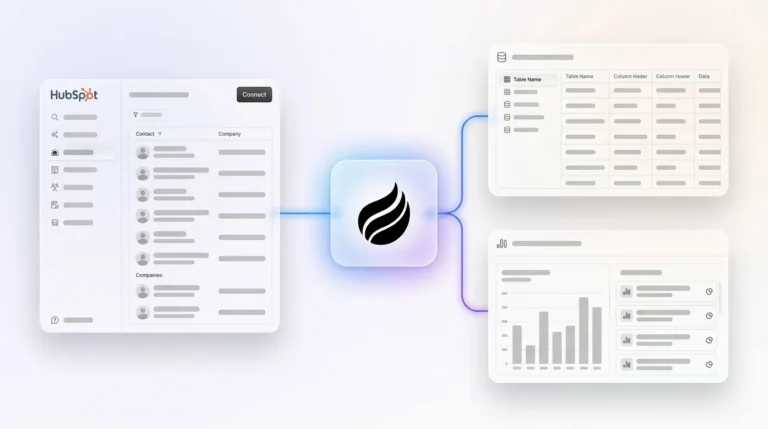
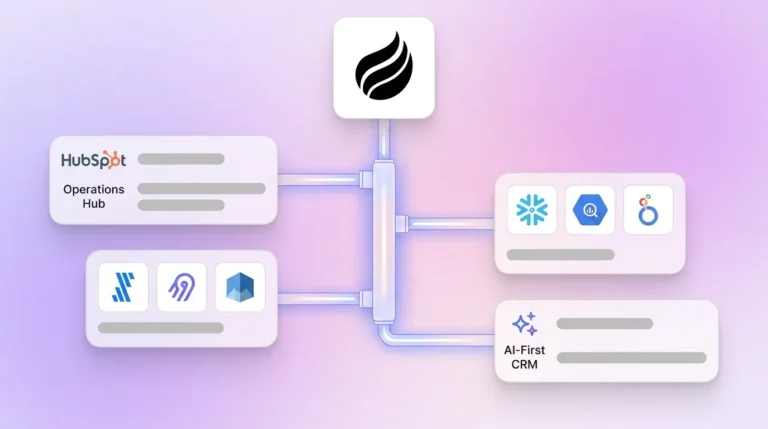
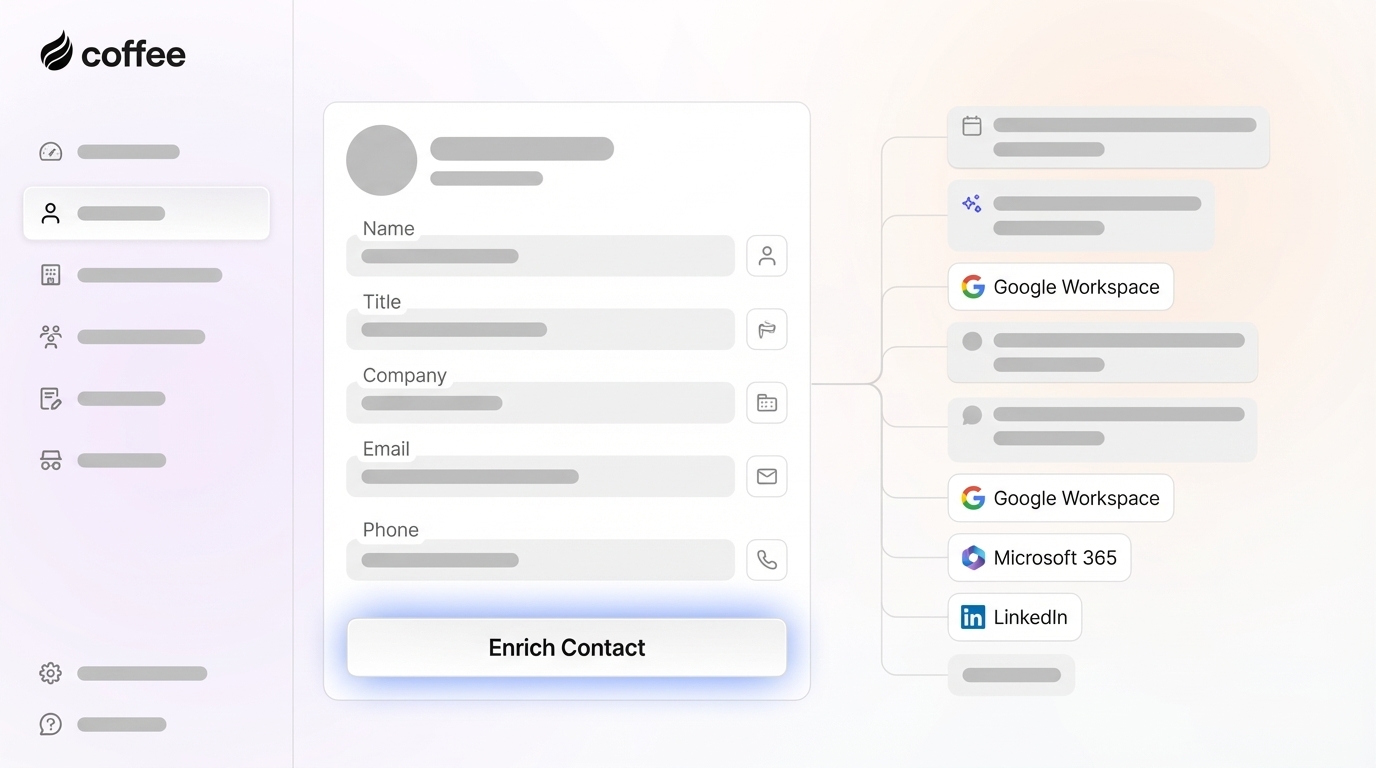
Coffee’s Companion App authenticates directly against an existing Salesforce or HubSpot instance. The agent scans emails, calendars, and call transcripts to auto-create contacts, enrich records with job titles, funding data, and LinkedIn profiles via licensed data partners, and log activity, all without a human triggering the process. For early-stage teams, Coffee’s Standalone CRM removes the CRM setup burden entirely. For growing and established mid-market teams already invested in Salesforce or HubSpot, the Companion App acts as an autonomous enrichment and data-entry layer on top of the existing system of record.
Waterfall Accuracy Testing Results
Waterfall enrichment sequences multiple data providers in a fixed order, querying each only when the prior provider returns no confident result and stopping at the first verified match per record. This method addresses a structural limitation of single-source databases. No single B2B data provider has complete coverage of the market because each has different source relationships, update frequencies, and geographic or vertical strengths.
| Method / Tool | Email Coverage | Phone Coverage | Notes |
|---|---|---|---|
| Waterfall (15+ providers, Cleanlist benchmark) | 98% verified, deliverable | 85% direct-dial or mobile, connectivity-checked | 500-lead stratified benchmark, Aug 2026 |
| FullEnrich (waterfall) | strong coverage | Not reported in this test | Benchmark of B2B decision-maker contacts |
| Single-source databases (Cleanlist benchmark) | 70–80% | 30–60% | Same 500-lead input, Aug 2026 |
| Apollo | competitive coverage and high validity | Not reported in this test | Large sales-intelligence platform test |
Clay’s guides note that no single provider tops both quality and coverage due to inherent trade-offs, and a waterfall chain can improve usable coverage. OpenAI increased its inbound enrichment coverage from 40% to 80% after switching from a single data provider to a waterfall enrichment sequence.
Coffee’s agent applies waterfall enrichment continuously and autonomously. When a new contact enters the system via email, calendar, or inbound web visit, the agent queries licensed data partners in sequence, writes the first verified result back to the CRM record, and logs the activity. No human triggers the sequence, maps the fields, or reviews the output before it lands in Salesforce or HubSpot.
Get started with Coffee to put waterfall enrichment on autopilot for your CRM.
GDPR vs. US Coverage Requirements
Waterfall enrichment solves the coverage problem, but geographic compliance introduces a second constraint. Not all data providers can legally serve both US and EU contacts. US databases like Apollo and ZoomInfo generally provide stronger coverage in North America, while EU-focused tools such as Cognism, Dropcontact, and Kaspr are better aligned to GDPR-sensitive European outbound.
Cognism provides the strongest EU phone match and coverage with phone-verified mobiles and GDPR-compliant European data, making it the preferred choice for EMEA outbound or strict-consent teams, though its North American depth is thinner than ZoomInfo. Cognism’s pricing, which starts around $15,000+ annually, limits accessibility for small and growing teams.
Dropcontact uses real-time algorithmic email finding with no stored database and is CNIL-audited for EU-based processing, positioning it as a GDPR-native option at €79/month starter pricing. Its coverage is strong in France and Western Europe but thinner in North America.
Apollo offers a free-forever tier and paid plans from $49/seat/month with 240M+ contacts. Apollo carries weaker GDPR posture and has drawn scrutiny in the EU. Teams running EU outbound sequences from Apollo carry compliance risk that requires legal review to quantify.
GDPR applies to organizations that process personal data of EU residents when the organization is based in the EU or when it offers goods/services to or monitors individuals in the EU, regardless of incorporation or server location. US-based RevOps teams whose sales motion touches European prospects are subject to GDPR obligations on the enrichment tools they use, not just the CRM.
Coffee is SOC 2 Type 2 and GDPR compliant. The agent handles enrichment for both US and EU contacts within a single workflow, which removes the operational burden of maintaining separate tools or compliance postures by region. Teams do not need to segment their enrichment stack by geography to stay compliant.
2026 Data Freshness Trends and Cadence
B2B contact data decays at roughly 30% per year on the widely cited annual benchmark from Dun & Bradstreet, and closer to 67% per year when the same records are re-verified continuously rather than once annually. Industry reports indicate that decay rates vary by sector and geography, with technology, startup, and U.S. contacts often showing some of the highest rates.
Job titles change fastest due to promotions and role shifts; company affiliation follows with employer changes; mobile numbers remain the most stable field because of number portability. This field-level decay pattern means that quarterly batch refreshes, the standard cadence for most static databases, leave title and employer data stale for months at a time.
The B2B Data Quality Report 2026 recommends re-verification every 6 months for technology and startup contacts and every 9 months for financial services and director-level professional services to maintain accuracy. Monthly refresh is recommended for high-velocity segments such as SDR target lists and active pipeline, and quarterly refresh for dormant segments.
Static databases require a human to schedule, trigger, and validate each refresh cycle. Agent-driven automation treats enrichment as a continuous background process rather than a periodic project. Cross-functional ownership of data hygiene, historically a source of friction between RevOps, Sales, and Marketing, becomes less contentious when the agent handles re-verification autonomously and writes results directly to the system of record.
Risks and Limitations of Enrichment Tools
Every enrichment tool in this category carries trade-offs that procurement teams should evaluate honestly before committing.
- Hidden maintenance work: Primary integration challenges include field-mapping issues, workflow inconsistencies, and the need for clean sync rather than exports and re-imports when enrichment tools do not connect directly with CRMs. Tools that advertise CRM integration often require ongoing RevOps effort to maintain field mappings as CRM schemas evolve.
- Incomplete automation: Scheduled enrichment is not continuous enrichment. A tool that refreshes records monthly still leaves a contact’s title or employer stale for up to 30 days, which is long enough to send a sequence to someone who has left the company.
- Coverage gaps by ICP: Provider overlap can reduce incremental coverage gains from later waterfall layers, so teams must run representative test batches on their ICP to measure whether each additional provider returns useful results missed by earlier ones.
- Overbuying for current needs: ZoomInfo and Cognism are priced for established mid-market and enterprise teams. A 10-person sales team paying $15,000+ annually for enrichment data it cannot operationalize faces a procurement problem rather than a data quality problem.
- Agent limitations: Coffee’s agent enrichment is built for small to mid-market teams. Large enterprises with complex custom Salesforce configurations, multi-org environments, or heavily regulated data requirements may need dedicated enterprise data governance tooling beyond what any agent-first platform currently provides.
Decision Framework: 7 Questions to Match Your Enrichment Needs
Use the following criteria to match your team’s constraints to the right enrichment approach.
- CRM commitment: Determine whether you are locked into Salesforce or HubSpot, evaluating a new CRM, or running without one. Tools like Breeze Intelligence only work inside HubSpot. Coffee works as a Standalone CRM or as a Companion App on top of either platform.
- Geographic coverage priority: Clarify whether your ICP is primarily North American, European, or global. Apollo and ZoomInfo lead in US coverage, while Cognism and Dropcontact lead in EU compliance and coverage.
- RevOps capacity: Assess whether your team has a dedicated RevOps engineer to build and maintain enrichment workflows. Clay requires one. Coffee does not.
- Enrichment cadence needed: Match your pipeline velocity to continuous enrichment, monthly refresh, or quarterly batch. Align the cadence with your segment’s decay rate.
- Compliance posture: Confirm whether your outbound motion touches EU prospects. Treat GDPR posture as a source-of-data question, not just a checkbox.
- Budget ceiling: Place your annual enrichment budget under $10,000, $10,000–$25,000, or above $25,000. ZoomInfo and Cognism floor at $15,000+, which places them in the mid-to-high tier. Apollo starts at $49/seat/month, which fits the low-to-mid tier. Coffee uses seat-based pricing with the agent’s labor included, which removes the hidden RevOps cost that inflates total ownership beyond the sticker price of other tools.
- Manual entry tolerance: Decide how much human data-entry effort your team is willing to absorb on an ongoing basis. If the answer is zero, the tool must write verified data to the CRM autonomously.
Frequently Asked Questions
How long does it take to implement a contact enrichment tool with an existing Salesforce or HubSpot instance?
Implementation time varies significantly by tool and team. ZoomInfo and Cognism Salesforce integrations install via AppExchange in as little as 15 minutes, with configuration focused on field mappings rather than multi-week projects. Clay requires a dedicated RevOps engineer and can take longer depending on workflow complexity. Coffee’s Companion App connects to Salesforce or HubSpot via a simple authentication step. The agent begins scanning emails, calendars, and contacts immediately after connection, with no manual field mapping required, so most teams are operational within a single session.
How does waterfall enrichment affect CRM data quality compared to a single-provider approach?
Single-source databases return verified emails for roughly 70–80% of submitted contacts and phone numbers for 30–60%, based on 2026 benchmarks. Waterfall enrichment across 15 or more providers returns verified, deliverable emails for up to 98% of contacts and direct-dial or mobile numbers for 85% on the same input. The coverage gap is largest on phone data and on contacts in industries or geographies where any single provider has thin coverage. For teams whose outreach depends on direct dials or whose ICP spans multiple verticals, the difference between single-source and waterfall coverage directly affects pipeline volume.
What happens to enriched CRM data when a contact changes jobs or titles?
Static enrichment tools update records on their scheduled refresh cycle, which may be monthly, quarterly, or annually depending on the plan. Between cycles, the CRM holds stale data. B2B contact data decays at roughly 2.1% per month, meaning a quarterly refresh still leaves records that changed in months one and two of the cycle inaccurate until the next batch runs. Coffee’s agent monitors connected email and calendar signals continuously, flagging and updating records when interaction data indicates a contact has changed roles or companies. This event-driven approach catches changes faster than scheduled batch refreshes.
Is Coffee’s enrichment data comparable in quality to dedicated databases like ZoomInfo or Apollo?
For most small to mid-market use cases, Coffee’s enrichment via licensed data partners is on par with standalone databases for the fields that matter most to sales workflows: job title, company, email, and LinkedIn profile. ZoomInfo’s breadth of firmographic data and intent signals is deeper for enterprise account-based marketing programs, and Cognism’s phone-verified direct dials in Europe are a specific strength for EMEA outbound. Coffee’s advantage is not raw database size. The advantage is that enrichment happens autonomously and continuously, and writes directly to the CRM without human intervention, which removes the operational overhead that makes standalone databases expensive to maintain in practice.
Can Coffee handle GDPR compliance for teams with both US and EU contacts in the same CRM?
Yes. Coffee is SOC 2 Type 2 and GDPR compliant. The agent handles enrichment for both US and EU contacts within a single workflow, so teams do not need to maintain separate enrichment tools or manual compliance processes by region. Data is not used to train public models. For teams with specific legal requirements around data residency or special category data, a legal review of any enrichment tool, including Coffee, is recommended before deployment.
Conclusion: Moving From Manual Enrichment to Autonomous Agents
The core problem with B2B contact enrichment in 2026 is not a shortage of data sources. The real issue is that every static database in the market, regardless of coverage or accuracy benchmarks, requires humans to act as data-entry clerks by triggering refreshes, mapping fields, validating outputs, and managing decay between cycles. The $12.9 million annual cost of poor data quality compounds when enrichment workflows require ongoing RevOps hours that could be spent on pipeline strategy instead.
Coffee’s agent removes that burden. It applies continuous waterfall enrichment, writes verified contact data directly into Salesforce or HubSpot, logs every interaction autonomously, and maintains SOC 2 Type 2 and GDPR compliance across both US and EU contacts without a human in the loop. For RevOps leaders and Heads of Sales who need accurate CRM data and accurate forecasts, the decision centers on whether to keep paying people to do what an agent can handle automatically.
Get started with Coffee and put accurate B2B CRM data on autopilot.