Written by: Doug Camplejohn, CEO & Co-Founder, Coffee | Last updated: August 12, 2026
Key Takeaways for 2026 Sales Teams
- B2B contact data enrichment appends and verifies firmographic and contact fields so CRM records stay accurate without manual research.
- Most teams struggle with stale CRM records, overlapping subscriptions, and reps chasing data instead of closing deals.
- Five evaluation criteria – data quality, implementation effort, CRM workflow fit, total cost of ownership, and long-term scalability – shape platform choices for 11–40 seat teams.
- Single-source databases usually reach 50–75% match rates, while well-configured multi-provider waterfalls often exceed 80% on real ICP lists.
- Coffee runs enrichment natively inside Salesforce or HubSpot and can remove the need for a separate enrichment subscription line item.
How We Evaluated the Top 2026 Platforms
Five criteria drive every comparison below and tie directly to real costs and risks for 11–40 seat mid-market teams.
- Data quality and coverage, measured by verified email and phone match rates on real ICP lists, not vendor-claimed figures.
- Implementation effort, measured by time from contract signature to the first enriched record in the CRM.
- Workflow fit inside Salesforce and HubSpot, including native connectors, field-mapping depth, and support for Salesforce objects such as opportunities and forecasting quotas.
- Total cost of ownership at 15–40 seats, including 2026 list pricing, credit overages, add-ons, and integration engineering time.
- Long-term scalability, meaning the architecture can handle higher volume without matching increases in cost or complexity.
Side-by-Side Comparison: Clay, ZoomInfo, Apollo, Cognism, and Lusha
The table below compares each platform against the five criteria. Notice how Clay offers the highest coverage ceiling but demands the most implementation effort, while Apollo balances self-serve usability with moderate coverage. ZoomInfo favors enterprise depth and annual contracts, and Cognism and Lusha split between EMEA compliance strength and lightweight browser-first workflows. These patterns help you match each platform’s strengths to your team’s size, geography, and RevOps capacity. Pricing figures reflect 2026 published rates, and quote-based ranges come from published buyer reports.
| Criterion | Clay | ZoomInfo | Apollo | Cognism / Lusha |
|---|---|---|---|---|
| Data quality & coverage | A 3–5 vendor waterfall pushes coverage past 80%, with quality depending on underlying providers. | 84% verified email return rate in a March 2026 1,000-lead test. | 78% verified email and 41% mobile in the same March 2026 test. | Cognism focuses on GDPR-first positioning. Lusha claims 95–98% email verification accuracy by region and 80% business email accuracy in its docs, with GDPR and CCPA compliance. |
| Implementation effort | High, because teams must design workflows, wire APIs, and select providers before enrichment runs. | Moderate, with a dedicated onboarding team, but rigid contract terms slow deployment. | Low to moderate, with self-serve setup and Salesforce or HubSpot connectors on paid tiers. | Cognism requires moderate effort with guided onboarding. Lusha is low effort through a browser extension and CRM plugin. |
| Workflow fit (Salesforce / HubSpot) | Indirect, since enrichment outputs route back to the CRM through Zapier or custom APIs without native write-back. | Strong native Salesforce integration, and a HubSpot connector that still needs field-mapping configuration. | Native Salesforce and HubSpot sync on Professional and Organization tiers, with API access gated behind higher plans. | Lusha keeps Salesforce integration behind the Scale tier, while Cognism offers CRM sync across plans. |
| Total cost of ownership (15–40 seats, 2026) | Starter $149/mo and Pro $800/mo, with median contracts around $30K per year and provider credits billed on top. | Professional from $14,995 per year for three users, and overages and add-ons often push totals above $40K per year. | Basic at $49 per user per month and Organization at $119 per user per month, with phone lookups costing eight credits versus one for email, which accelerates credit burn. | Cognism often starts around $20K per year and can reach $50K. Lusha’s Pro plan runs $22.45 per user per month and Premium runs $52.45 per user per month. |
| Long-term scalability | High ceiling for volume, but credit consumption is hard to predict, which creates budget risk at scale. | Built for enterprise scale, though data accuracy varies by region and contracts are annual only. | Scales well for outbound-heavy teams, while the credit model limits cost predictability at high phone-lookup volume. | Cognism scales well for EMEA-heavy teams. Lusha fits SMB to mid-market, with enterprise features reserved for the Scale tier. |
Setup and Onboarding Effort in 2026
Implementation time varies sharply by platform category, and that timing affects how quickly reps see value. Apollo and Lusha deploy fastest, since both provide browser extensions and self-serve CRM connectors that most teams activate within a day. ZoomInfo includes a dedicated onboarding team, but the annual contract requirement stretches procurement cycles and adds weeks to time-to-value.
Clay sits at the opposite end of the spectrum. It functions as a waterfall orchestration layer across more than 150 providers rather than a proprietary database. A RevOps engineer must design cascade logic, select and contract individual providers, and wire outputs back to the CRM before any records are enriched. Wiring five separate API contracts for a custom waterfall usually costs about a week of engineering plus ongoing monthly maintenance. Cognism falls in the middle, since guided onboarding is included, but EMEA compliance configuration such as consent flags and do-not-call suppression adds setup time for mixed-geo teams.
Data Capture, Maintenance, and Accuracy Over Time
B2B contact data decays at approximately 2.1% per month, or roughly 22–25% per year, because of job changes, acquisitions, and remote work. This decay directly affects the “data quality and coverage” criterion, since a platform that delivers strong accuracy today can drift below acceptable thresholds within a year without continuous re-verification.
Single-source B2B databases typically reach 50–75% match rates on real ICP lists, while a well-configured multi-provider waterfall often exceeds 80% on most audiences. The tradeoff is operational effort. A multi-vendor DIY waterfall carries significant costs in vendor licenses, initial engineering, and ongoing maintenance, so it suits only teams with high enrichment volumes and dedicated RevOps capacity.
Vendor-claimed accuracy figures also diverge from third-party benchmarks. Anymail Finder’s June 2026 benchmark of 5,000 B2B decision-maker contacts found wide variation in email coverage across tools. Neither ZoomInfo nor Cognism appeared in any of the three major third-party email accuracy benchmarks reconciled in that study. Because of this gap, teams should run a pilot on their own ICP list and measure real match rates before signing an annual contract.
Frontline Usability and Manager Visibility
Frontline usability determines whether reps actually use the enrichment tool during prospecting. Apollo scores highest for rep experience, since its interface surfaces contact and company data inside a single prospecting workflow, and the free tier lets teams validate fit before buying. ZoomInfo’s interface is comprehensive and gives managers strong reporting dashboards, although many reps describe it as built more for admins than sellers.
Clay functions as a power-user tool. RevOps leaders who enjoy building workflows appreciate its flexibility, while frontline reps rarely touch it directly. Cognism’s mobile-verified data and compliance flags matter to EMEA-focused managers, though US-centric teams often find Apollo’s interface more intuitive. Lusha’s browser extension gives reps the fastest path to a phone number or email mid-prospecting, but manager-level pipeline visibility on lower tiers still depends on manual CRM exports.
Integration Complexity with Salesforce and HubSpot
That manual export requirement highlights a broader issue: CRM integration depth determines whether enriched data reaches the workflows that matter. Salesforce integration on platforms such as Lusha sits behind higher-tier plans, which creates hidden upgrade costs. ZoomInfo’s Salesforce connector is the most mature in this group, although field-mapping to custom objects, opportunity stages, and forecasting categories still requires configuration that rarely appears in the initial scope.
Apollo’s HubSpot sync works reliably for contact and company records on Professional and higher tiers, while activity logging to custom CRM objects remains limited. Clay offers no native CRM write-back, so enriched data must pass through Zapier or a custom API endpoint, which adds a maintenance dependency that grows with workflow complexity. Standalone point solutions for data enrichment often fail to sync cleanly with other tools, which creates data silos, constant context switching for reps, and broken attribution at handoffs.
When to Replace Enrichment Tools with an Agent
The platform comparison above assumes your team keeps a separate enrichment subscription. Many 2026 teams now question that assumption and treat enrichment agents as an alternative model rather than another tool in the stack. Separate enrichment subscriptions still make sense when a team has a large existing database that needs a one-time refresh or when inbound-lead enrichment is missing from the primary CRM.
Standalone enrichment remains worth maintaining in those two scenarios, but in most others the economics and operational overhead no longer justify a separate subscription. The replacement case becomes clear when any of the following conditions apply.
- RevOps spends more than a few hours per week managing the enrichment stack, which signals the team has outgrown a DIY waterfall approach.
- The average B2B sales tech stack runs 10–15 tools, and consolidation to 5–8 tools is a stated goal, making enrichment a natural candidate for removal because it often sits outside core CRM workflows.
- Gartner estimates that poor data quality costs organizations an average of $12.9 million per year, and separate enrichment tools can worsen this by creating sync gaps and stale records.
- Credit overages from phone-heavy campaigns create unpredictable monthly costs, which seat-based pricing can remove entirely.
An autonomous agent like Coffee addresses these problems by changing where enrichment happens. Rather than querying an external database on demand, which requires managing credits, API connections, and field mappings, the Coffee Agent ingests emails, calendar events, and call transcripts from Google Workspace or Microsoft 365 and writes enriched contact, company, and activity records directly into Salesforce or HubSpot. This native CRM enrichment appends job titles, funding data, and LinkedIn profiles through licensed data partners without the overhead of a standalone Apollo or ZoomInfo subscription.

Because enrichment runs inside the CRM instead of a separate tool, teams avoid credit meters, API maintenance contracts, and cross-system field-mapping gaps. CRM automation can reduce administrative tasks by up to 80% and save roughly 4–5 hours per rep per week, and teams often replace three to five separate tools with one unified CRM automation platform and cut subscription costs directly.

Team-Size Decision Matrix for 1–100 Seats
1–10 seats: Early-stage teams with limited budgets often start with free tiers and lower-cost providers before committing to a platform, as long as monthly enrichment volume stays below a few hundred lookups. Apollo’s free tier with 100 export credits per month or Lusha’s free plan with 40 credits per month can cover initial prospecting. Coffee’s Standalone CRM suits teams that have outgrown spreadsheets and want enrichment built into the system of record from the start.
11–40 seats: This segment feels the most friction from separate enrichment subscriptions, and the five evaluation criteria converge here. By 2026 many B2B sales teams had already reduced their tool count. Teams committed to Salesforce or HubSpot should review Coffee’s Companion App, which deploys the agent as an enrichment and data-capture layer on top of the existing CRM without replacing it. Teams with heavy EMEA coverage and strict phone-verified data requirements may still pair Cognism with an agent layer, while US-only outbound teams with predictable volume are the clearest candidates for full consolidation.

41–100 seats: Most mid-market and enterprise organizations eventually consolidate to a unified GTM platform once waterfall workflows become a bottleneck at scale. ZoomInfo’s enterprise tier and Cognism’s Diamond plan fit organizations with dedicated RevOps engineers and compliance needs that demand manually phone-verified data. For teams already standardized on Salesforce or HubSpot that want to eliminate enrichment subscriptions, Coffee’s agent model scales without per-credit pricing and keeps the CRM as the system of record.

Practical Checklist: Align Constraints with Your Enrichment Model
This checklist turns the five evaluation criteria into concrete questions you can use before committing to a platform or consolidation path.
- Is the primary geography US-only, EMEA-heavy, or mixed? EMEA-heavy teams should prioritize Cognism’s GDPR-first data and consent flags.
- Is monthly enrichment volume above or below 500 records? Single-vendor approaches work best for teams with lower monthly enrichment volumes.
- Does the team have a dedicated RevOps engineer to maintain waterfall logic? Without that role, Clay’s complexity will create ongoing overhead.
- Are Salesforce or HubSpot the system of record with active forecasting and quota management? If so, integration depth, not just connector existence, becomes the deciding factor.
- Are credit overages or unpredictable monthly costs a recurring problem? An agent model with seat-based pricing removes this variable.
- Is the team spending more than a few hours per week managing enrichment workflows? That time cost signals it is time to consolidate.
- Does the ICP require phone-verified direct dials at scale? Cognism’s Diamond tier is the only option in this group with manually verified mobile coverage at a claimed 98% accuracy.
Frequently Asked Questions
How long does it take to implement a B2B contact data enrichment platform?
Implementation time ranges from one day to several weeks, depending on the platform and the team’s technical resources. Browser-extension tools such as Lusha and Apollo’s self-serve tier can be activated and connected to a CRM within a single business day. ZoomInfo’s enterprise onboarding usually takes two to four weeks because of contract complexity and field-mapping configuration.
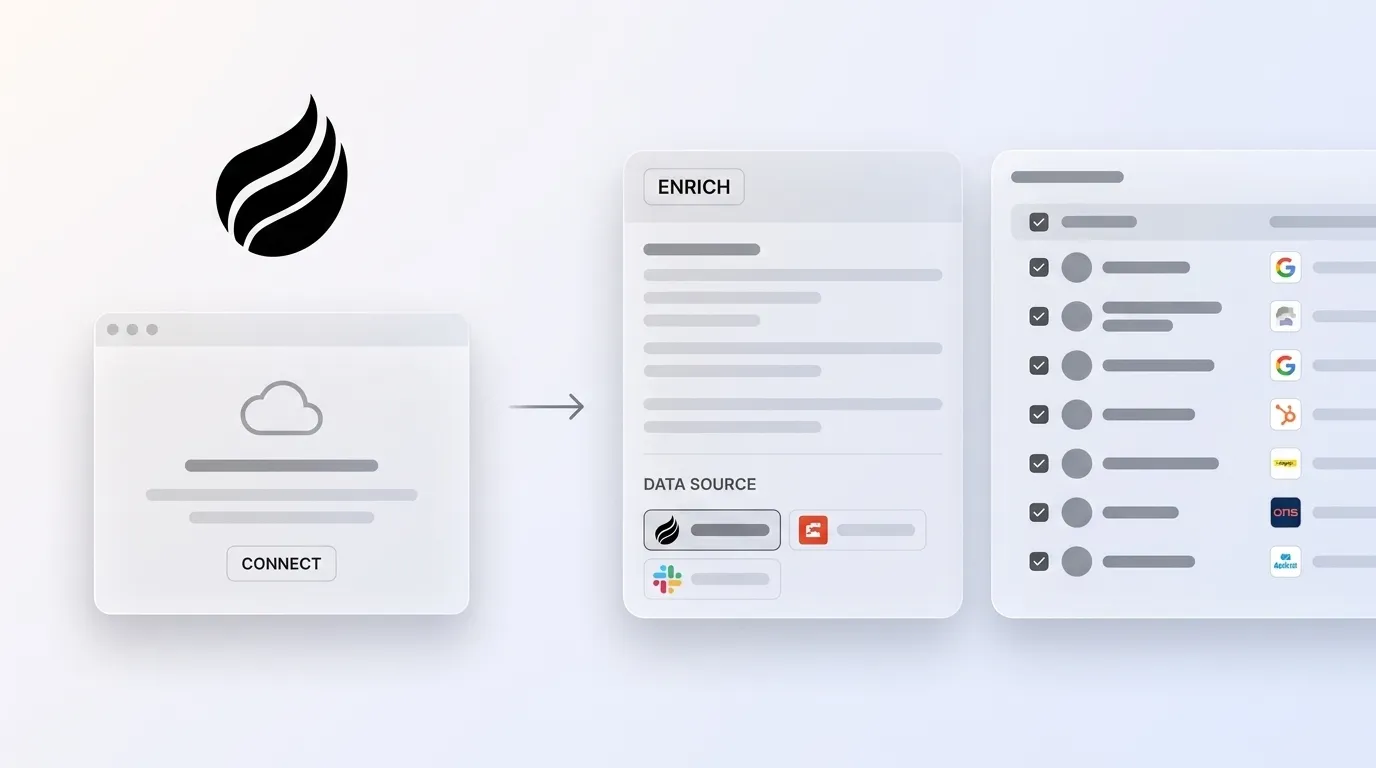
Clay requires the most time, since teams must design waterfall cascades, contract individual data providers, and route outputs back to Salesforce or HubSpot. That work can consume a week of engineering time upfront plus ongoing maintenance. Coffee’s Companion App connects to an existing Salesforce or HubSpot instance through a simple authentication flow, and the agent begins scanning emails and calendars and writing enriched records back to the CRM immediately after connection, with no waterfall design or API wiring.
How difficult is it to migrate from one enrichment tool to another?
Migration complexity depends on how deeply the existing tool sits inside CRM workflows. If the current tool only appends fields to contact records, migration stays straightforward. Teams export enriched records, map fields to the new platform’s schema, and update automation triggers that reference the old tool’s output.
Migrations become harder with tools such as Clay, where waterfall logic, provider credentials, and Zap or API connections must be rebuilt in the new environment. Teams moving from a standalone enrichment subscription to an agent model like Coffee follow a simpler path. The agent enriches records from live data sources immediately, and the existing CRM data is augmented instead of replaced. The main task is canceling the old subscription and confirming that the agent’s enrichment fields map correctly to current CRM field labels.
How much does data quality vary across enrichment providers, and what should teams measure?
Data quality varies significantly across providers, and vendor-claimed accuracy figures often exceed third-party benchmark results. The most reliable evaluation method is a pilot on a sample of your own ICP list, not a vendor-supplied test set. Teams should measure verified email delivery rate, hard bounce rate, and mobile number connectivity on real outbound sends.
A June 2026 benchmark showed email coverage varying across tools on the same contact set. Phone coverage gaps were even wider, with one March 2026 test finding ZoomInfo returning mobile numbers for 67% of leads versus Apollo’s 41% on identical inputs. Teams also need to factor in data decay. B2B contact data decays at approximately 2.1% per month, which means a database that tested at 80% accuracy in January will lose significant accuracy by year-end without continuous re-verification, as described earlier in the data maintenance section.
What are the key compliance differences between EMEA and US enrichment data?
EMEA enrichment data falls under GDPR, which imposes stricter requirements on legal basis for processing, the right to erasure, and cross-border data transfers than US frameworks such as CCPA. In practice, EMEA-focused teams need a provider that maintains consent records, suppresses opted-out contacts, and can demonstrate a legitimate interest basis for holding and sharing contact data.
Cognism is the only platform in this comparison that treats GDPR compliance as a core product feature rather than a checkbox. It includes do-not-call list suppression for multiple European countries and manually phone-verified data to reduce the risk of contacting individuals without a valid legal basis. US-focused providers such as Apollo and ZoomInfo offer GDPR documentation but are not architected around European data residency or consent management in the same way. Teams with mixed US and EMEA territories often keep Cognism for European contacts and a lower-cost provider for US contacts, while accepting the added stack complexity.
What hidden costs should teams budget for beyond the published subscription price?
Published subscription prices rarely match total cost of ownership. Common hidden costs include credit overages, especially for phone lookups that consume more credits than email lookups on platforms such as Apollo. Teams also face annual contract renewal increases of 10–20%, add-on fees for intent data, org charts, and mobile number access on ZoomInfo, and integration engineering time for platforms that lack native CRM write-back.
Clay’s credit consumption becomes difficult to predict when teams build complex multi-step enrichment workflows, and provider credits sit on top of the platform subscription. Teams should also budget internal RevOps time to maintain waterfall logic, monitor per-provider match rates, and troubleshoot sync failures between the enrichment tool and the CRM. An agent model with seat-based pricing, where enrichment labor is included in the seat cost, removes most of these variables.
Conclusion: Choosing the Right Path in 2026
The five platforms covered here each fit a specific scenario. ZoomInfo works best as a single-source option for enterprise teams with dedicated RevOps staff and US-heavy ICPs. Cognism stands out for EMEA-focused teams that need phone-verified, GDPR-compliant data. Apollo offers a strong balance of self-serve usability and cost for SMB and lower mid-market outbound teams. Clay delivers the highest coverage ceiling for teams with engineering resources and high enrichment volume. Lusha gives individual reps the fastest browser-based path to a contact record.
For Salesforce or HubSpot teams at 11–40 seats, the more pressing decision in 2026 is whether a separate enrichment subscription is necessary at all. Standalone enrichment tools are being commoditized by unified platforms that combine contact search, enrichment, intent scoring, and outreach generation in one interface. Coffee’s Companion App deploys an autonomous agent directly inside Salesforce or HubSpot, ingesting emails, calendars, and call transcripts to enrich records natively while removing the Apollo or ZoomInfo subscription line from the budget. Teams that want to move off legacy CRMs entirely can use Coffee’s Standalone CRM, which applies the same agent-led enrichment as the foundation of a modern system of record.