Written by: Doug Camplejohn, CEO & Co-Founder, Coffee | Last updated: August 6, 2026
Key Takeaways
- Automated contact management in 2026 depends on agentic AI platforms that capture, enrich, and sync records on their own, not passive databases that wait for manual entry.
- Sales leaders should evaluate platforms across six criteria: depth of data-entry automation, AI meeting handling, integration flexibility, pipeline intelligence quality, total cost of ownership, and user adoption impact.
- Coffee stands out as the only agent-first platform offering both Standalone CRM and Companion App deployment models that handle data capture, meeting automation, and pipeline intelligence without human effort.
- Legacy CRMs like HubSpot, Salesforce, Pipedrive, and Zoho remain passive systems that depend on manual data entry, while newer tools like Clarify and Day.ai lack the integration depth required by mid-market teams.
- Eliminate manual data entry from your sales workflow today with Coffee and let an autonomous agent handle enrichment, meeting automation, and pipeline intelligence in a single platform.
Six Evaluation Criteria for Automated Contact Management
Every vendor in this space should be scored against the same six criteria so comparisons stay objective and consistent.
- Depth of data-entry automation. Does the system auto-create contacts, log activities, and enrich records from live signals, or does it rely on manual field completion? This is the foundation, because without autonomous data capture, every other capability still depends on human effort.
- AI meeting handling. Once contacts exist in the system, can the platform join calls, generate structured summaries aligned to sales methodologies (BANT, MEDDIC, SPICED), and draft follow-up emails without rep intervention? Meeting automation turns raw conversations into usable, structured intelligence.
- Integration flexibility with Salesforce or HubSpot. For teams with existing CRM investments, does the tool write enriched data back to the system of record, and does it understand quotas, forecasting fields, and required-field validation? This determines whether the agent can coexist with current infrastructure.
- Pipeline intelligence quality. Does the platform track week-over-week deal changes automatically, or does accurate forecasting still require manual CSV exports? Strong pipeline intelligence gives leaders a real-time view of risk and momentum.
- Total cost of ownership. How many point solutions (enrichment, sequencing, recording, prospecting) does the platform replace, and how is pricing structured? Consolidation cuts both software spend and RevOps overhead.
- User adoption impact. Does the interface serve the rep, or does the rep serve the interface? Adoption improves when the system removes work instead of adding it.
With these six criteria established, this comparison first examines Coffee as the agent-first benchmark, then evaluates how legacy and emerging platforms perform against the same standards.
Coffee: Agent-First Contact Management Across Your Revenue Workflow
Coffee is the only platform in this comparison built from the ground up as an autonomous agent rather than a passive database. It operates in two deployment models: a Standalone CRM for teams of one to twenty reps that want a modern system of record, and a Companion App that layers the Coffee Agent on top of an existing Salesforce or HubSpot instance. Both models share the same core agent, which addresses every criterion above without human effort.
On data-entry automation, the Coffee Agent connects to Google Workspace or Microsoft 365 and immediately begins auto-creating contacts, enriching them with job titles, funding data, and LinkedIn profiles via licensed data partners, and logging every interaction as last and next activity. Coffee’s Stripe integration automatically imports customers and companies, enriches them, and marks paid invoices as Closed Won deals, while a QuickBooks integration syncs invoices and payment statuses in real time, which removes entire categories of manual reconciliation.
On AI meeting handling, the agent joins Zoom, Teams, and Meet calls, transcribes them, and generates summaries in whatever format the team requires. Custom Meeting Briefings and Summaries, launched in February 2026, let users define exact formats, from high-level executive summaries to granular technical breakdowns, so every post-call record is immediately usable.
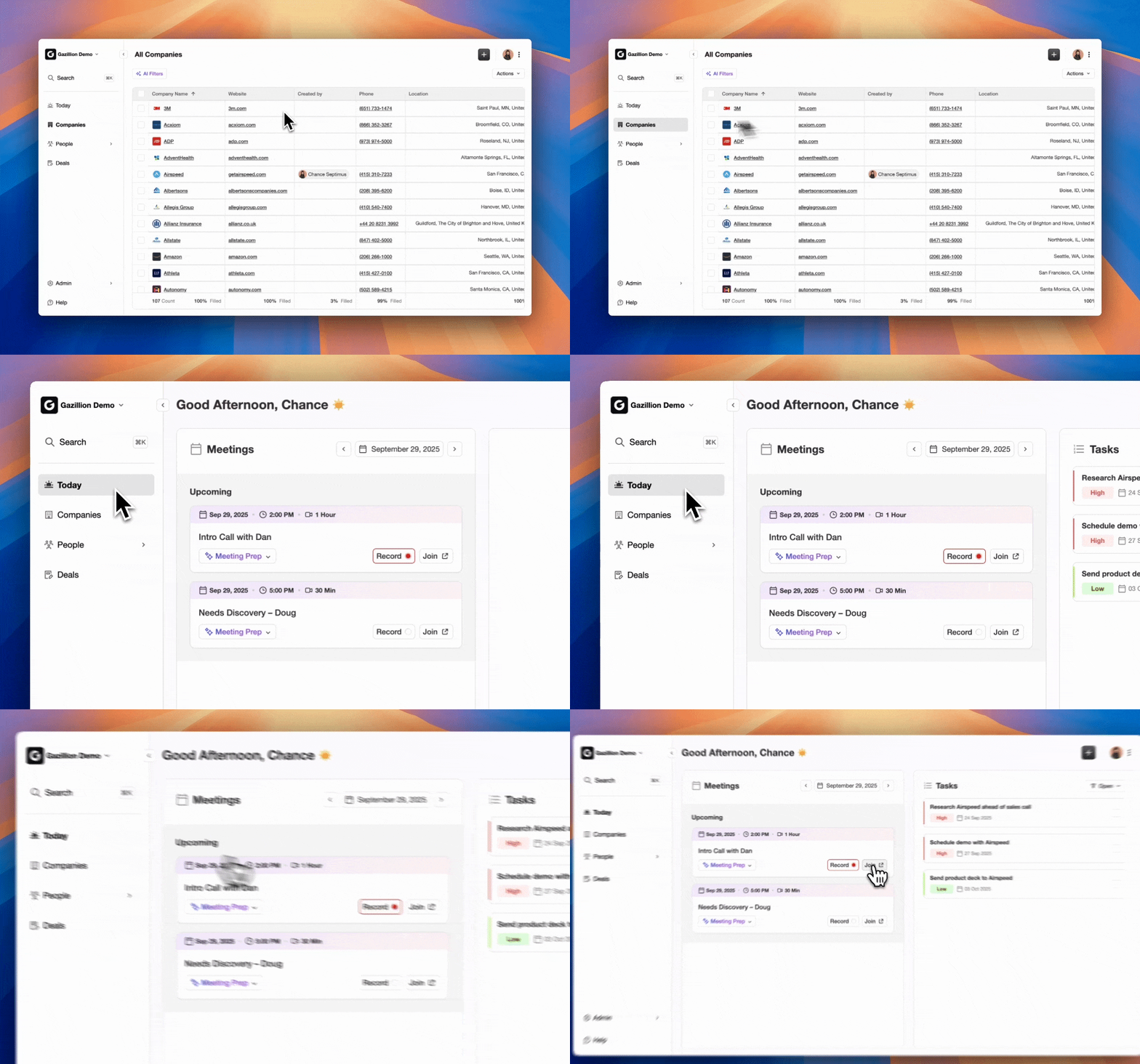
On pipeline intelligence, Coffee’s AI search on deals answers natural-language questions such as “Which deals are stuck in negotiation?” or “What is closing this month?” The Pipeline Compare feature visualizes week-over-week changes without a single spreadsheet. An Intelligence layer introduced in February 2026 stores deep context on business model, ICP, and competitors to generate tailored AI suggestions across every record.

On total cost of ownership, Coffee consolidates CRM, enrichment, prospecting (Lead Finder), meeting recording, visitor identification, and outbound sequencing (Campaigns) into one seat-based subscription. On adoption, reps interact with an agent that handles their busywork rather than a database that creates it.

Get started with Coffee and eliminate manual data entry from your sales workflow today.
HubSpot vs Agent CRM for Data Entry
HubSpot began as a marketing automation platform and later added a CRM on top of that foundation. On data-entry automation, HubSpot logs emails and meetings when reps connect their inbox, but contact creation, enrichment, and activity association still require significant manual intervention or paid add-ons. On AI meeting handling, HubSpot offers call recording through its Sales Hub tiers, but post-call summaries are basic and do not map to structured sales methodologies without additional configuration.
On integration flexibility, HubSpot’s native ecosystem is broad, but writing enriched, agent-generated data back to custom objects requires developer work. On pipeline intelligence, forecasting is available at higher tiers but depends on reps keeping stage and close-date fields current, which keeps the process human-dependent. On total cost of ownership, a fully featured HubSpot stack (Sales Hub Enterprise plus enrichment, recording, and sequencing tools) carries significant per-seat cost. On adoption, reps consistently report that HubSpot feels like a reporting obligation rather than a selling tool.
HubSpot’s limitations appear, in varying degrees, across the remaining platforms in this comparison. The next section evaluates five additional vendors against the same six criteria, grouping legacy systems and emerging AI-native tools to highlight their shared architectural constraints.
Pipedrive, Zoho, Salesforce, Clarify, and Day.ai Compared
Pipedrive is a visual pipeline tool built for small sales teams. Data-entry automation is limited to email sync and basic activity logging, and enrichment requires third-party integrations. AI meeting handling is absent natively. Integration with Salesforce or HubSpot is not a use case Pipedrive targets. Pipeline intelligence is visual but manual. Total cost of ownership is low at entry level but rises quickly when enrichment and sequencing tools are added. Adoption is generally positive for simple deal tracking but degrades as team complexity grows.
Zoho CRM offers broad feature coverage at competitive price points. Its Zia AI assistant provides some predictive scoring, but data-entry automation remains largely form-driven. Meeting handling requires Zoho Meeting integration and manual note entry. Integration with Salesforce or HubSpot is not a primary design goal. Pipeline intelligence through Zia is improving but still depends on clean human-entered data. Total cost of ownership is low, but the platform’s breadth can create configuration complexity that consumes RevOps bandwidth.
Salesforce is the market-share leader and carries 25 years of architectural legacy. Data-entry automation requires Einstein Activity Capture or third-party tools, and enrichment requires Data Cloud or ZoomInfo contracts. AI meeting handling is available through Einstein Conversation Insights at additional cost. Integration flexibility is unmatched for large enterprises, but that flexibility demands certified administrators. Pipeline intelligence through Einstein Forecasting is powerful when data is clean, a condition that rarely holds without an agent enforcing it. Total cost of ownership is the highest in this comparison. Adoption is the industry’s most documented pain point.
Clarify is a post-ChatGPT CRM with a modern interface and AI-assisted note-taking. Data-entry automation is more advanced than legacy tools. However, Clarify lacks the deep integration capabilities required by established mid-market teams running Salesforce or HubSpot with custom objects, required fields, and quota structures. Pipeline intelligence is early-stage. Total cost of ownership is moderate. Adoption is favorable for greenfield teams but limited for teams with existing CRM commitments.
Day.ai focuses on unstructured data processing, surfacing context from emails and meetings into a relationship intelligence layer. Data-entry automation is strong for contact enrichment from communications. AI meeting handling is a core feature. However, Day.ai functions primarily as a productivity and relationship tool rather than a full pipeline management system. Integration with Salesforce or HubSpot is present but does not match the depth required for forecasting and quota management. Pipeline intelligence is limited. Total cost of ownership is moderate as a standalone tool but adds to stack complexity rather than reducing it.
2026 Automation Scorecard
The analysis above shows a clear pattern. Only Coffee and Day.ai achieve high ratings across data capture and meeting automation, and Day.ai lacks the pipeline visibility required for full sales operations. The table below summarizes these capability gaps across all platforms.
| Platform | Data Capture & Enrichment | Meeting Automation | Pipeline Visibility |
|---|---|---|---|
| Coffee | High | High | High |
| HubSpot | Medium | Medium | Medium |
| Salesforce | Medium | Medium | High |
| Pipedrive | Low | Low | Medium |
| Zoho CRM | Low | Low | Medium |
| Clarify | Medium | Medium | Low |
| Day.ai | High | High | Low |
The scorecard above demonstrates that Coffee is the only platform delivering high automation across all three dimensions. That technical advantage translates into different deployment strategies depending on team size and existing CRM commitments.
Choosing Coffee for Small Teams vs Mid-Market Sales Orgs
Team size and existing CRM commitment are the two variables that determine the right deployment model. Small teams without a legacy CRM benefit most from a clean slate, while larger teams usually need an agent that works alongside their current system.
Teams of one to twenty reps with no entrenched CRM are the natural fit for Coffee’s Standalone CRM. These teams have outgrown spreadsheets and Notion but find HubSpot and Pipedrive to be expensive manual chores. The Coffee Agent acts as the entire automated contact management infrastructure, capturing contacts, running outreach via Campaigns, identifying website visitors, and delivering pipeline intelligence, without requiring a dedicated RevOps hire to maintain it.

Mid-market teams of twenty or more reps already running Salesforce or HubSpot should deploy Coffee as a Companion App. The agent handles the data-in process, auto-creating contacts, enriching records, logging meeting outcomes, and writing structured data back to the existing system of record. The CRM investment stays protected while the manual entry burden disappears. Coffee therefore complements, rather than replaces, tools like HubSpot when it operates as the agent layer.
Addressing Common Objections
Most evaluation cycles raise similar concerns about integration depth, security posture, and data quality. Coffee addresses each of these directly.
- Integration depth. Coffee integrates with Google Workspace, Salesforce, and HubSpot. Broader tool connectivity is available via Zapier today, with deeper integrations on the product roadmap. Coffee’s Companion App is engineered to respect Salesforce and HubSpot’s required fields, quota structures, and forecasting configurations, a level of integration sophistication that newer entrants like Clarify and Day.ai have not yet matched.
- Security certifications. Coffee meets enterprise security requirements with SOC 2 Type 2 and GDPR compliance (detailed in the FAQ below). Customer data is not used to train public AI models, which addresses the primary data-governance concern raised by RevOps and legal teams during procurement.
- Data quality parity with ZoomInfo. Coffee’s built-in enrichment via licensed data partners delivers contact and company data roughly on par with ZoomInfo for the majority of mid-market use cases, and it is included in the seat price rather than billed as a separate subscription.
Get started with Coffee and see how the agent handles enrichment, meeting automation, and pipeline intelligence in a single platform.
Decision Checklist for Automated Contact Management Software
Use this checklist to map your situation to the right solution category and confirm whether an agent-first platform like Coffee fits.
- Team size is 1–20 reps and no existing CRM commitment → Coffee Standalone CRM.
- Team size is 20+ reps with an active Salesforce or HubSpot instance → Coffee Companion App.
- Manual data entry consumes more than two hours per rep per day → any passive CRM is disqualified, and an agent-first platform is required.
- Pipeline reviews still rely on manual CSV exports or rep-reported updates → the current system lacks pipeline intelligence, and Coffee’s Pipeline Compare and AI deal search resolve this directly.
- Stack includes separate subscriptions for enrichment, recording, sequencing, and prospecting → consolidation onto Coffee reduces cost and eliminates data fragmentation.
- Security review requires SOC 2 Type 2 and GDPR compliance → Coffee qualifies; confirm with your legal team for industry-specific requirements.
- Team requires deep Salesforce customization (custom objects, complex approval workflows, multi-currency) at enterprise scale → Coffee is not the right fit, so evaluate Salesforce with a dedicated admin team.
Frequently Asked Questions
How long does it take to implement Coffee?
For the Standalone CRM, implementation is measured in minutes rather than weeks. Connecting Google Workspace or Microsoft 365 triggers the Coffee Agent to begin auto-creating contacts and logging activities immediately. There is no complex configuration, no required-field mapping exercise, and no administrator certification required. Most small sales teams are fully operational on the day they sign up.
For the Companion App deployment on Salesforce or HubSpot, a simple authentication flow connects the Coffee Agent to the existing system of record. The agent begins enriching and writing data back to the CRM the same day. Teams with heavily customized Salesforce orgs should plan for a brief mapping session to confirm which fields the agent should populate.
How difficult is it to migrate existing contact data to Coffee?
For teams moving to the Standalone CRM, Coffee ingests contact and company records from CSV exports of legacy systems. Because the Coffee Agent immediately begins enriching imported records from live data sources, the quality of migrated data typically improves within the first week of operation. For Companion App users, migration is not required, because Coffee writes to the existing Salesforce or HubSpot instance rather than replacing it, so historical records remain in place and the agent begins augmenting them from the activation date forward.
What security certifications does Coffee hold?
Coffee is SOC 2 Type 2 certified and GDPR compliant. These certifications cover the full platform, including the AI agent’s data processing pipelines. Customer data is not used to train public AI models, and all data handling is governed by Coffee’s data processing agreement. Teams in regulated industries such as healthcare or financial services with multi-year security review requirements should consult Coffee’s security documentation and legal team before committing, as those environments may exceed Coffee’s current compliance scope.
Does Coffee replace the need for ZoomInfo or Apollo?
For most mid-market sales teams, yes. Coffee’s built-in Lead Finder and enrichment capabilities, powered by licensed data partners, deliver contact and company data at a quality level comparable to ZoomInfo for standard prospecting use cases. The Lead Finder accepts natural-language queries, builds targeted prospect lists, and routes them directly into Campaigns for automated outreach, all within the same agent. Teams with highly specialized data requirements in niche verticals may find that a dedicated enrichment database adds incremental coverage, but the majority of Coffee customers eliminate their ZoomInfo or Apollo subscription after onboarding.
Conclusion: Choose the Agent That Removes the Data-Entry Burden
The best automated contact management software for sales teams in 2026 is not the platform with the most features. It is the platform whose agent does the most work. Legacy CRMs like Salesforce, HubSpot, Pipedrive, and Zoho remain passive databases that produce accurate pipeline intelligence only when reps reliably enter clean data. They rarely do. Newer tools like Clarify and Day.ai move in the right direction but lack the integration depth and full-stack agent capabilities that mid-market teams require.
Coffee is the only platform that operates as a true agent across the entire revenue workflow, capturing contacts, enriching records, handling meetings, running outreach, identifying website visitors, and delivering pipeline intelligence, while meeting teams where they are, either as a standalone system of record or as the agent layer on top of an existing Salesforce or HubSpot investment.
Get started with Coffee and put an agent to work on your data today.