Written by: Doug Camplejohn, CEO & Co-Founder, Coffee | Last updated: August 15, 2026
Key Takeaways for 10–50-Person SaaS Teams
- Five leading CRM platforms with AI sales insights are evaluated for 10–50-person US SaaS teams, and data quality emerges as the decisive factor for trustworthy AI outputs.
- Automated data capture is the critical differentiator, because platforms that depend on manual entry produce unreliable AI predictions when up to 79% of opportunity data never reaches the CRM.
- Salesforce Agentforce and HubSpot Breeze deliver sophisticated AI when they receive clean data, yet neither autonomously maintains data quality at mid-market scale.
- Freshsales Freddy and Pipedrive AI Assistant provide lightweight advisory AI, but manual data entry and a lack of independently verified forecast benchmarks limit their impact.
- Coffee is the only platform offering both a standalone AI-first CRM and a companion agent layer that guarantees clean input data — explore both deployment options.
How This Guide Evaluates AI-Ready CRMs
Eight criteria determine whether a CRM can deliver reliable AI sales insights for a 10–50-person SaaS company. Each criterion appears below before any vendor comparison.
- Automated Data Capture: The degree to which the platform logs emails, calls, meetings, and contacts without rep intervention.
- Forecast Accuracy: Documented error rates or accuracy benchmarks for pipeline and revenue predictions.
- Deal-Risk Detection: The platform’s ability to surface stalled, at-risk, or mis-staged opportunities using behavioral signals rather than rep-submitted stage data.
- Next-Best-Action Relevance: The quality and specificity of AI-generated rep guidance tied to live deal context.
- Implementation Effort: Time-to-value, configuration complexity, and prerequisite data-readiness work.
- User Adoption: Rep experience, interface friction, and shadow-CRM risk.
- Integration Depth: Native connections to email, calendar, telephony, and downstream GTM tools.
- Administrative Burden: Ongoing maintenance, governance overhead, and hidden operational costs.
2026 CRM Platform Comparison Matrix
| Platform | Automated Data Capture | Forecast Accuracy | Admin Burden (10–50-person SaaS) |
|---|---|---|---|
| Salesforce Agentforce | Partial, Einstein Activity Capture stores data on AWS outside Salesforce records | Median B2B forecast accuracy (regardless of method) sits at 70–79%, with only 7% of organizations reaching 90%+. AI and ML methods improve this by 15–25%. | High, 25 years of legacy architecture and significant RevOps governance required |
| HubSpot Breeze | Partial, native email and calendar sync with AI extraction gated behind Breeze add-ons | Comparable to industry median, with no published 2026 error-rate benchmark | Moderate, simpler than Salesforce but bolted-on CRM architecture limits data unification |
| Freshsales Freddy | Limited, relies primarily on manual entry supplemented by Freddy scoring | No independently verified 2026 benchmark available | Low to moderate, lighter configuration but fewer enterprise-grade AI controls |
| Pipedrive AI Assistant | Limited, activity logging remains largely manual and AI Assistant provides guidance only | No independently verified 2026 benchmark available | Low, minimal setup and advisory AI features rather than autonomous execution |
| Coffee Agent | Full, autonomous capture from email, calendar, and call transcripts with a data-warehouse architecture that retains full history | Trustworthy outputs supported by automated input and no reliance on rep-submitted stage data | Low, the agent handles data entry, enrichment, and pipeline tracking autonomously |
Salesforce Agentforce for Data-Mature Enterprises
Salesforce Agentforce reached $800M ARR by the end of fiscal 2026 with 169% year-over-year growth, and the company closed 29,000 Agentforce deals. Its agents can trigger workflows, draft emails, summarize calls, and execute next-best-actions inside the Salesforce record. For enterprise deployments with mature data architectures, Agentforce delivers measurable value.
The data-capture limitation remains structural. Einstein Activity Capture stores data on AWS outside native Salesforce records, which directly limits the reliability of downstream Agentforce outputs. Teams with poor data hygiene see worse output from Agentforce than from a standalone agent with its own data layer.
Implementation effort is high for 10–50-person SaaS teams. Many teams must simplify fields, clean data, realign workflows, and establish governance, and this work demands RevOps capacity that most small SaaS teams lack.
HubSpot Breeze for HubSpot-Centric Stacks
HubSpot’s Spring 2026 update introduced the Agentic Engagement Object (AEO), which automatically surfaces relevant insights, next actions, and workflow automations to sales and marketing teams. Smart Deal Progression recommends deal-specific nudges and workflow triggers, and the Breeze Assistant delivers role-aware guidance with expanded visibility into campaign data and customer records.
HubSpot’s architecture creates a similar data-quality constraint to Salesforce. HubSpot began as a marketing tool with a CRM bolted on, not as a unified intelligence system. Native activity sync captures structured interactions, but unstructured data such as call transcripts, email body text, and meeting notes requires additional Breeze add-ons to extract and write back to records. Up to 79% of opportunity data never reaches CRM systems, and HubSpot’s default configuration does not close that gap autonomously.
For 10–50-person SaaS teams already committed to HubSpot, Breeze offers the most accessible AI upgrade path within the existing stack. Administrative burden stays moderate, and the interface feels familiar. The ceiling on AI accuracy, however, is set by how completely reps log activity, a dependency that Coffee’s companion layer is specifically designed to remove.
Freshsales Freddy and Pipedrive AI Assistant for Lightweight Needs
Freshsales Freddy provides AI-powered contact scoring, deal insights, and next-best-action suggestions within the Freshsales ecosystem. It targets teams that want AI guidance without enterprise-scale configuration. Data capture remains primarily manual, so Freddy’s scoring quality depends on rep discipline, and no independently verified 2026 forecast-accuracy benchmark exists for Freddy in mid-market SaaS environments.
Pipedrive AI Assistant offers pipeline guidance, email suggestions, and activity reminders. It functions as an advisory layer rather than an autonomous agent, because it recommends actions but does not execute them or capture data independently. For teams at the lower end of the 10–50-person range that need lightweight CRM with AI nudges, Pipedrive’s low administrative burden helps. Its AI ceiling stays low for the same reason, since forecasting models trained only on rep-submitted stage data produce predictions that reflect what reps say rather than what buyers actually do.
Coffee Agent as Standalone CRM or Companion Layer
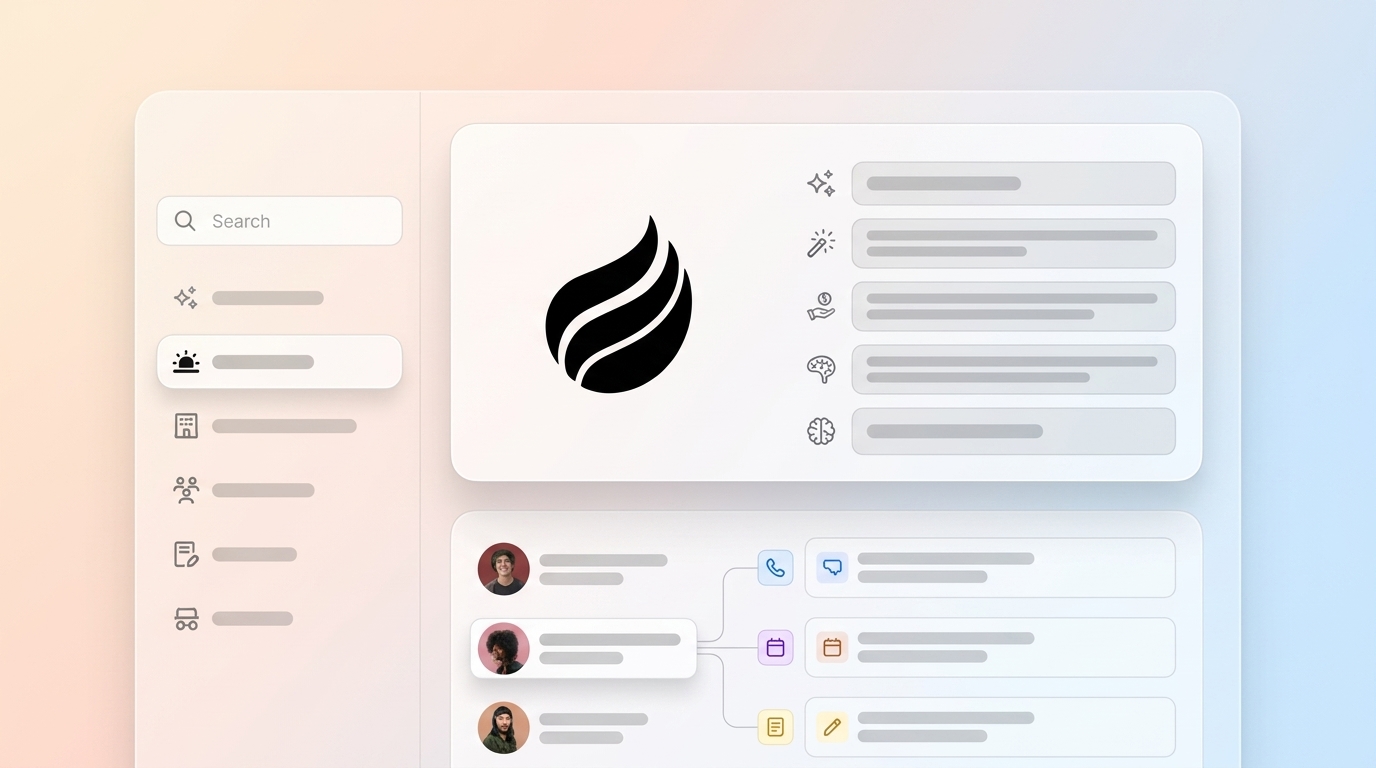
Coffee’s architecture inverts the legacy CRM model. Instead of storing data and waiting for reps to fill fields, the Coffee Agent autonomously captures contacts, companies, and activities from connected email and calendar accounts as soon as it is authenticated. Every interaction is logged, enriched with job titles, funding data, and LinkedIn profiles via licensed data partners, and written to a built-in data warehouse that retains full historical context indefinitely.

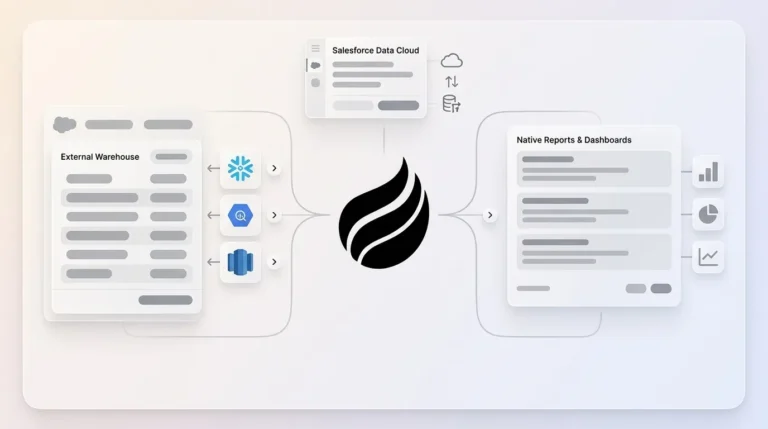
This architecture supports two distinct deployment options. As a Standalone CRM, Coffee replaces legacy systems entirely for teams of one to twenty that have outgrown spreadsheets but view Salesforce and HubSpot as expensive manual burdens. As a Companion App, Coffee deploys as an intelligent layer on top of an existing Salesforce or HubSpot instance, handling the “data in” process so the system of record becomes accurate without human effort and so Agentforce or Breeze AI features receive the clean input they need to function reliably.

On next-best-action relevance, Coffee’s Pipeline Compare feature visualizes week-over-week deal changes, highlights stalled opportunities, and surfaces new additions automatically, without CSV exports or manual review sessions. Meeting briefings, post-call summaries, MEDDIC or BANT-structured notes, and follow-up drafts are generated by the agent and written back to the record. Because the data warehouse captures full interaction history, deal-risk signals come from what buyers actually do, not from what reps report.

Administrative burden for a 10–50-person SaaS team stays near zero. The agent handles enrichment, activity logging, pipeline tracking, and outreach sequencing natively, and pricing is seat-based with no metering on agent actions.
See Coffee’s autonomous data capture in action.
Why Bad Data Kills AI Accuracy
AI will not expose your model weaknesses first. It will expose your data quality weaknesses. This reality applies to every CRM AI feature in 2026.
The scale of the problem is documented across multiple 2026 sources:
- 45% of contacts involved in deals never get added to the CRM, and CRM field accuracy audits show only 55–65% alignment with actual deal activity.
- Up to 79% of opportunity data never reaches CRM systems, making every AI insight built on that data unreliable regardless of vendor claims.
- B2B contact data decays at 2.1% per month, or 22.5% annually, so a CRM that was clean twelve months ago has already degraded significantly without automated maintenance.
- 55% of organizations cite data quality as AI’s biggest blocker.
The downstream consequences are direct. When data quality improves, B2B companies using AI-powered lead generation see an average 73% increase in qualified leads within six months. Yet fewer than 25% of sales organizations forecast within 10% of actual results, a gap that persists because AI forecasting platforms often require clean pipeline data before generating reliable predictions. Manual entry cannot consistently provide that quality.
Automated capture offers the only structural fix. Automated capture can improve CRM accuracy and reduce rep time spent on data entry, which produces trustworthy pipeline reports, forecasts, and coaching data for downstream AI tools.
Operational Risks That Undermine AI CRM Investments
Several operational factors determine whether a CRM AI investment delivers returns or becomes a maintenance liability for a 10–50-person SaaS team.
Change management and adoption: 70% of sellers feel overwhelmed by the number of technologies, and overwhelmed sellers are 45% less likely to attain quota. Platforms that require reps to serve the software rather than the reverse generate shadow CRMs such as spreadsheets and Notion documents that become the real workspace while the CRM degrades.
Data-hygiene ownership: AI cannot automatically clean CRM data at scale or determine correct values and valid historical patterns versus artifacts of drift, and vendors claiming their AI works with messy data produce output but not reliable predictions when records are only 60% complete. Without an autonomous agent handling capture, data-hygiene ownership falls to RevOps, a function that most 10–50-person SaaS companies staff lightly or not at all.
Hidden maintenance costs: Conversation intelligence tools that write extracted data back to CRM fields introduce a new error vector. AI-generated action items can be inaccurate, with false attribution, fabricated consensus, and inflated objections flowing directly into fields that drive forecasting and routing.
Scalability and integration gaps: Organizations that rate themselves behind competitors are far more likely to cite legacy-system integration as a barrier, a 13.1-point gap, than organizations further ahead. Point solutions for enrichment, sequencing, recording, and forecasting each add subscription cost, integration maintenance, and data-silo risk.
Compliance: Several US states require all-party consent for call recording, and GDPR requires a valid legal basis such as explicit consent or legitimate interest, requirements that affect whether automated capture can legally produce the data AI models depend on. Coffee is SOC 2 Type 2 and GDPR compliant, and data is not used to train public models.
Decision Framework for Choosing an AI CRM
The right platform depends on company size, existing stack commitment, and data-readiness maturity. Use this framework to match options to your context.
For teams of 1–20 with no existing CRM commitment or teams that have outgrown spreadsheets:
- Coffee Standalone CRM fits best, because the agent handles all data entry, enrichment, and pipeline tracking from day one with no RevOps prerequisite.
For teams of 20–50 already committed to Salesforce or HubSpot with low CRM adoption and poor data quality:
- Coffee Companion App closes the data-quality gap without a migration. The agent authenticates to the existing instance, begins capturing and enriching data autonomously, and writes structured intelligence back to native records, which enables Agentforce or Breeze AI features to function as designed.
For teams evaluating Salesforce Agentforce or HubSpot Breeze as standalone AI upgrades:
- Before signing, confirm that automated activity capture writes to native CRM objects with no external storage, no retention cap, and full custom-object support. This verification matters because if that capability is absent, AI output quality will be bounded by manual data entry rates.
For teams considering Freshsales Freddy or Pipedrive AI Assistant:
- These platforms suit teams that need lightweight CRM with advisory AI and have low forecasting-accuracy requirements. Teams that need reliable deal-risk detection or autonomous next-best-action execution will reach the ceiling of these platforms quickly.
Compare Coffee’s pricing for standalone and companion deployments.
Frequently Asked Questions
How long does it take to implement Coffee and see reliable AI outputs?
The Coffee Standalone CRM delivers time-to-value in hours rather than weeks. Once a user connects Google Workspace or Microsoft 365, the Coffee Agent immediately begins scanning emails and calendars to auto-create contacts, companies, and activity logs. Pipeline intelligence features become useful as soon as the first deals are active in the system, because the agent captures interaction history from the moment of connection rather than waiting for manual entry to accumulate.

For the Companion App on Salesforce or HubSpot, a simple authentication allows the agent to begin syncing and enriching data immediately. Teams typically see measurable improvements in CRM completeness within the first week. This experience contrasts with legacy AI implementations, which usually require substantial data cleaning and configuration work before AI features produce reliable outputs.

What does migrating from Salesforce or HubSpot to Coffee involve?
Teams that choose the Coffee Standalone CRM can migrate existing records through a structured import process. The Coffee Agent then takes over ongoing data maintenance, so the migration effort becomes a one-time event rather than a recurring burden. Teams that prefer to keep Salesforce or HubSpot as their system of record do not need to migrate at all, because the Coffee Companion App deploys as an agent layer on top of the existing instance.
This dual-model architecture means the decision between migration and augmentation is driven by business preference rather than technical necessity. Coffee has deep knowledge of Salesforce and HubSpot integration requirements, including quotas, forecasting configurations, and required fields, which distinguishes it from newer CRM alternatives that lack this integration depth.
How does Coffee handle data security and compliance?
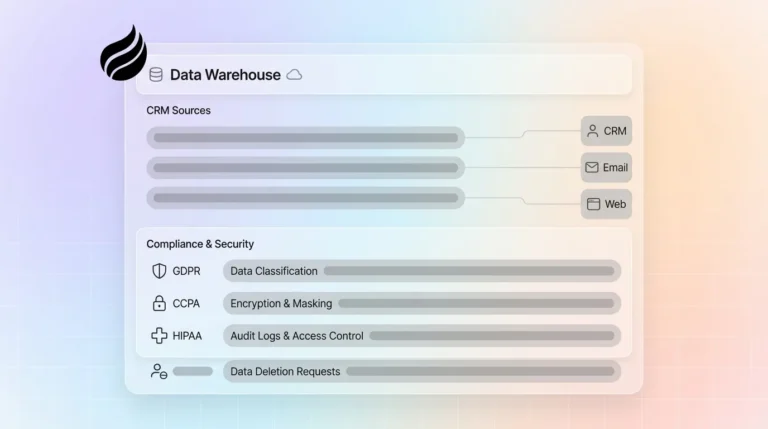
Coffee is SOC 2 Type 2 certified and GDPR compliant, and data processed by the Coffee Agent is not used to train public AI models. For US SaaS companies operating in states with all-party call-recording consent requirements, Coffee’s meeting bot joins calls with participant awareness, which supports compliant capture workflows. The agent’s data-warehouse architecture stores interaction history within Coffee’s controlled infrastructure, with no reliance on third-party external storage that could introduce retention gaps or governance blind spots.
Teams in heavily regulated industries such as healthcare or finance with multi-year security review requirements fall outside Coffee’s current ideal customer profile.
Which tools does Coffee integrate with, and what happens to the existing sales stack?
Coffee connects natively to Google Workspace and Microsoft 365 for email and calendar capture, and the meeting bot joins Zoom, Google Meet, and Microsoft Teams calls. For teams using Salesforce or HubSpot, the Companion App writes enriched data and AI-generated insights directly back to the primary CRM. Broader integrations with other GTM tools are currently available via Zapier, and deeper native integrations sit on the product roadmap.
One of Coffee’s core value propositions is stack consolidation. The agent performs the functions of separate enrichment tools, prospecting databases, sales engagement platforms, and conversation intelligence tools within a single system, which reduces subscription cost and the data-silo risk that degrades AI accuracy across fragmented point solutions.
How do I assess whether Coffee is the right fit before committing?
The clearest signal comes from the current state of CRM data quality and rep adoption. If sales reps maintain shadow CRMs in spreadsheets or Notion, if pipeline reviews require manual CSV exports, or if AI features in the existing CRM produce scores that the team ignores, the underlying problem is automated data capture, and that is precisely what the Coffee Agent is built to solve.
Coffee’s pricing is seat-based with no metering on agent actions, which makes the cost model straightforward to compare against the current stack. The Coffee Companion App particularly suits teams that have invested in Salesforce or HubSpot and want to preserve that investment while eliminating the manual data-entry dependency that limits AI output quality.
Conclusion: Choose AI CRM Based on Data Quality Guarantees
Every platform in this comparison offers AI sales features. The differentiating variable in 2026 is not model capability, but whether the platform guarantees the clean, complete, continuously updated data those models require to produce trustworthy outputs. Salesforce Agentforce and HubSpot Breeze deliver sophisticated AI when they receive good data, yet neither platform autonomously ensures that data quality at the 10–50-person SaaS scale. Freshsales Freddy and Pipedrive AI Assistant provide accessible entry points with advisory AI, but their ceilings are set by manual entry rates.
Coffee is the only platform in this comparison that treats automated data capture as the primary product rather than an add-on, and the only one that delivers this guarantee in both a standalone CRM and a companion layer on top of existing systems. For Head of Sales and RevOps leaders evaluating the best CRM platforms with advanced AI sales insights, the decision centers on whether the platform ensures good data goes in so trustworthy insights come out. Coffee is built around that answer.
Start your free trial and experience guaranteed data quality.