Written by: Doug Camplejohn, CEO & Co-Founder, Coffee | Last updated: August 15, 2026
Key Takeaways
- BANT and MEDDIC are distinct qualification frameworks, with BANT suited to quick, low-value deals and MEDDIC suited to complex, high-value enterprise sales.
- BANT remains effective for deals under $25K ACV with 1–2 stakeholders, but it breaks down when buyer committees or sales cycles grow larger.
- MEDDIC delivers 25–30% higher close rates on complex deals by uncovering Champions, Decision Criteria, and deeper pain points that BANT misses.
- A hybrid BANT-to-MEDDIC handoff model lets SDRs qualify quickly while AEs deepen discovery, cutting pipeline waste by up to 40%.
- The Coffee Agent automates BANT or MEDDIC field capture on every call. Get started with Coffee to eliminate manual data entry and enforce consistent qualification.
BANT vs MEDDIC at a Glance
The table below highlights the structural differences between BANT and MEDDIC. Use deal size, cycle length, and stakeholder count as your primary decision points.
| Dimension | BANT | MEDDIC | Source |
|---|---|---|---|
| Ideal deal size | Under $25K ACV | $25K–$100K ACV (MEDDPICC for $100K+) | AmpUp |
| Sales cycle length | Days to weeks (under 60 days) | 30-90 day cycles (MEDDPICC for 90+ days) | AmpUp |
| Stakeholder count | 1–2 decision-makers | 3 to 5 stakeholders (MEDDPICC for 6+) | AmpUp |
| Data-capture burden | 4 fields, 3–5 minutes per call | 6 fields, 30–90 minutes across 2–3 calls | Skipcall |
Let Coffee auto-tag every BANT or MEDDIC field, with no manual entry required.
Where BANT Still Works in 2026
BANT is not obsolete, but many teams use it in the wrong situations. A 2023 Gartner survey found that 52% of sales professionals rely heavily on the BANT method to qualify leads, which confirms it still delivers value in the right context. The problem is scope and deal complexity. BANT was designed to run in three to five minutes on the phone as the minimum sufficient information set for SDR first-touch qualification, not to manage a six-month enterprise deal.
BANT fails when the buyer committee exceeds four stakeholders or the cycle stretches past 90 days. Gartner research indicates that a typical complex B2B purchase now involves six to ten decision-makers, each with their own information, which makes BANT's single “Authority” question structurally insufficient. Many deals die in the decision stage because teams never identify a Champion, a dimension BANT does not include. BANT remains the correct tool for high-volume SDR triage on sub-$25K deals with one or two stakeholders. Beyond those boundaries, it creates false confidence instead of accurate forecasts.
Why MEDDIC Outperforms BANT on Complex Deals
MEDDIC is not universally better than BANT, but it is structurally superior for complex, high-value deals where BANT's four dimensions leave critical risks unexamined. Teams running MEDDIC at the AE layer achieve 25–30% higher close rates than teams running BANT in complex enterprise deals, per Sybill 2025 and Salesforce 2024 benchmarks.
The Champion dimension explains a large share of that gap. A deal with a verified high-level champion achieves win rates around 90% (or at least 37%), while deals with only a supportive contact or coach achieve rates around 19%. BANT has no mechanism to surface that distinction. Reps who shape Decision Criteria by embedding their product strengths into the buying committee's evaluation rubric early win at 2–3× the rate of reps who learn the criteria after the RFP is issued, which BANT also cannot support. Reported MEDDIC win-rate improvements range from 18-32% across various 2025 benchmarks, with some sources also noting ~24% larger deals or ~18% shorter cycles. On $50K+ enterprise deals, the data consistently favors MEDDIC's depth over BANT's speed.
When BANT Breaks and What to Use Instead
Given MEDDIC's advantages on complex deals, the inverse question becomes critical: at what threshold does BANT stop working? Avoid using BANT as the primary qualification framework when any of the following conditions are present:
- Annual contract value exceeds $50K, where MEDDIC is the recommended framework for deals over $50K with sales cycles over 90 days and multiple stakeholders.
- The sales cycle extends beyond 60–90 days, which causes BANT's timeline field to become stale before the deal closes.
- Three or more stakeholders are involved, since committee complexity often determines whether a deal should shift from BANT to MEDDIC, as a purchase requiring procurement and security review sign-off makes BANT's single Authority field insufficient.
- Forecast accuracy is a persistent problem, because fewer than 50% of sales leaders have high confidence in their forecasting accuracy, often due to optimistic rep self-reporting of qualification fields rather than evidence-based scoring.
- The deal involves formal procurement, legal review, or a competitive bake-off, where MEDDIC or MEDDPICC's Paper Process and Competition dimensions are required.
Using the right qualification framework matched to deal size cuts pipeline waste by up to 40%. Misapplying BANT to complex deals does not save time, and it manufactures bad pipeline data that corrupts every downstream forecast.
The Hybrid SDR-to-AE Handoff Playbook
The hybrid model applies BANT or CHAMP at SDR first-touch for 3–5 minute qualification and MEDDIC at AE discovery for 30–90 minutes, which delivers both SDR throughput and AE close-rate quality. The two-gate structure works as follows.
Gate 1 — SDR First-Touch (BANT): The SDR qualifies Budget, Authority, Need, and Timeline in a single call. Deals scoring below threshold are disqualified or nurtured. Deals above the threshold, typically $30K+ ACV or three or more stakeholders, move to the AE with BANT findings documented.
Gate 2 — AE Discovery (MEDDIC): The AE carries the BANT findings into mapped MEDDIC elements. Budget maps to Metrics plus Economic Buyer; Authority maps to Economic Buyer plus Champion; Need maps to Identify Pain plus Metrics; Timeline maps to Decision Process plus Paper Process. The AE then deepens each element and adds Champion, Decision Criteria, and Decision Process over two to three calls.

The measurable outcome is clear. Teams running the hybrid model achieve strong first-touch qualification rates and higher AE close rates in enterprise B2B SaaS. This improvement comes from disqualifying unfit prospects earlier while giving AEs the depth they need to advance qualified deals with confidence.
Coffee Agent Implementation: Enforcing BANT or MEDDIC Automatically
The real cost of qualification programs comes from the hours reps spend manually logging BANT or MEDDIC fields after every call. BANT breaks at scale in SaaS organizations because it depends on manual conversation data that quickly becomes stale, leaving reps spending only 28% of their time selling while CRM fields become fiction. MEDDIC increases the burden further, with six fields across multiple calls and structured notes that reps rarely complete accurately under quota pressure.
The Coffee Agent removes this enforcement tax. After joining a call via its AI Meeting Bot, the Agent structures its notes according to BANT, MEDDIC, or SPICED, whichever framework the team has standardized, and writes clean, evidence-based records directly to Salesforce or HubSpot without human input. Key capabilities include:
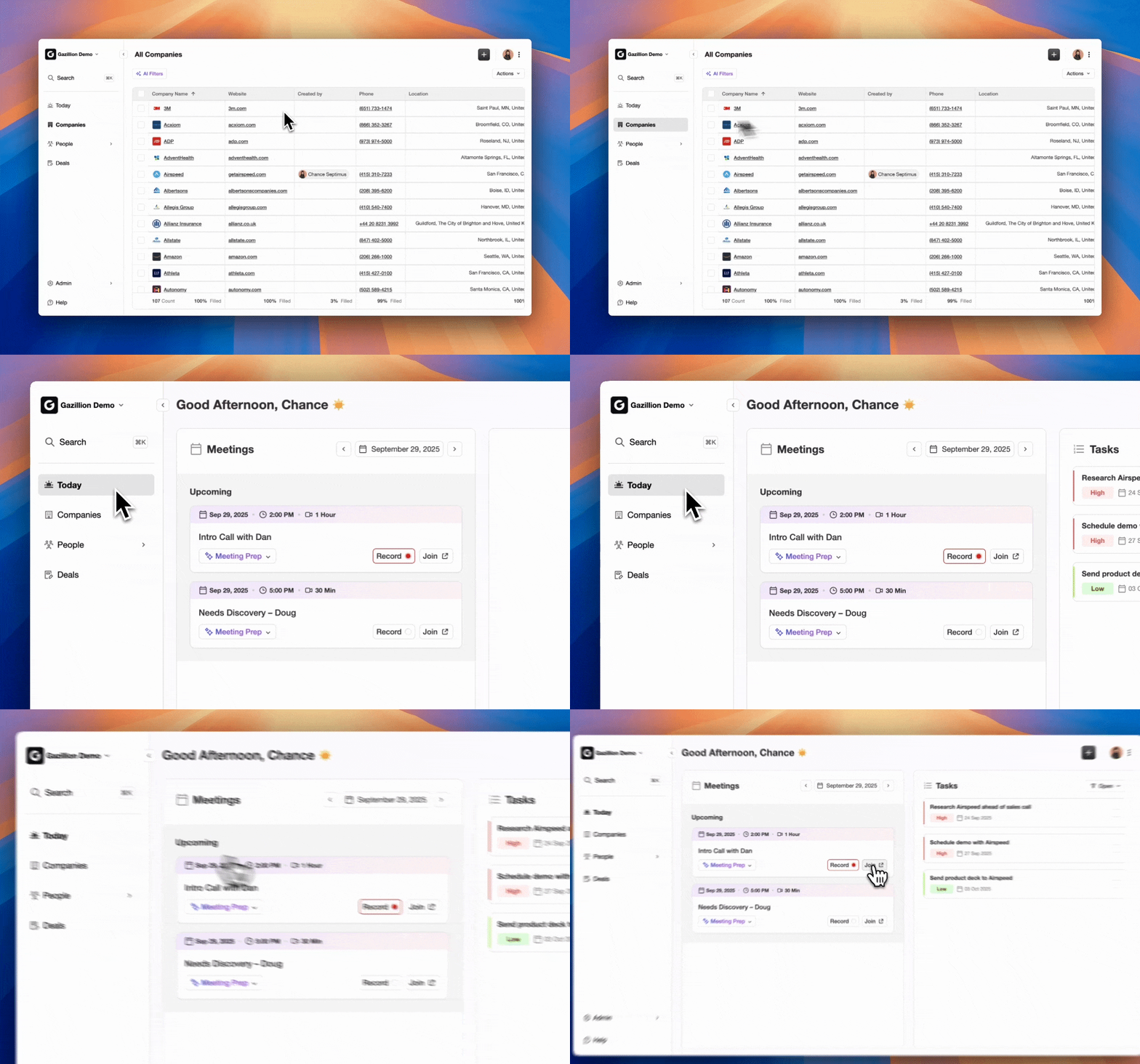
- Auto-tagging: The Agent maps transcript content to the correct qualification fields in real time, surfacing which MEDDIC dimensions were confirmed, which were mentioned but unverified, and which were not addressed.
- Interaction logging: Every email, call, and calendar event is logged automatically, which keeps last-activity and next-activity fields current.
- Pipeline Compare: The Agent visualizes week-over-week pipeline changes and highlights stalled opportunities where key MEDDIC fields remain empty, turning pipeline reviews from interrogation sessions into strategic discussions.
- CRM sync: Enriched, structured qualification data writes back to Salesforce or HubSpot via Coffee's Companion App, preserving the existing system of record while removing the data-entry burden.
Enforce BANT or MEDDIC automatically on every deal without adding headcount or manual process.
Total Cost of Ownership in 2026
The hidden cost of qualification frameworks is not the training, but the ongoing data-entry labor required to keep CRM fields accurate. Reps spend only 28% of their time selling, with the remainder consumed by admin, unqualified opportunities, and research. The data-entry burden alone accounts for a significant portion of that lost time, and Coffee's market data shows that 71% of sales reps cite data entry as their primary non-selling activity.
The Coffee Agent saves 8–12 hours per week per rep by automating contact creation, activity logging, meeting summaries, and qualification field population. At a fully loaded rep cost of $100K–$150K annually, 10 hours per week of recovered selling time represents $25K–$37K in recaptured labor value per seat per year, before you factor in the close-rate improvements that accurate MEDDIC data produces.
Coffee's pricing model is seat-based. The human seats are billed, and the Agent's unlimited labor is included. There is no metering on LLM usage, no per-process fees, and no additional subscription required for enrichment, recording, or qualification enforcement. Compared to a fragmented stack of a CRM, a conversation intelligence tool, an enrichment database, and a manual MEDDIC scorecard, Coffee consolidates the entire workflow into a single agent at a lower total cost.
Decision Matrix: Choosing a Framework for Your Team
The three variables that determine framework selection are average deal size, sales cycle length, and stakeholder count. Use the matrix below to match your current deal profile, and if you fall between two rows, default to the more rigorous framework to avoid underqualifying complex deals.
| Company Profile | Avg Deal Size | Cycle Length | Recommended Framework |
|---|---|---|---|
| High-velocity SMB / inside sales | Under $25K ACV | Under 60 days, 1–2 stakeholders | BANT end-to-end |
| Mid-market SaaS (scaling) | $25K–$50K ACV | 60–90 days, 2–4 stakeholders | BANT at SDR, light MEDDIC at AE |
| Enterprise SaaS | $50K–$250K+ ACV | 90+ days, 5–10+ stakeholders | BANT/CHAMP at SDR, full MEDDIC at AE |
A combined BANT and MEDDIC hybrid qualification approach can deliver win-rate improvements for complex deals. For teams at the mid-market inflection point, around $50K ACV with 20–200 employees and growing buyer committees, the hybrid model enforced automatically by the Coffee Agent offers a high-ROI path to consistent pipeline data and reliable forecasts.
Book a demo to see how the Agent enforces your chosen framework on every deal from first touch to close.
Frequently Asked Questions
Can the Coffee Agent enforce MEDDIC on deals already in progress inside Salesforce or HubSpot?
Yes. The Coffee Companion App authenticates directly with existing Salesforce or HubSpot instances and begins structuring data immediately. For deals already in the pipeline, the Agent reviews available email threads, calendar history, and call transcripts to populate whichever MEDDIC fields can be confirmed from existing evidence. Fields that remain unverified appear in Pipeline Compare as gaps that require rep attention, which turns a legacy pipeline review into a structured qualification audit without asking reps to re-enter data manually.
How does Coffee handle teams that use BANT for SDRs and MEDDIC for AEs simultaneously?
Coffee supports both frameworks within the same instance. The Agent structures SDR call notes to BANT fields and maps those findings to the corresponding MEDDIC elements at the point of handoff, with Budget mapped to Metrics and Economic Buyer, Authority mapped to Economic Buyer and Champion, Need mapped to Identify Pain and Metrics, and Timeline mapped to Decision Process. The AE receives a pre-populated MEDDIC record with confirmed fields marked and unverified fields flagged, which removes the qualification gap that typically occurs at the SDR-to-AE transition and prevents duplicate or lost discovery work.
Does Coffee require reps to fill out qualification scorecards manually after calls?
No. The Coffee Agent joins calls via its AI Meeting Bot, transcribes the conversation in real time, and automatically maps content to the active qualification framework, whether BANT, MEDDIC, or SPICED, without any post-call data entry from the rep. After the call, the Agent generates a structured summary, identifies next steps, and drafts a follow-up email for the rep to review and send. The qualification record in Salesforce or HubSpot updates automatically, so reps interact with the output instead of the input, which recovers 8–12 hours of weekly admin time per seat.

Is MEDDIC or MEDDPICC the right choice for SaaS deals with procurement and legal review?
MEDDPICC, the extension of MEDDIC that adds Paper Process and a second C for Competition, fits best when procurement, legal, or security review adds 30 or more days after a verbal agreement, or when two or more vendors compete in a formal evaluation. For deals under approximately $50K ACV with a straightforward master service agreement and no named-account procurement team, standard MEDDIC provides sufficient depth without extra overhead. Coffee supports MEDDIC natively and can be configured to capture Paper Process and Competition fields for teams that have standardized on MEDDPICC.