Written by: Doug Camplejohn, CEO & Co-Founder, Coffee | Last updated: July 25, 2026
Key Takeaways for BANT, MEDDIC, and Coffee
- BANT qualifies fast, low-complexity deals with short cycles, while MEDDIC fits $25K–$100K ACV deals with 3–5 stakeholders and 30–90 day cycles.
- Most scaling teams use a hybrid model, with BANT at SDR triage and MEDDIC at AE discovery to match framework to deal profile.
- Both frameworks break down when treated as one-time events, and ongoing manual data entry remains a primary cause of forecast inaccuracy and stalled deals.
- AI automation removes the data capture burden by extracting and updating BANT or MEDDIC fields automatically from emails, calendars, and call transcripts.
- Keep your qualification fields current automatically with Coffee, so stale data never distorts your forecast.
Why Sales Leaders Compare BANT and MEDDIC in 2026
Many B2B sales reps still skip formal qualification frameworks and rely on intuition. Modern B2B deals usually involve multiple people in the buying group, and analysis of sales calls shows that a mismatched framework can reduce close rates in complex deals.
This mismatch creates a compounding problem. Inconsistent qualification produces inaccurate forecasts. Inaccurate forecasts drive poor resource allocation. Choosing between BANT and MEDDIC, or combining them, is one of the highest-leverage decisions a RevOps leader can make in 2026.
How to Evaluate a Qualification Framework for Your Motion
To make that decision systematically, evaluate each framework against the criteria that define your sales motion. The following ten dimensions determine which framework fits a given deal profile:
- Average contract value (ACV)
- Sales cycle length
- Number of stakeholders in the buying committee
- Forecast accuracy requirements
- SDR and AE onboarding time
- CRM data capture and maintenance burden
- Manager visibility into deal health
- Integration and customization complexity
- Scalability as deal size and team size grow
- Change-management overhead
Side-by-Side Comparison of BANT, MEDDIC, Hybrid, and Coffee
The table below compares how each approach performs across these ten criteria. It highlights where BANT excels in speed and simplicity, where MEDDIC supports complex deals, how a hybrid model splits work by role, and how Coffee removes the data capture burden common to every framework.
| Criterion | BANT | MEDDIC | Hybrid (BANT + MEDDIC) | Coffee Agent Automation |
|---|---|---|---|---|
| Ideal ACV range | Lower ACV deals | $25K–$100K | $50K+ at AE layer | Any ACV, captures fields from emails, calls, and calendars regardless of framework |
| Ideal cycle length | 30–90 days | 30–90 days | 90+ days at AE layer | Any cycle length, deal state kept current automatically |
| Stakeholder complexity | Fewer stakeholders | 3–5 stakeholders | 5+ at AE layer | Surfaces stakeholder data from call transcripts and email threads automatically |
| Average close rate | Varies by deal size and motion | Can improve close rates in complex deals | Can improve when frameworks are matched to sales stage | Improves whichever framework is in use by ensuring fields are populated and current |
| Forecast accuracy | Varies depending on data quality | Can improve with proper qualification | Improves over BANT-only when MEDDIC is applied at the AE layer | Pipeline Compare surfaces week-over-week changes automatically, replacing manual CSV exports |
| Onboarding time to proficiency | 3–5 minutes per call, days to train | 90 days to internalize, 6–12 months to embed | Phased, BANT first, MEDDIC added at AE layer over 90+ days | Connects to Google Workspace or Microsoft 365 on day one, no rep training required for data capture |
| Data capture burden | Manual CRM entry per field | Manual CRM entry across 6 dimensions per deal | Manual entry across both frameworks at two funnel stages | Automatically logs BANT or MEDDIC fields from emails, calendars, and call transcripts |
| Manager visibility | Dependent on rep entry discipline | Dependent on rep entry discipline across more fields | Dependent on rep entry discipline at both layers | Always-current deal state, pipeline changes surfaced automatically |
| Integration complexity | Requires CRM custom fields, manual mapping | Requires CRM custom fields, dropdown standardization, and stage mapping | Requires both sets of fields and stage-based routing logic | Companion App authenticates to existing Salesforce or HubSpot and writes structured data back automatically |
| Scalability | Can be outgrown as deal size and complexity increase | 73% of $100K+ ARR SaaS companies use a MEDDIC variant | MEDDIC alone lifts enterprise close rates 25-30% versus BANT alone in complex deals | Scales with team size, agent labor is unlimited regardless of seat count |
See how Coffee automates the data capture burden shown in the table above, across BANT, MEDDIC, or any hybrid model.
Setup and Onboarding Timelines for BANT, MEDDIC, and Hybrid
BANT qualification runs in 3–5 minutes on a single call, which makes it trainable in days. MEDDIC requires dedicated training programs and CRM customization, and teams typically need a longer runway to reach proficiency. Teams should expect 90 days for reps to internalize MEDDIC sufficiently for consistent application and 6–12 months for it to become embedded in deal reviews and forecasting.
A hybrid model compounds this timeline. BANT must be standardized at the SDR layer before MEDDIC is introduced at the AE layer. Full hybrid proficiency usually takes six months or more.
Data Capture and Maintenance Responsibilities
Salesforce research states that reps spend less than 30% of their time selling, and CRM data entry for qualification frameworks is a major productivity drag. Both BANT and MEDDIC fail when treated as one-time events rather than continuous processes. Deals change when economic buyers leave, timelines slip, or competitors enter, yet keeping fields current requires ongoing manual effort that most reps deprioritize.
Coffee’s AI Agent addresses this directly. After connection to Google Workspace or Microsoft 365, the Agent scans emails, calendars, and call transcripts to populate and update BANT or MEDDIC fields automatically. For teams running Salesforce or HubSpot, the Companion App writes structured qualification data back to the existing system of record without human intervention. The Agent also structures its post-call notes according to BANT, MEDDIC, or SPICED, so consistent qualification data enters the pipeline after every interaction.

Frontline Usability and Manager Visibility
RevOps leaders report forecast accuracy improvements after switching from BANT to MEDDIC when the framework better matches their enterprise motion. Standardizing on a single framework can also lift forecast accuracy compared with letting reps choose their own approach.
Manager visibility degrades in direct proportion to how much qualification data depends on rep discipline. Coffee’s Pipeline Compare feature visualizes week-over-week deal changes automatically. This turns pipeline reviews from interrogation sessions into strategic discussions and removes the need for spreadsheet exports or manual field audits.
Integration and Customization Requirements
MEDDIC implementation usually requires building pipeline stages around each of its six components and creating custom fields with standardized dropdown options. BANT requires fewer fields but still needs stage-gating logic that enforces completion before deals advance. A hybrid model needs both sets of fields plus routing logic that applies different requirements at different funnel stages.
Coffee’s Companion App authenticates to existing Salesforce or HubSpot instances through a simple authorization flow and writes enriched, structured data back automatically. It does not require rebuilding the existing CRM architecture. It operates as an intelligent layer on top of it.
Scaling from BANT to MEDDIC as Deal Size Grows
A transition from BANT to MEDDIC becomes worthwhile as average deal sizes and buying committees grow. Startups typically begin with BANT for quick qualification and add MEDDIC as deal sizes and sales cycles grow.
For teams moving upmarket, migration from BANT to a hybrid or full MEDDIC model is the most common scaling inflection point. It is also a common source of data quality degradation, because new fields enter the CRM without a reliable mechanism to keep them populated.
Best-Fit Use Cases by Stage, Deal Size, and Maturity
- Early-stage SMB (sub-$25K ACV, 1–2 stakeholders, under 30-day cycles): BANT serves as a fast first-pass filter for high-velocity inside sales motions.
- Mid-market ($30K–$100K ACV, 3–5 stakeholders, 60–90-day cycles): MEDDIC fits deals where custom implementation requires organizational buy-in beyond a single decision-maker and a champion must be developed.
- Enterprise ($100K+ ACV, 6+ stakeholders, 90-day to 18-month cycles): MEDDPICC adds Paper Process and Competition elements for deals with formal RFP processes and heavy procurement.
- Scaling B2B SaaS (mixed deal sizes, SDR + AE motion): A hybrid model, with BANT or CHAMP at SDR first-touch followed by full MEDDIC at AE discovery, is commonly used.
Operational and Change-Management Considerations
Reps should establish pain before asking about budget or authority, because sequencing affects objection rates. Asking about budget before establishing pain often triggers defensive responses. To internalize this sequencing, AI role-play sessions that use a two-phase BANT-MEDDIC model help reps practice disqualifying deals faster and advancing qualified deals with more confidence.
Change management for MEDDIC adoption requires manager reinforcement in deal reviews, CRM field enforcement at stage gates, and consistent coaching cadences. Without an automated data layer, these requirements add administrative burden to both reps and managers.
Risks, Limitations, and Common Misconceptions
Several risks apply regardless of framework choice:
- BANT oversimplifies authority: Gartner reports that most B2B buying decisions today involve 6 to 10 stakeholders, so BANT’s Authority check on a single VP often misses the full decision-making group.
- BANT timelines are weak predictors: Prospects routinely provide optimistic dates that slip, which makes BANT’s timeline field an unreliable forecast signal in enterprise contexts.
- MEDDIC is not a one-time event: As noted earlier, qualification must be continuous, yet keeping fields current requires ongoing manual effort that most reps deprioritize.
- False-positive SQLs: Deals that pass BANT qualification often stall because of missing stakeholders, unclear decision processes, or lack of internal alignment.
- Neither framework solves the buying-group problem fully: Both BANT and MEDDIC still define MQLs and SQLs around individual contacts rather than the full set of 6–10 stakeholders typically involved in B2B purchases.
- Champion absence is a leading indicator of loss: Deals with a real internal Champion are significantly more likely to close than those with only a supportive contact.
Eliminate these risks by automating your qualification data with Coffee, so champion changes, timeline slips, and stakeholder additions update your CRM automatically.
Decision Framework for Matching Approach to Constraints
Use the following criteria to select a starting point:
- ACV under $25K, 1–2 stakeholders, cycle under 30 days: apply BANT as a standalone framework.
- ACV in the mid-market range with multiple stakeholders and 30–90 day cycles: apply MEDDIC at the AE layer, while BANT remains viable for SDR triage.
- ACV above $100K, 6+ stakeholders, cycle 90+ days: apply MEDDPICC throughout and use BANT only for initial SDR disqualification. This configuration delivers the 25–30% close rate lift cited earlier.
- Mixed motion (SDR + AE, growing deal sizes): implement the hybrid model, with BANT at SDR first-touch and MEDDIC at AE discovery. MEDDIC alone lifts enterprise close rates 25-30% versus BANT alone in complex deals.
Whichever framework you select, its value depends on data quality. A framework with empty or stale CRM fields produces the same forecast errors as no framework at all. Coffee’s AI Agent removes this constraint by capturing and structuring qualification data automatically from the communication channels where deals actually happen.
Frequently Asked Questions
How long does it take to implement BANT versus MEDDIC?
BANT can be trained in days and applied within a single call, typically running 3–5 minutes per qualification conversation. MEDDIC requires the 90-day internalization and 6–12 month embedding timeline described earlier, plus additional time for CRM customization such as custom fields, stage gates, and dropdown standardization. A hybrid model needs phased implementation, with BANT standardized at the SDR layer first and MEDDIC introduced at the AE layer over the following quarter.
Do we need internal expertise or can an AI agent handle the data work?
Internal expertise is required to design the qualification process, define stage gates, and coach reps on framework application. The data capture and maintenance work, including populating CRM fields after calls, updating deal records when stakeholders change, and logging activity, can be handled entirely by an AI agent. Coffee’s Agent connects to Google Workspace or Microsoft 365 and automatically extracts BANT or MEDDIC fields from emails, calendar events, and call transcripts, then writes structured data back to Salesforce or HubSpot without human entry. This separation lets RevOps and sales managers focus on strategic work instead of administrative work.

What is the migration effort when moving from BANT to MEDDIC or adding a hybrid?
Migration involves three workstreams. CRM reconfiguration covers adding MEDDIC fields, updating stage requirements, and building new pipeline views. Rep enablement covers training on MEDDIC discovery questions and scorecard usage. Manager calibration covers updating deal review templates and forecast categories. A SaaS team that switched from BANT to MEDDIC after finding that 74% of lost late-stage deals had passed BANT qualification saw late-stage conversion improve by 23% twelve months later, but the migration required sustained manager reinforcement throughout. The data capture burden increases significantly during migration because reps must populate more fields per deal. An AI agent that automatically structures call notes and emails into the new MEDDIC fields reduces this burden and accelerates adoption.
How does each framework affect forecast accuracy and reporting?
BANT’s timeline field is a weak forecast predictor because prospects routinely provide optimistic dates that slip. BANT-based pipelines therefore show varying forecast accuracy. MEDDIC can improve forecast accuracy in enterprise contexts because it validates the economic buyer, documented decision process, and active champion, which are stronger predictors of close than stated timeline alone. Forecast accuracy under either framework degrades when fields are incomplete or stale. Automated data capture that keeps qualification fields current is a prerequisite for realizing the forecast accuracy gains that MEDDIC is designed to deliver.
Which approach scales best for teams growing from SMB to enterprise deals?
BANT scales well for high-velocity SMB motions but becomes inadequate as average deal size and buying committee size grow. The hybrid model, with BANT at SDR triage and MEDDIC at AE discovery, is a common configuration for teams moving upmarket without losing the speed advantages of BANT at the top of the funnel. Teams should plan for the hybrid model from the outset if enterprise deals are on the roadmap, and they should build MEDDIC fields into the CRM early so that migration does not require a full system rebuild later. An AI agent that captures qualification data automatically scales with the team regardless of which framework is in use and prevents the data quality degradation that usually accompanies rapid headcount growth.

What security and governance requirements should we evaluate?
Any qualification automation tool that ingests emails, call transcripts, and calendar data must meet baseline security standards relevant to your industry and geography. Evaluate SOC 2 Type 2 certification, GDPR compliance, data residency options, and whether the vendor uses customer data to train shared models. Coffee is SOC 2 Type 2 and GDPR compliant, and customer data is not used to train public models. Teams in regulated industries such as healthcare or financial services may need additional review cycles, which should be scoped into the implementation timeline.
Conclusion: Match Your Framework to Deal Shape and Automate the Data
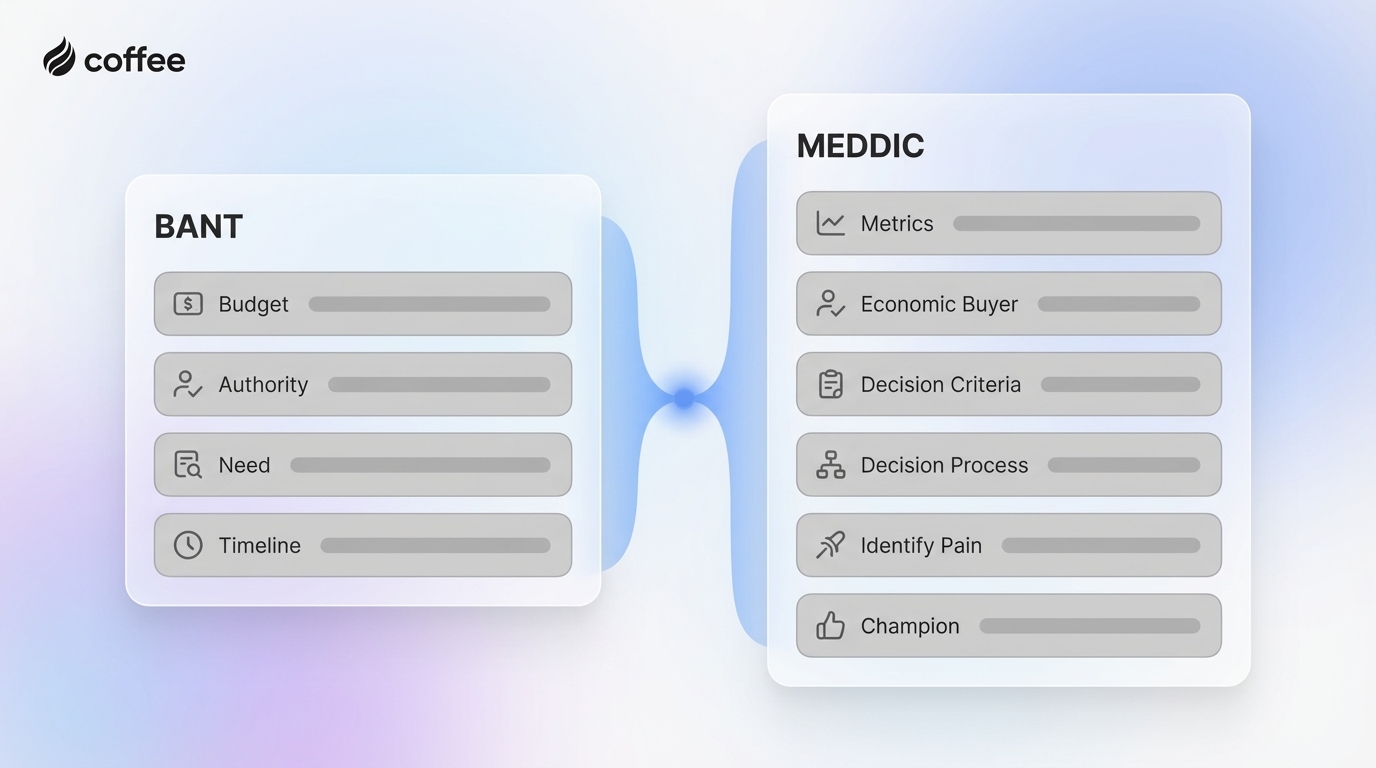
BANT and MEDDIC serve different purposes. BANT delivers strong results for fast, low-complexity deals with clear single-buyer authority. MEDDIC delivers higher close rates, shorter cycles, and more accurate forecasts for enterprise deals with large buying committees and formal procurement processes. The hybrid model, with BANT at SDR triage and MEDDIC at AE discovery, is the configuration most scaling B2B SaaS teams have converged on in 2026.
The framework choice sets the ceiling, and data quality sets the floor. A MEDDIC implementation with incomplete champion and economic buyer fields produces the same forecast errors as no framework at all. Coffee’s AI Agent removes the manual data entry barrier that causes most methodology failures by capturing and structuring BANT or MEDDIC fields automatically from the emails, calendars, and call transcripts where deals actually happen. Qualification data stays current without adding administrative burden to reps or managers.
Let Coffee’s Agent handle the data work behind whichever framework you choose, so your team can focus on selling, not CRM entry.