Written by: Doug Camplejohn, CEO & Co-Founder, Coffee | Last updated: August 28, 2026
Key Takeaways for Small Sales Teams
- Low-cost CRMs look inexpensive until you factor in 5–6 hours per rep per week of manual data entry and admin work.
- Attio’s modern data model and unlimited-seat pricing sit between budget tools like Zoho and HubSpot Starter and higher-tier options, but manual logging still creates hidden labor costs.
- Teams of 3–10 reps typically spend two to six weeks on data cleaning and setup for passive CRMs, while Coffee’s agent ingests live email and calendar data without any prerequisite cleanup.
- AI auto-capture from Coffee raises data completeness from below 40% to above 80%, reclaiming 8–12 hours of selling time per rep each week compared with passive systems.
- Small teams that cannot spare rep hours for CRM maintenance can start a free Coffee trial and remove manual data entry from day one.
Why Small Teams Compare Attio with Budget CRMs in 2026
Most 3–10 person sales teams hit the same point: spreadsheets break down, but a premium CRM still feels expensive. Attio often becomes the middle-ground option because it offers a modern data model at a price that sits above the lowest-cost tools.
This guide compares Attio with five passive low-cost CRMs: Pipedrive, Zoho CRM, HubSpot Starter, Folk, and Copper. It then introduces Coffee’s agent-powered model as a different category. The comparison focuses on total cost of ownership, setup time to first usable pipeline report, data quality without human entry, workflow fit for teams of 3–10, integration complexity, and long-term admin burden.
Before diving into the details, consider whether your team can absorb those hidden admin hours. If not, compare Coffee’s agent-powered pricing with these passive CRM costs.
Side-by-Side Costs: Pricing and Real TCO
Attio’s current annual-billing rates are $29/user/month for Plus and $69/user/month for Pro, both with unlimited seats, which positions it above the lowest-cost tiers. Pipedrive’s entry tier lists at $14/user/month but lacks email tracking and key automation triggers, so most outbound teams move to the $39/user/month Growth tier within two months. Zoho CRM Standard sits at $14/user/month annually, and HubSpot Sales Hub Starter ranges from $15–$20/user/month on monthly billing, with promotional annual rates that can drop to $7–$9 per seat.
The table below assumes a loaded labor cost of $50/hour and an industry-reported 5–6 hours per rep per week of manual CRM admin for passive systems. Coffee’s agent removes most of that manual layer, and the company reports that reps save 8–12 hours per week. Three-year TCO figures include subscription, one-time implementation, and cumulative admin labor.
| CRM | Annual subscription (5 users) | Est. admin hours/rep/week | 3-year TCO — 5 users (subscription + labor at $50/hr) |
|---|---|---|---|
| Attio Plus | $1,740/yr ($29/user/mo) | ~5 hrs (passive logging) | ~$44,220 |
| Attio Pro | $4,140/yr ($69/user/mo) | ~4 hrs (some auto-capture) | ~$44,940 |
| Pipedrive Growth | $2,340/yr ($39/user/mo) | ~5–6 hrs | ~$47,340 |
| Zoho CRM Standard | $840/yr ($14/user/mo) | ~5–6 hrs | ~$46,440 |
| HubSpot Starter | $900–$1,200/yr ($15–$20/user/mo) | ~5–6 hrs | ~$46,500–$47,400 |
| Coffee (agent) | See coffee.ai/pricing | ~1–2 hrs (agent handles entry) | Materially lower labor component |
Industry benchmarks place real CRM total cost of ownership at two to three times the license line, with licensing covering only 30–40% of actual spend. Hidden costs often include onboarding or professional-services fees of $1,500–$5,000, third-party middleware such as Zapier at roughly $100–$300 per month, and add-on charges for storage, integrations, and advanced features that can double the effective subscription cost. Once you count admin labor, the subscription advantage of low-cost CRMs largely disappears.
Setup and Onboarding Effort for Small Teams
Small businesses with under 20 users usually complete CRM implementation in four to eight weeks, with data cleaning as the main variable that can add about two weeks. For a team of five to fifteen users, DIY CRM implementation typically requires 40 to 100 internal hours.
Pipedrive often goes live in one to two weeks and has a low learning curve for basic pipeline management. Zoho CRM for small teams often takes 3–6 weeks, while HubSpot Starter can reach basic functionality in hours to two weeks. Duplicate data cleanup usually stretches a two-week rollout into three to five weeks.
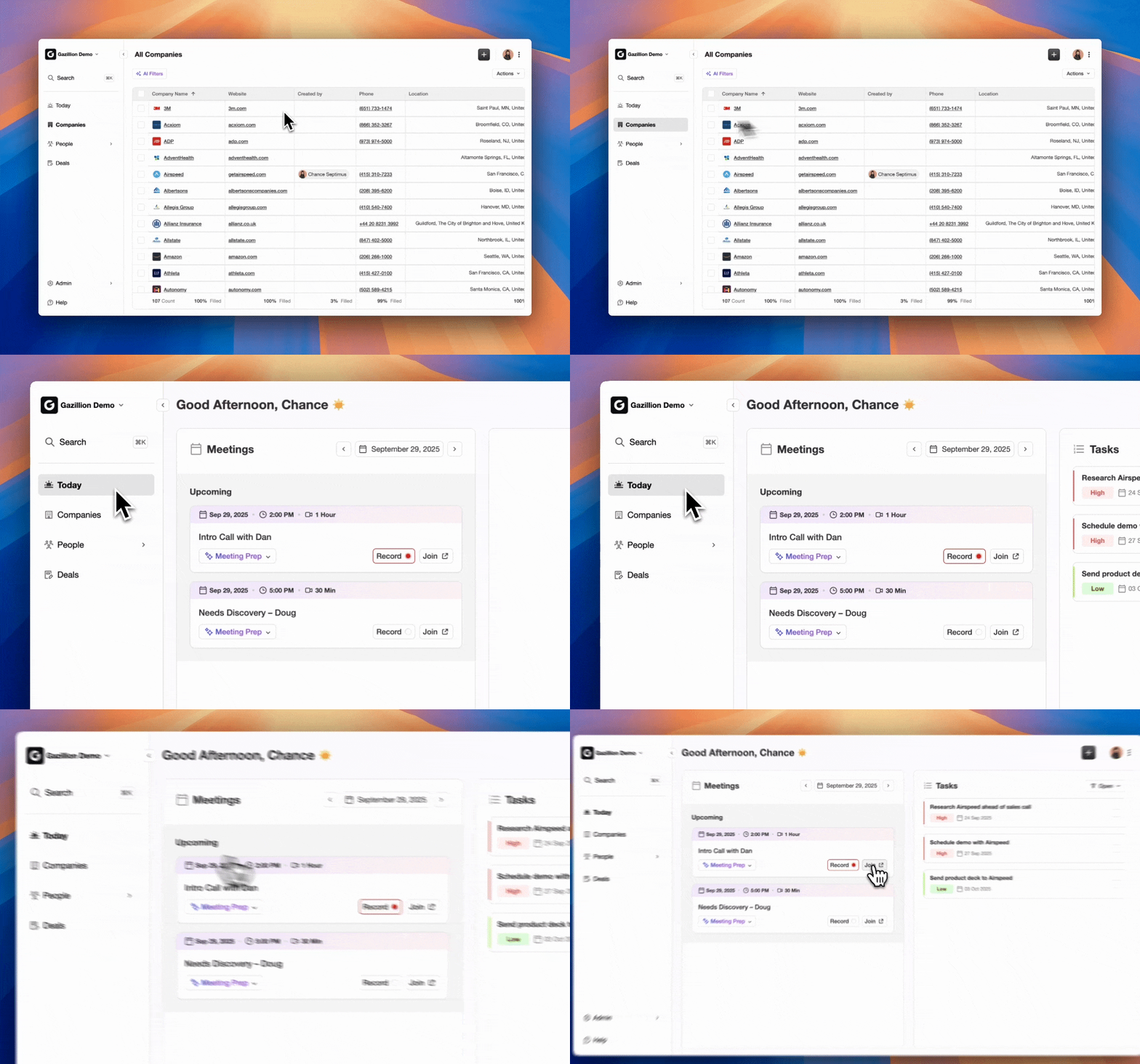
Coffee connects to Google Workspace or Microsoft 365 and starts auto-creating contacts and logging activity right away. The agent ingests and structures data from live email and calendar streams, so you do not need a clean CSV import before the system becomes useful.

Data Capture and Ongoing Maintenance
HubSpot’s 2025 State of Sales Report shows that sales reps spend less than one third of their time actually selling. Salesforce’s State of Sales reports add that reps lose a large share of time to manual CRM data entry and other nonselling tasks, which AI-powered automatic capture can cut significantly.
Attio, Pipedrive, Zoho, and HubSpot Starter still depend on reps to log calls, update deal stages, and record next steps. Before AI auto-logging became common, reps logged only 24–52% of real activity, often under 40% in some reports, which left CRM reports incomplete. Even with 2026 auto-logging upgrades in Pipedrive and HubSpot, auto-logging quality varies, and many implementations miss context or mis-attribute activities.
Coffee’s agent ingests emails, calendar events, call transcripts, and meeting recordings without rep input. Nucleus Research found that AI-powered CRM data capture delivers the completeness improvement cited earlier, taking logged activity from under 40% to over 80%. This level of auto-capture can reclaim several hours of selling time per rep each week.

Usability for Reps and Manager Visibility
Research shows that 55% of CRM implementations fail to meet objectives, with low user adoption and people-related challenges as the main causes. When data entry stays manual, reps see the CRM as a reporting chore instead of a selling tool, and pipeline data quality drops. Salesforce research indicates that CRM data degrades by roughly 30% per year when entry is manual.
Managers using passive CRMs often need to quiz reps to confirm deal status because the system reflects what was typed, not what actually happened. Coffee’s Pipeline Compare feature automatically visualizes week-over-week changes, including progressed deals, stalled opportunities, and new additions. Pipeline reviews shift from interrogation to strategy sessions, and managers no longer need spreadsheet exports.
Integrations, Customization, and Scaling Up
Third-party middleware such as Zapier typically costs $100–$300 per month and is required by most low-cost CRMs to connect outbound tools, enrichment databases, and meeting recorders. For a ten-person team, a stack of six add-on tools at about $40 per user per month adds close to $28,800 per year in extra subscriptions.
Attio’s two-tier structure, Plus and Pro, shown in the pricing table above, means teams that need advanced features must move to the higher tier. Zoho and HubSpot appear to scale smoothly, but feature gates still push growing teams into more expensive plans. Coffee’s seat-based pricing includes the agent’s unlimited labor, so adding users does not introduce hidden costs or force tier jumps for automation features.
Scenario-Based Picks for Different Teams
Three variables drive the right choice: budget ceiling, tolerance for ongoing admin work, and need for pipeline intelligence.
- Tightest budget, simple pipeline, low outbound volume: Zoho CRM Standard or HubSpot Starter keeps subscription costs under $1,200 per year for five users, but you should plan for 5–6 hours per rep per week of manual logging.
- Moderate budget, outbound sequences required: Pipedrive Growth at $2,340 per year for five users adds email automation but still needs manual activity logging and a Zapier subscription for enrichment.
- Premium data model, funded team: Attio Pro at $4,740 per year for five users offers the cleanest architecture among passive CRMs and an 80% startup discount in year one for venture-backed teams, but custom objects and sequences sit behind the Pro tier.
- No admin tolerance, need for accurate pipeline intelligence: Coffee’s agent model removes the human data-entry layer, making it the lowest true-cost option for teams that cannot spare rep hours for CRM maintenance.
Risks, Limitations, and Misconceptions to Watch
Low subscription prices rarely equal low total cost. A practical 2026 rule of thumb is that true annual cost lands 30–50% higher than the advertised per-seat price once add-ons and billing terms are included. Teams also underestimate implementation effort. Data migration and cleansing alone often require two to six weeks to remove duplicates and move contacts, companies, histories, and opportunities from spreadsheets.
AI auto-logging claims deserve careful review. Startups that deploy fully autonomous CRM AI without approval gates often see reps lose trust after incorrect auto-updates. They then build shadow spreadsheets, and data quality collapses within 60–90 days. Coffee addresses this with a review-before-send model that preserves human judgment on subjective fields while still capturing efficiency gains.
Integration gaps also create hidden costs. Coffee currently connects to external tools through Zapier, with deeper native integrations planned. Teams with complex multi-system environments should map integration needs carefully before committing to any platform.
Decision Framework Summary Matrix
| Constraint | Best fit | Avoid |
|---|---|---|
| Subscription under $1,000/yr for 5 users | Zoho Standard, HubSpot Starter | Attio Pro, Pipedrive Growth |
| Zero tolerance for manual data entry | Coffee (agent) | All passive CRMs |
| Outbound sequences without add-ons | Attio Pro, Coffee | Attio Plus, Zoho Standard, HubSpot Starter |
| Fastest time to first usable pipeline report | Coffee, Pipedrive | Zoho (configuration-heavy), Salesforce |
| Scaling beyond 10 seats without forced tier jump | Attio Pro, Coffee, HubSpot | Attio Plus (10-seat cap) |
| Lowest 3-year TCO including labor | Coffee (agent eliminates admin hours) | Any passive CRM at 5–6 hrs/rep/week |
FAQ: Implementation, Data, and Integrations
How long does implementation take for a 5-person team?
For passive CRMs like Pipedrive or Zoho, a realistic timeline from decision to stable daily usage is two to four weeks when data is reasonably clean, and four to six weeks when spreadsheet data needs deduplication and field mapping. HubSpot Starter usually lands in the three-to-four-week range for a basic sales setup. Attio’s modern architecture shortens configuration but still requires a data import and pipeline definition phase. Coffee’s agent model compresses this: connecting Google Workspace or Microsoft 365 lets the agent start auto-populating contacts and logging activity within hours, with no data-cleaning prerequisite before the first pipeline view.
What internal expertise is required to maintain data quality?
Passive CRMs need at least one internal owner who enforces field hygiene, monitors duplicates, audits pipeline stages, and follows up with reps who skip logging. Without this role, CRM data degrades at roughly 30% per year as stale records pile up. Zoho CRM’s configuration depth increases admin burden compared with Pipedrive, which is simpler but still manual. Attio reduces some overhead through its structured data model, yet reps still decide whether activities get logged. Coffee’s agent removes the dependency on rep discipline because it captures emails, calendar events, and call transcripts autonomously, so data quality holds without a dedicated internal admin.
How much migration effort is needed from spreadsheets?
Migrating from spreadsheets to any passive CRM requires auditing existing data, removing duplicates, standardizing field formats, and mapping columns to CRM fields before import. A thorough cleaning usually takes about one full working day per 5,000 contacts. For a 5-person team with a few hundred contacts, this fits into two to three days, but teams with fragmented data across multiple sheets or inboxes can spend one to two weeks on cleanup alone. Coffee reduces this effort because the agent builds the contact database from live email and calendar data instead of demanding a clean import file. You can still import spreadsheet data, but it is optional for day-one usefulness.
Which integrations matter most for small outbound teams?
The most important integrations for a 3–10 person outbound team are email, calendar, a meeting recorder, and a prospecting data source. Passive CRMs usually handle email and calendar sync natively at most tiers, but meeting transcription and enrichment often require separate tools and Zapier connections. Coffee covers all four natively. The agent connects to Google Workspace or Microsoft 365 for email and calendar, joins calls via an AI meeting bot to record and transcribe, and enriches contact records with job titles, funding data, and LinkedIn profiles through licensed data partners, which removes the need for separate tools like Apollo or Fathom.
Which option scales best without adding headcount?
Passive CRMs scale subscription cost and admin burden together, because each new rep adds more manual logging and more chances for data gaps. Attio Plus hits a hard 10-seat ceiling before forcing a tier upgrade. HubSpot and Pipedrive scale more smoothly on subscription but still require more admin oversight as the team grows. Coffee’s agent model scales differently. The agent’s labor does not increase with headcount, so a 10-person team gets the same automated data capture as a 3-person team without adding an admin role. That structure gives Coffee the lowest marginal cost per additional rep for teams that care most about pipeline accuracy.
Conclusion: Match Your Constraints to the Right CRM
The subscription gap between Attio and low-cost alternatives looks large but shrinks once you count admin labor. A 5-person team on Zoho Standard saves about $1,260 per year in subscription fees compared with Attio Plus, yet spends an estimated 5–6 hours per rep per week on manual logging. At any reasonable loaded hourly rate, that labor cost outweighs the subscription savings.
Teams that prioritize the lowest possible monthly invoice and have a rep willing to own data hygiene can still choose Zoho Standard or HubSpot Starter. Teams that need outbound sequences and a cleaner data model will likely pick Attio Pro or Pipedrive Growth as their passive options. Teams that cannot afford to turn reps into data-entry clerks, and want Attio-level pipeline intelligence without ongoing manual work, will find that Coffee’s agent model is the only option in this comparison that removes the human layer entirely.
Calculate your true TCO with Coffee’s agent doing the data work